
President Prabowo's hybrid education model erodes the 3T disparity
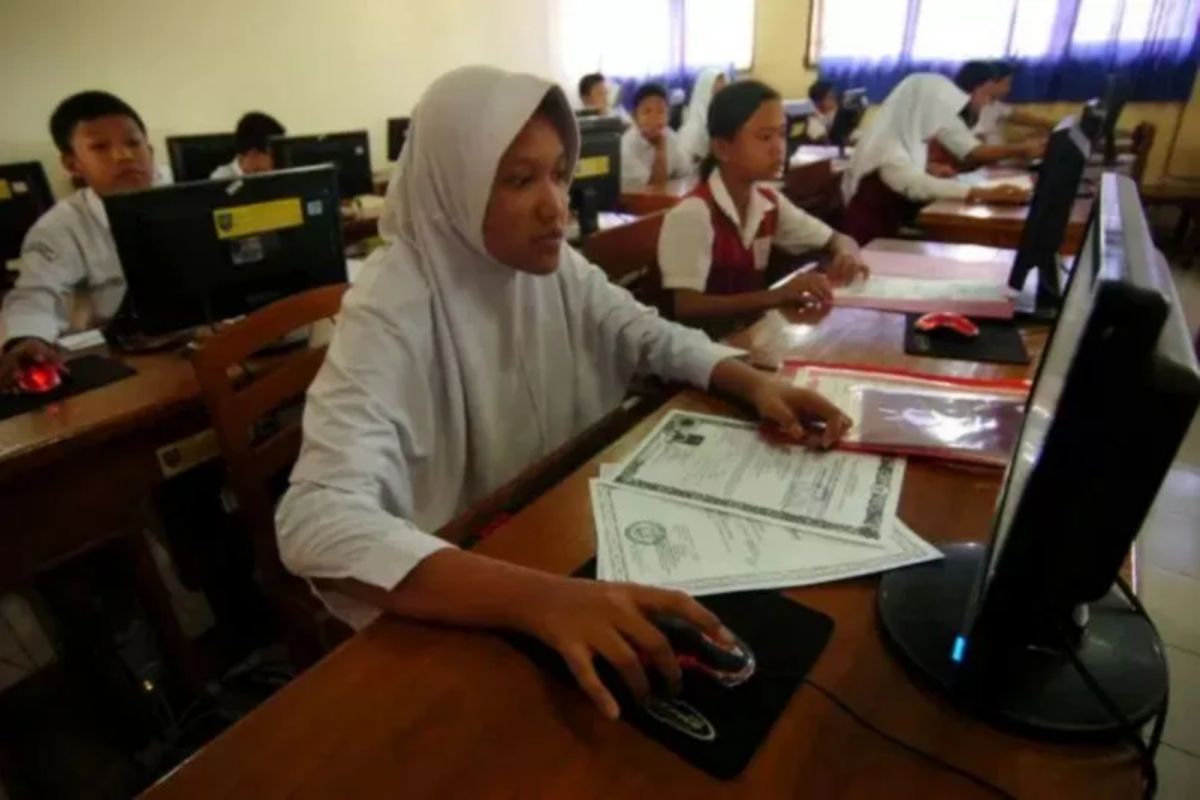
The government must ensure that the “central studio” does not become an ivory tower fabricating one-way content. There must be space for dialectics between the centre and the regions. Additionally, dependence on energy is also a note of concern.
Jakarta (ANTARA) - Indonesian education is undergoing accelerated digitalisation to untangle the knots caused by disparities across various regions, including the outermost, outermost, and remote areas or 3T.
Ambitious policy orchestration is needed to address educational problems in the face of the digitalisation era. Therefore, President Prabowo, on one occasion, emphasised the new direction for national education going forward as hybrid-based education.
This breakthrough is a systemic effort to perform a “frog leap” (leapfrogging) to catch up on the lag in human resource quality due to geographical limitations.
Rationale
The government’s step to reach 288,000 schools with interactive flat panels (IFP) is a rational response to the current educational anomalies. For decades, our education has been trapped in the “physical building” paradigm. That educational equity can only be achieved by building school buildings. However, reality shows that a building without quality teachers is like a body without a soul, dry of cognitive values.
The hybrid education policy shifts the burden of physical building costs to the digital realm. A shared space that can be accessed nationally in a networked manner. The installation of IFPs in 3T areas is an effort to democratise education and knowledge.
Economically, this is far more efficient than mobilising thousands of specialist teachers to remote areas that are often hindered by logistical and welfare issues. With this technology, the Mathematics and English curricula, two main pillars of knowledge for global competitiveness, are no longer the monopoly of students in big cities like Jakarta or Surabaya. Students in Sabang, Merauke, to Miangas or Rote, can access the same content, the same standards, and the same intellectual frequency from the same teachers.
Dual-teacher solution
One important point in this idea is the development of a central studio as an answer to the teacher distribution crisis. Data shows that Indonesia not only lacks the number of teachers but also experiences “malnutrition” of quality teachers in certain areas.
Thus, President Prabowo’s hybrid system, which is a dual-teacher class model, is hoped to become a pillar of success for national education. In this scheme, a “master teacher” teaches from the central studio with complete multimedia facilities, while the local teacher in the classroom acts as a facilitator, mentor, and guardian of learning morality.
Pedagogically, this is a harmony between technological efficiency and the touch of “inner humanity”, where students still feel together with their teacher. Technology handles the rapid and effective transfer of information, while the teacher focuses on character building.