
President Prabowo Reports on 21 Months of Government Achievements at MPR Annual Session
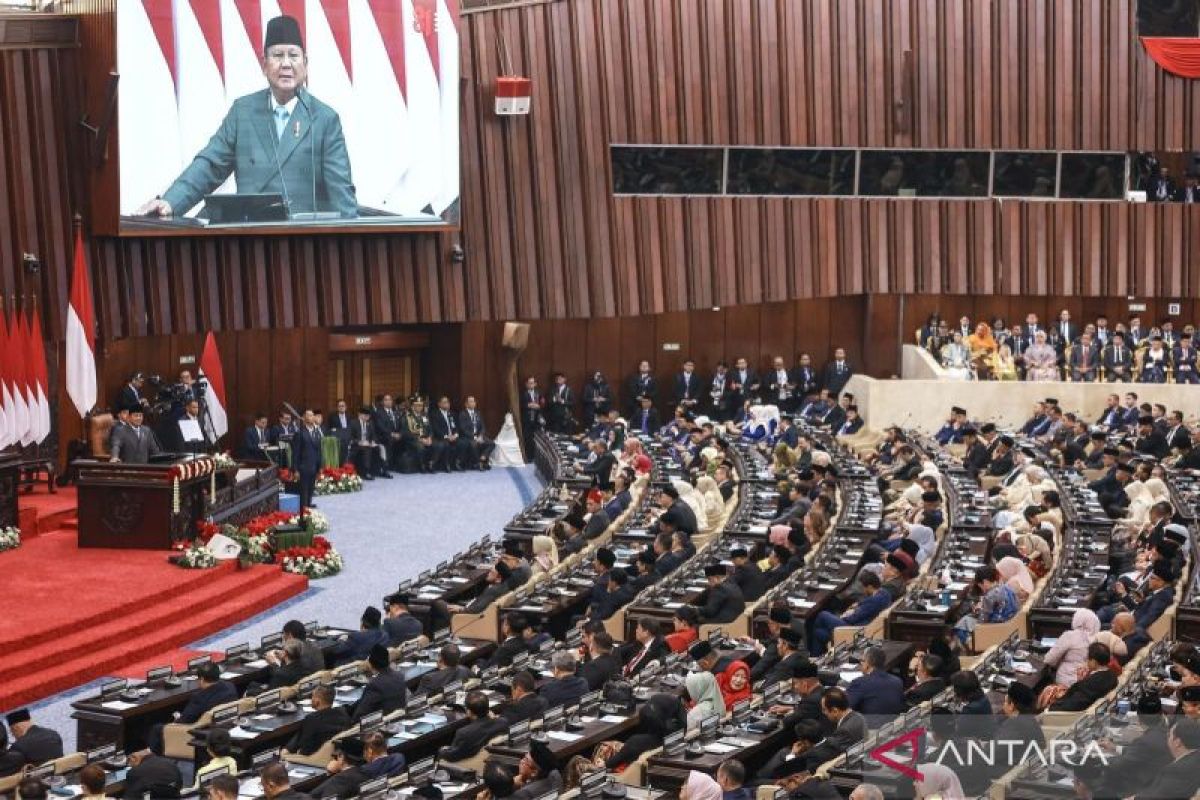
First of all, as people of faith, let us offer praise and gratitude to Almighty God, Allah SWT, for by His grace and blessings we are able to attend the 2026 Annual Session of the People’s Consultative Assembly (MPR RI) and the Joint Session of the Regional Representative Council (DPD RI) and the House of Representatives (DPR RI) in good health, peace, and with a spirit of service.
This morning I stand once again in this honourable chamber, the same chamber where I took my oath as President of the Republic of Indonesia and where Gibran Rakabuming Raka took his oath as Vice President.
On that day, 20 October 2024, before this honourable assembly, before all the people of Indonesia, and most importantly before Almighty God, I swore to lead the state and nation with sincerity and honesty; to prioritise the interests of all Indonesian people, including those who did not vote for me.
To fulfil the promises I made and to honour my oath as President of the Republic of Indonesia, I have led the Government of the Unitary State of the Republic of Indonesia for 21 months guided by four main principles:
First, we work to uphold and implement the mandates of the 1945 Constitution of the Republic of Indonesia.
Second, we work to safeguard, exercise and protect the core and vital national interests. This includes protecting the nation’s wealth so that it can be fully utilised for the prosperity of all Indonesian people.
Third, we work to overcome the people’s difficulties in the shortest possible time.
Fourth, in our work, we are always oriented towards the interests of the people and the interests of their children and grandchildren.
Today, 21 months since I took that oath, I return before this Assembly. I return to report what we have done; what results we are beginning to see; and what still remains to be completed.
I cannot yet say that all the nation’s problems have been resolved, or that all the promises I made have been fulfilled. Not yet.
But in less than two years, we have proven that with the courage to make decisions, with hard work, founded on sincere hearts, clear intentions, orientation towards the people and mutual cooperation from all elements of the nation, problems that for decades were considered highly complex, or too complex, can begin to be resolved.
I am not saying they are resolved, but we have begun to resolve them.
In 21 months, precisely 663 days up to today, the Government I lead has decided and implemented 121 transformative policies to resolve the nation’s problems. Some of these problems had remained unsolved for decades.
This means we can say that we have decided one transformative policy every five days.
So hard have my ministers and my aides worked that some of them have had to be hospitalised, some have fainted, some have undergone surgery, many have been exhausted. I promised them that in the remainder of my term I would give them more time to rest, and they replied that a promise is just a promise.
Such is the evidence of the seriousness of the government I lead. According to my aides, there are no red-letter days in my calendar.
What I wish to convey is that we accept this mandate with full honour. The task from the people is a noble honour for us. Therefore we will work as hard as we possibly can.
We will work to the utmost for our people and our nation.
And because of our policies and our hard work, food self-sufficiency, which we had originally targeted to achieve in four years, has in fact been achieved in one year.
Amidst a world now deeply worried about mass starvation due to food shortages and unpredictable weather, we, alhamdulillah, can report to this assembly that regarding food, regarding sustenance for the Indonesian people, we are in a secure position and we will be able to face challenges including the El Niño phenomenon, which is said to be the most severe El Niño this year.
We achieved this with the courage to confront problems. We eliminated 145 regulations on fertiliser distribution. We succeeded in reducing fertiliser prices by 20 percent. This has happened for the first time in the history of the Republic of Indonesia. For the first time, fertiliser prices have been reduced for the people.
But at the same time that prices fell, the volume of fertiliser available to our people increased. So our people now find it easy to obtain fertiliser. And because of that, production increased, and because of that too, we achieved food security more quickly.
At the same time, the profit of PT Pupuk Indonesia, a state-owned enterprise, rose by 252.8 percent. Fertiliser prices fell, volume increased, yet the profit for PT Pupuk Indonesia rose by 252.8 percent.
This is the result of the teamwork of those who assist me: the Minister of Agriculture with all his staff, the agricultural extension workers, supported by many other ministries, supported by regional governments, supported by the TNI and Polri. All of this, with the spirit of mutual cooperation, has achieved a feat recognised by the world.
Because of this, this year we have achieved self-sufficiency in eight food commodities. We are self-sufficient in rice, maize, consumption sugar, chicken meat, chicken eggs, shallots, large chillies, and bird’s eye chillies.
We are not yet self-sufficient in beef; that we will work on, and insyaallah we can achieve it within the next five to six years.
The promise of energy self-sufficiency has now begun to be realised with, for the first time, self-sufficiency in diesel fuel. We have succeeded in producing diesel with B50 from palm oil. So starting this year, from 1 July 2026, we no longer import diesel from abroad, and we have succeeded in saving Rp170 trillion in foreign exchange, around 9.5 billion US dollars that no longer needs to be sent overseas.
Ladies and gentlemen, the promises of nutritious food, digital social assistance, and downstreaming are no longer plans on paper. All of them are underway and their benefits are beginning to be felt by the people.
This is not a reason for us to be complacent. It is a stimulus for us to work even harder. Because we realise that independence is not only what we proclaim. Independence is what the people can feel.
Eighty-one years ago, the nation’s founders bequeathed to us a state and an ideal: an Indonesia that is sovereign, just and prosperous; an Indonesia whose wealth is used to the greatest extent for the prosperity of the people and no longer enjoyed only by a handful of people.
I did not receive a mandate from the people to explain why problems cannot be solved. I received a mandate from the people precisely to solve problems and overcome the people’s difficulties.
We choose to make difficult decisions today rather than bequeath even heavier and more complex problems to our successors.
Ladies and gentlemen, nation-building is not the work of the President alone. It is not the work of the government alone. This Republic is built by the joint work of all state institutions, central and regional governments, and all elements of society, all the people of Indonesia.
The MPR RI continues to carry out its role as the House of the Nation, strengthening constitutional literacy, nurturing Pancasila, the 1945 Constitution, the Unitary State of the Republic of Indonesia, and Bhinneka Tunggal Ika. Democracy must not stop at electoral procedures. Democracy must fulfil the basic rights of the people and adhere to all articles of our Constitution.
The DPR RI, together with the government, has completed and enacted 13 draft laws up to July 2026. One of them is Law Number 2 of 2026 on the Protection of Domestic Workers, an acknowledgement that every job has dignity and every worker has the right to protection.
The DPD RI has gathered 10,883 aspirations from 38 provinces and brought them into dialogue with Bappenas as input for the 2027 Government Work Plan. The DPD also continues to advocate for the Draft Law on Archipelagic Regions, which has now entered tripartite deliberation with the DPR and the government. Insyaallah, it will be completed.
The Supreme Court in 2025 handled 38,148 cases and succeeded in deciding 37,973 cases, a productivity rate of 99.54 percent. A total of 96.74 percent of cases were resolved in less than three months. This is the highest timeliness achievement in the history of the Supreme Court. Let us give our appreciation to the Chief Justice and his staff.
Indeed, justice delayed is injustice prolonged.
The Constitutional Court throughout 2025 handled 701 cases and petitions, including 334 disputes over regional head election results. A total of 598 cases and petitions have been decided.
Up to 23 July 2026, 84.51 percent of petitions to the Constitutional Court were filed online, so that citizens from Aceh to Papua do not always have to come to Jakarta.
The Audit Board (BPK) ensures that every rupiah of the people’s money is used correctly and appropriately. Throughout 2025, recommendations from BPK audit findings have resulted in state financial savings of Rp112 trillion.
The world’s trust in Indonesian auditors has also increased. The BPK was elected as Chair of the International Organization of Supreme Audit Institutions (INTOSAI) for the 2028-2031 period, and as a member of the United Nations Board of Auditors for the 2026-2032 period.
The Judicial Commission from January to June 2026 received 1,402 public reports and 622 requests for trial monitoring. The Judicial Commission has proposed sanctions for 121 judges proven to have violated the code of ethics, including 14 moderate sanctions and 17 severe sanctions.
We must uphold the supremacy of law and the independence of judges. The government continues to strive to improve the standard of living of judges, but independence does not mean judges are without accountability.
Regarding the matter of judges, the government has succeeded in raising judicial remuneration. For the most junior judges, their income has risen by 280 percent, the highest in several decades.
Now the income of our judges, especially junior ones, is above the ASEAN average. In fact, the Chief Justice has reported to me that the income of the Chief Justice of the Republic of Indonesia is now higher than the income of the Chief Justice of Singapore. He reported that to me himself.
Fellow countrymen, we must strengthen our judicial institutions. Because the judges of our courts are the last bastion of justice, the last bastion where the people seek and hope to obtain justice. The supremacy of law and justice must not only be for the powerful, but our most powerless citizens must be able to obtain justice in our courts, in our tribunals.
Ladies and gentlemen, we know the world is facing geopolitical conflicts, trade wars, open warfare in Europe, in the Middle East, and in various other parts of the world.
The entire world is experiencing supply chain disruptions and economic pressures. In circumstances like these, Indonesia must increasingly be able to stand on its own two feet. We must be self-reliant; we must not depend on supplies from abroad, because if the situation suddenly changes for the worse, we must still survive.
Alhamdulillah, because of our hard work and the people’s trust in the government, amidst global uncertainty, investment continues to grow. Throughout 2025, realised investment reached Rp1,931 trillion and created more than 2.7 million jobs.
In the first half of 2026 alone, realised investment reached Rp1,010 trillion and created more than 1.4 million jobs.
Our economy grew by 5.61 percent in the first quarter of 2026, and by 5.45 percent in the first half of 2026. This is the highest first-quarter growth and highest first-half growth in the last 13 years.
With the right policies, rational policies that use common sense, I am confident that our economic growth by the end of this year can reach 6 percent. But I emphasise before this assembly that for me, growth and investment are not the final goals. Our goal is the welfare of our people.
High growth that cannot be enjoyed by our people is largely of no benefit to us. Every rupiah of investment must create jobs and must produce improvements in the quality of life of our people, especially our people at the very bottom.
That is the orientation of the government I lead. We must not abandon those who are powerless. We must not allow hunger to exist on Indonesian soil. The Republic of Indonesia, a member of the G20, should not still have citizens who are hungry.
Ladies and gentlemen, a strong nation is a nation that can feed its own people. When we received the mandate, farmers still faced fertiliser that was difficult to obtain, paddy prices that fell at every harvest, and convoluted regulations.
We must have the courage to confront these difficulties and problems, and thus, although we do not blame anyone, we move forward by seeking solutions. Bureaucracy must not hinder good decisions. We must acknowledge that one of our nation’s problems is a convoluted bureaucracy, a bureaucracy that does not work efficiently.
Bureaucrats who often use their positions and authority to enrich themselves, enrich their families and enrich their groups must be eradicated, not covered up.
The current era is a digital era, an information era. There is no point in covering things up. Instead, we must solve these problems, and this requires unity among all leaders and political groups. Because an inefficient bureaucracy, a corrupt bureaucracy, will destroy a nation. The state must make things easier for the people, not more difficult.
When I speak, I am not only speaking to the central government. I am also speaking to regional governments, provincial governments and district governments. Ask the people, listen to the voice of the people. They will be the first to tell you that programmes often do not reach the people.
Present among us today is Mr Joko Purnomo, Chair of the Sri Makmur Farmers Group from Purwosari Village, Ngawi Regency, East Java. Mr Joko has been farming for 20 years. With water, technology and fertiliser provided by the government, he is able to harvest three times a year with productivity of up to 9 tonnes of paddy per hectare. The 20 percent reduction in fertiliser prices has also helped cut his production costs.
Where is Mr Joko? Let us give a round of applause to Mr Joko, as a representative of Indonesian farmers, the nation’s heroes, the food producers for all Indonesian people.
We may have the most formidable army, we may have sophisticated aircraft, but if there is no food, I think this nation would simply cease to be a nation.
The hard work of farmers, extension workers, regional governments, all elements of the TNI and Polri — thank you. Cooperatives and state-owned food enterprises — thank you for your cooperation and mutual assistance. We have achieved great things, and we must sometimes realise that our nation is capable of achieving great things. Let us not always feel inferior. Let us not always be defeated before we even fight.
Ladies and gentlemen, in the past year Indonesia has achieved self-sufficiency in eight food commodities, and thus we realise that our achievements are quite something to be proud of. We are not yet self-sufficient in garlic; we are striving so that within three years we can achieve garlic self-sufficiency. As I mentioned earlier, beef is not yet self-sufficient, nor is buffalo meat. But chicken meat is. In essence, for protein we are actually already self-sufficient, namely protein from fish.