
President Prabowo Has Three Agriculture Ministers Like Amran, Problems Solved: Minister
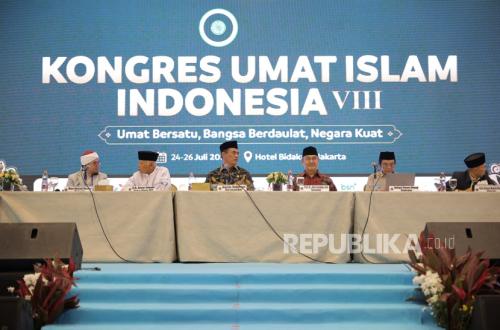
Agriculture Minister (Mentan) Andi Amran Sulaiman received direct appreciation from participants of the Indonesian Ulema Congress VIII for his courage in addressing fundamental issues in the food sector. A participant even suggested that President Prabowo Subianto needs more figures like Amran to resolve various national problems. The praise was delivered during a dialogue session at the congress organised by the Indonesian Ulema Council (MUI) in Jakarta on Sunday (26/7/2026). “Sir, President Prabowo needs at least three figures like you, and the problems will be solved,” a participant said.
Responding to this, Minister Amran emphasised that the government’s achievements in the food sector are not the work of a single person. He stated that food self-sufficiency is the result of cross-sector collaboration involving ministries, institutions, the Indonesian National Armed Forces (TNI), the National Police (Polri), regional governments, academics, and religious scholars. “This success is not mine alone, but ours together, including the MUI. Without the advice of the ulama, we could not work properly because we must set an example for tens of thousands of employees in the ministry. No success stands alone,” Amran said.
The dialogue then shifted to palm oil governance. A participant raised complaints from oil palm farmers who feel they still face limited access to the processing industry. The participant argued that building processing factories in plantation areas is necessary so that the added value is not solely enjoyed by large corporations but also returns to the farmers. Minister Amran stated that the government is continuously improving palm oil governance, including taking action against areas operating illegally. He noted that these measures are part of an effort to ensure natural resources provide maximum benefits for the state and society. “The illegal ones are being taken over by the state along with their assets. The value is hundreds of trillions of rupiah. As far as I remember, such a policy has never happened before. There are still some unresolved issues, but we are fixing them one by one,” he said.
He stressed that the restructuring of the palm oil sector must be accompanied by downstream processing so that Indonesia does not stop at being a raw material supplier but becomes a producer of high-value-added products domestically. Minister Amran also highlighted other concerning issues, such as alleged irregularities in cooking oil distribution, including price manipulation and packaging content reduction that harm the public. “The price of cooking oil is already high, yet the volume is reduced to only about 700 cc. This is being cracked down on. There was a fine of Rp11 trillion. If it is right, it is right; if it is wrong, it is wrong. No grey areas,” he asserted. He noted that this issue is particularly serious because Indonesia, as one of the world’s largest palm oil producers, once experienced a domestic cooking oil shortage. He reported the situation to President Prabowo, who instructed him to take full action, leading to a formal request to the National Police Chief for enforcement.
Participants’ aspirations also extended to the livestock sector. The government was urged to strengthen the restructuring of the chicken and egg trading system, which is perceived to be dominated by large companies. A participant claimed that around 80 percent of the poultry farming sector is controlled by two companies and requested that the livestock trading system be made a priority. Minister Amran acknowledged the challenges in the chicken and egg trading system. He said the government is preparing a livestock development model that strengthens the community’s position through upstream support and downstream business development. The government will encourage state-owned enterprises (BUMN) to strengthen the upstream sector, including feed and day-old chick (DOC) support, while encouraging ordinary citizens to develop downstream livestock businesses. “Our target is for every island to be self-sufficient in protein, then food, then ethanol. The upstream will be assisted with feed and DOC, and the downstream will be built by the people so that farmers are not manipulated,” he said.
Minister Amran affirmed that this trading system reform is part of a larger agricultural downstream agenda. He said Indonesia possesses vast natural resources and must be able to process them domestically so that the added value benefits the people while strengthening food and energy sovereignty. “Indonesia is very rich. If we just downstream our CPO and coconut domestically, in the next five to ten years, if this runs well, Indonesia can be truly sovereign in energy and food,” he said. In the forum, Minister Amran also invited Islamic boarding schools (pesantren) to play a greater role in strengthening national food security. The Ministry of Agriculture has prepared support for pesantren with productive land, including free land cultivation, provision of plantation crop seeds, and cultivation assistance. “If any pesantren needs it, there are sugarcane, cocoa, coconut, cashew, and coffee seeds, all free from the President. The land cultivation is also free. The seeds are free. Just prepare the land, and we will plant it,” he said.