
President Halts Strategic Project to Mend Economy
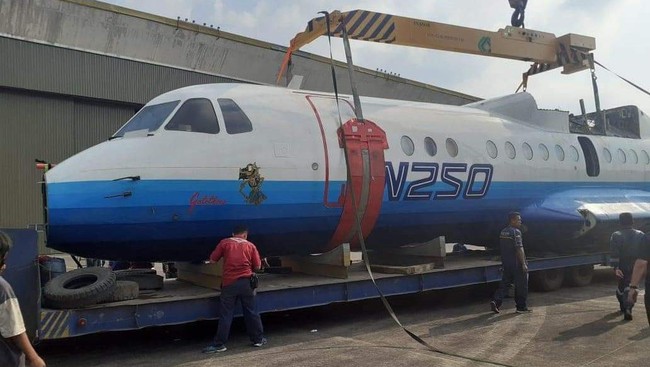
Jakarta, CNBC Indonesia - Indonesia’s third president, B.J. Habibie, halted a national strategic project in order to repair the country’s economy. Ironically, the project he stopped was the fruit of his own decades-long struggle: the N250 aircraft. For the man who was born exactly 90 years ago today, the N250 was not just an aeroplane. The project was a symbol of his ambition to transform Indonesia into a high-tech industrial nation through the mastery of science and technology. However, shortly after the N250 took to the skies for the first time on 10 November 1995, Indonesia entered one of the worst economic periods in its history. The rupiah exchange rate collapsed, many banks failed, and state finances were under severe pressure due to the 1997-1998 monetary crisis. To escape the crisis, the Indonesian government signed a Letter of Intent (LoI) with the International Monetary Fund (IMF) in early 1998. A consequence of the agreement was the cessation of state support or subsidies for strategic projects. As a result, projects requiring large funding no longer received capital injections from the government. One of the most affected was the national aircraft project, the N250. At the time, the N250 was just one step away from the final development phase. The aircraft, which had successfully completed its maiden flight in 1995, was in the final stages of flight testing to obtain airworthiness certification from the United States and Europe. Habibie admitted he could not understand the IMF’s rationale for demanding the cessation of support for the project. In his memoir, ‘Detik-Detik yang Menentukan’ (2005), he wrote, ‘I cannot comprehend, because there is no rational reason at all, why the IMF at the end of 1997 demanded that the government immediately stop assisting IPTN in completing the sophisticated N250 turboprop aircraft, whose maiden flight on 10 August 1995 was a success.’ According to Habibie, the N250 had promising economic prospects. He believed the turboprop aircraft would become increasingly competitive if global oil prices rose above US$35 per barrel, as it was more fuel-efficient than jet aircraft on short and medium-haul routes. ‘The N250 was planned to play a role and become superior if the oil price increased above 35 dollars per barrel and would become a superior product we could rely on,’ he said. Habibie also saw the N250 not just as a means of transport, but as a tool to strengthen connectivity while supporting tourism in an archipelagic nation like Indonesia. Ultimately, however, economic conditions left very limited choices. To save the national economy, Habibie had to let the project that symbolised Indonesia’s technological ambition be halted midway.