
President Attacked During Military Parade, Shot and Grenaded
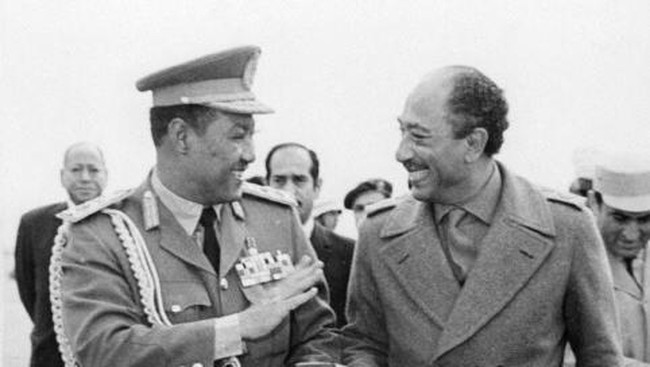
A bloody event occurred in Egypt during a massive military parade. President Anwar Sadat was shot by a defector soldier, resulting in his death in an incident that took place on 6 October 1981, exactly 45 years ago today.
On that day, Sadat was attending a large military parade in Cairo. The grand celebration was held to commemorate the success of the Egyptian forces in crossing the Suez Canal and breaking through Israeli defence lines during the 1973 Yom Kippur War.
Sadat sat in the main tribune under super-strict security. No one suspected a fatal incident would occur, given that, as standard procedure, military parades always use weapons without live ammunition.
However, the tight surveillance was breached after the military forces were infiltrated by a radical group. As the military vehicle procession passed in front of the tribune, a truck suddenly stopped. An officer descended from the truck and saluted Sadat.
Quoting the New York Times, Sadat responded to the salute by standing up. However, this gesture of respect was merely a tactic. Within seconds, three grenades were thrown towards the tribune, followed by a burst of automatic rifle fire from the direction of the truck. The celebratory atmosphere instantly turned into mass chaos. Sadat collapsed on the spot along with several officials and invited guests.
Sadat was rushed to the hospital and underwent emergency medical treatment, but his life could not be saved. The president was declared dead on the same day.
At the scene, security forces immediately detained Lieutenant Khalid Islambouli, the mastermind behind the attack. He was part of the radical group Egyptian Islamic Jihad. This group was formed as a harsh reaction to Sadat’s political steps, which were deemed a betrayal of the Palestinian struggle and the hardline stance of Arab nations.
As a note, quoting the book ‘Anwar Sadat: Visionary Who Dared’ (2013), on 26 March 197lag, Sadat signed the Camp David Peace Accords with Israeli Prime Minister Menachem Begin. He chose this agreement because he believed that military force could no longer achieve an absolute victory over Israel, making diplomacy the most realistic choice for regional stability.
In fact, since the establishment of the State of Israel in 1948, Egypt has consistently been one of the main pillars opposing Zionism. The country has been involved in open warfare against Israel several times, including the 6 October 1973 Yom Kippur War, when Egyptian and Syrian forces launched a surprise attack that evaded US intelligence surveillance and shocked the world.
It was on this basis that the peace treaty triggered a massive wave of domestic opposition. Military circles and hardline clerics responded strongly to the policy, leading to the birth of radical cells that planned the president’s assassination.
Although resistance movements were suppressed by the authorities, the ideology continued to infiltrate the military through figures such as Khalid Islambouli. Following his action during the 1981 military parade, Islambouli was arrested at the scene, sentenced to death, and executed by the hangman on 15 April 1982.