
Preserving the Orangutan's Home in Tabalong's Peat Forests
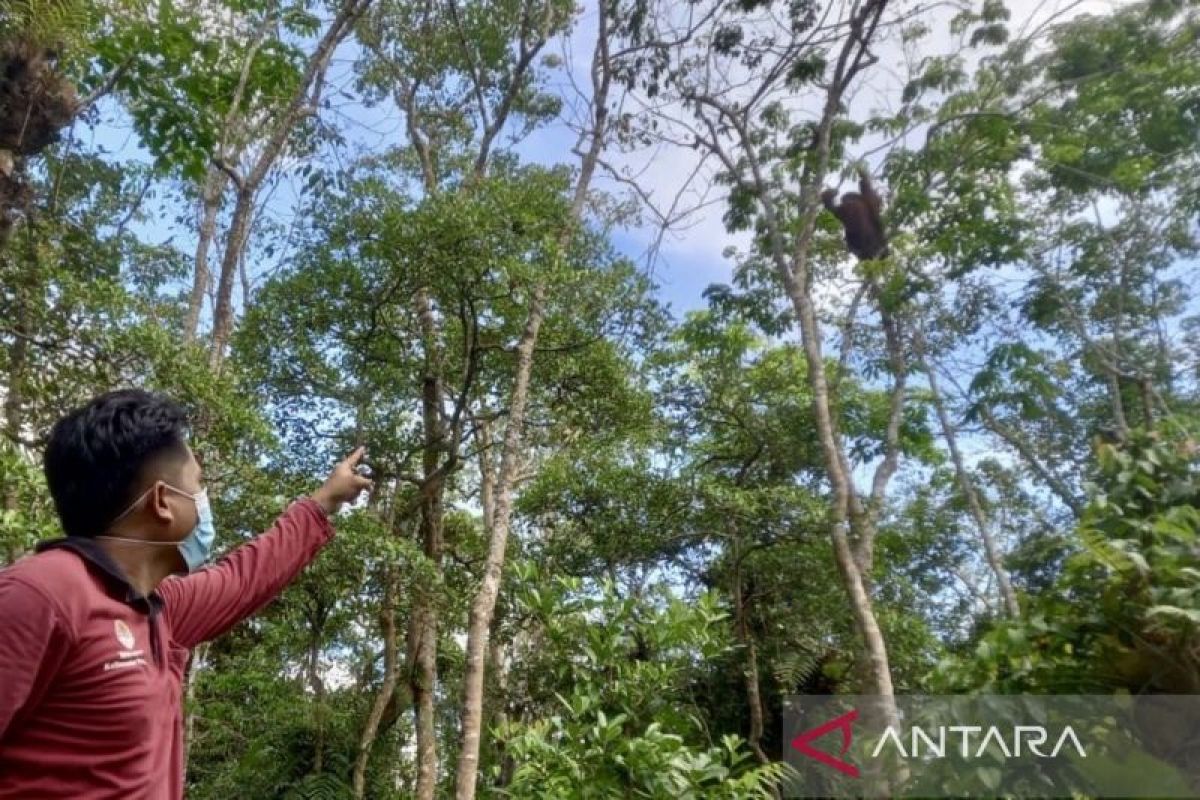
Tabalong (ANTARA) - The expanse of peat forest in Habau Village, Banua Lawas District, Tabalong Regency, South Kalimantan, still provides a living space for the Bornean orangutan. Beneath the dense forest canopy, this endemic species survives in a landscape located outside of formal conservation areas, a habitat that continues to support various forms of wildlife.
The presence of orangutans in this area is more than just a monitoring record. Nests found at the treetops serve as indicators that the forest ecosystem is still functioning well. For conservationists, these findings bring hope that orangutans still have a decent home to be maintained in South Kalimantan.
This hope has prompted the South Kalimantan Natural Resources Conservation Agency (BKSDA) to work alongside local governments and various stakeholders to take further steps. Beyond merely monitoring the protected animals, they are also striving to protect the landscape that serves as their habitat through a Preservation Area proposal to the Ministry of Forestry.
Heri Sofian, a Forest Ecosystem Controller (PEH) at BKSDA South Kalimantan, stated that the proposal process is currently in the preparation stage. Several steps are underway, including the formation of working groups involving various parties, data collection, and information updates to serve as the basis for the proposal.
The area to be proposed is currently classified as Other Use Area (APL). Although the exact size to be designated is still under discussion, various studies by BKSDA South Kalimantan, the South Kalimantan Forestry Service, and research institutions indicate that the habitat expanse potentially serving as orangutan living space in the area reaches approximately 3,000 hectares.
This landscape also holds significant ecological functions. The area is a peat protection zone with high potential as an orangutan habitat. Currently, the condition of the habitat is still considered good, and therefore needs to be maintained before environmental pressures increase.
For BKSDA South Kalimantan, the orangutan is no longer just a national issue, but an international one. Their habitat in this region remains sufficiently intact and must be preserved.
For South Kalimantan, the proposal for a Preservation Area is not merely about fulfilling administrative procedures. This step is an effort to ensure the orangutan’s living space remains sustainable, while simultaneously maintaining the ecosystem function of the peat forest which acts as a life support system.
A Surviving Habitat
Efforts to protect orangutan habitats in South Kalimantan have been carried out sustainably over the last decade. Since 2015, BKSDA South Kalimantan, alongside the South Kalimantan Forestry Service, local governments, and the community, have routinely conducted monitoring across the borders of Hulu Sungai Utara Regency, Tabalong Regency, and East Barito Regency, Central Kalimantan.
In the most recent monitoring in Habau Village, officers once again discovered several orangutan nesting sites. The team also conducted observations using unmanned aerial vehicles (drones), although the dense tree canopy presented a significant challenge in identifying the presence of the animals.
Joint monitoring results since 2020 show that the density of orangutan nests in Tabalong Regency reaches 84.88 nests per square kilometre, with an estimated population of approximately 7.73 individuals. Meanwhile, in Hulu Sungai Utara Regency, a density of 121.36 nests per square kilometre was recorded, with an estimated population of around 12.45 individuals.