
Preserving the Historical Legacy of Ampenan Old Town in Lombok
Children playing on the sand, visitors sitting by the sea and rows of small food stalls along the shore are familiar sights in the coastal area of Ampenan, in Mataram, West Nusa Tenggara (NTB).
The area feels lively. Children play on the sandy expanse, while visitors sit on chairs along the beach. Trees, gazebos and stalls complement a public space that has become one of the places where residents spend their leisure time.
Ampenan’s story is not only about its beach and tourism. Behind the coastal scene, the district holds a long history as one of the major trading centres in eastern Nusantara in the 19th and 20th centuries.
A gateway bearing the words “KOTA TUA AMPENAN” marks the historic district. Old buildings still line the streets: some retain their original form, while others have been altered. A number are also falling into disrepair.
These changes reveal two sides of Ampenan today. The area continues to develop in response to residents’ needs, while its historic heritage faces the challenge of survival.
A legacy of trade
Ampenan’s history is inseparable from the trade and shipping that once made it a meeting place for people from different ethnic groups and parts of the world.
The Atlas of Historic Ports in Indonesia records that Ampenan Port stood on a major Asian trade route, between Australia, Singapore and Bengal (India), and on the route linking Australia with Manila and China.
In 1840, the Mataram Kingdom of Lombok made Ampenan Port a centre for import and export trade. The largest export commodity was rice, shipped to Manila, China, Bourbon, Mauritius and parts of the archipelago, including Java, Madura and Makassar.
Pigs and dried meat were also shipped through Ampenan Port to Sumbawa, Bima and Timor.
Imports entering Lombok through the port included ammunition, weapons, opium and alcoholic drinks brought from Singapore and Bengal (India).
Gold and silver were imported from Mauritius and Bourbon, while fish, sandalwood, sea cucumbers and turtles came from Sumbawa, Bima, Timor, Makassar and Maluku.
Ali Akbar of the Lombok Heritage Science Society (LHSS) said Ampenan developed as a trading district linking Lombok with other regions. That activity helped shape a diverse society comprising Sasak, Chinese, Arab, Bugis, Banjar, Malay and Balinese communities.
Traces of that diversity can still be found in the historic buildings scattered across Ampenan Old Town.
One example is Goedang Hookie, an old building with its name still visible above the entrance. Its walls are deteriorating, with some plaster having fallen away to expose the red brick beneath.
Ali said the building was associated with rice milling and the storage of trading commodities such as rice, coffee and spices.
Not far away, Po Hwa Kong Temple, also known as Bodhi Dharma Vihara, bears witness to the Chinese community’s presence in Ampenan. The building, predominantly red and white, has a distinctive Chinese-style roof with upturned ends, circular windows and lanterns decorating its front.
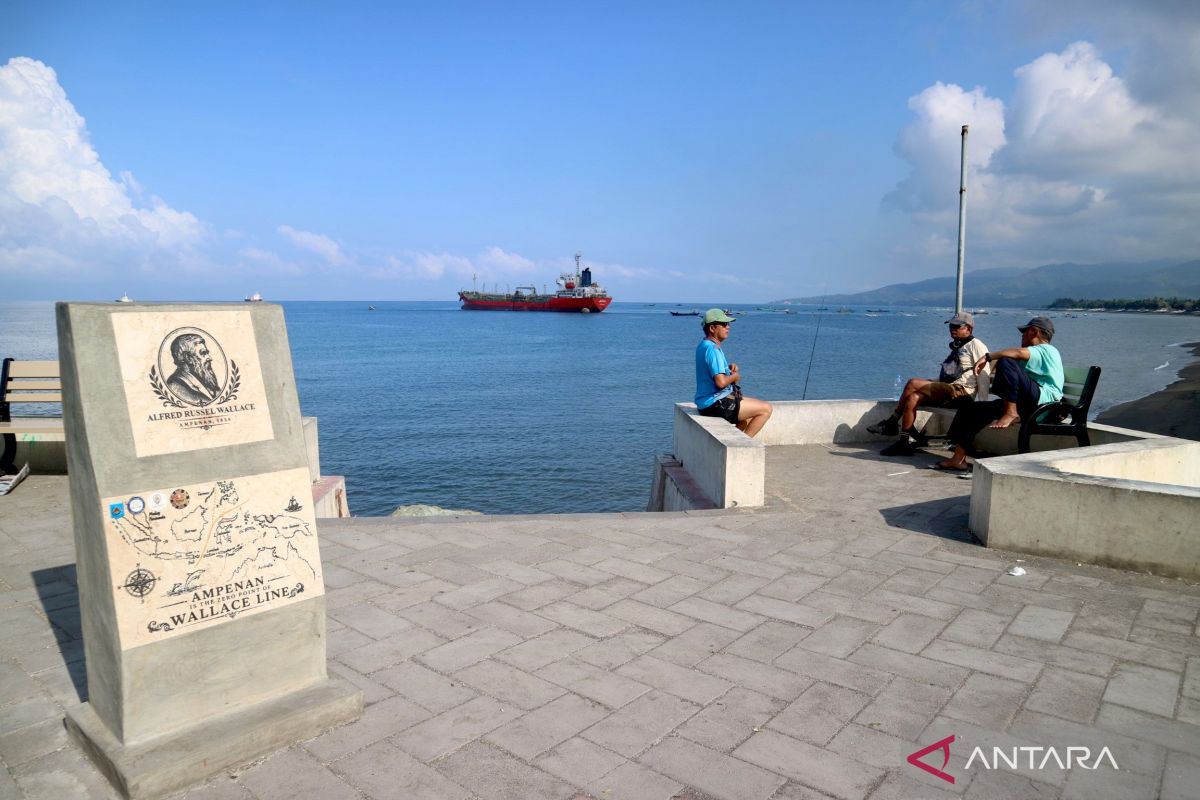
On the coast stands a monument depicting Alfred Russel Wallace. It bears the inscriptions “Ampenan, 1856” and “Ampenan is the zero point Wallace Line”.
These historic structures show that Ampenan’s past is preserved not only in written records, but also in buildings and landmarks that can still be seen today.
Local life
Life in Ampenan continues amid the old buildings. The coastal Kampung Melayu Bangsal neighbourhood, for example, illustrates the close relationship between residents’ homes and the sea.
Houses stand close to a pedestrian path running along the beach. Paving stones, a yellow tactile path, plant pots and wooden gazebos form part of the area’s facilities.
Visitors can take a leisurely walk or sit and enjoy the sea view. Residents, meanwhile, continue their everyday activities, including traditional fishing.
Asep, who has lived in Ampenan Old Town for seven years, said the area had changed noticeably. He considers the beach better organised now, but says its historic buildings still need attention.
It would be a shame if Ampenan’s heritage continued to disappear as buildings changed and preservation received too little attention.
Farul, head of the Ampenan Old Town Tourism Awareness Group (Pokdarwis), expressed similar concerns. The area has many historical stories that should be introduced to the public again.
Preservation efforts face several obstacles, including the fact that most buildings are privately owned. Some owners no longer live in Ampenan, making documentation and conservation a longer process.
Farul, who was born and raised in the area, wants to bring Ampenan’s history back into focus so that it is not known only to local residents.
“I was born here and grew up here, and I want to find a way to bring Ampenan’s stories to the fore,” he said.
The LHSS community is also working to introduce the area’s history through its Ampenan Heritage Walk. The activity gives people an opportunity to learn about old buildings, the history of trade and the development of social life in Ampenan Old Town.
Ali said conservation of a historic district must take account of both its buildings and the people who live there. In this way, Ampenan can remain not only a repository of the past, but also a living space for its community.
Planning the district
Efforts to safeguard Ampenan Old Town are also receiving attention from local government. The NTB Provincial Government and Mataram City Government have begun preliminary studies to support the planning of the historic district.
NTB Culture Agency head Muhamad Ihwan said the government was continuing to collect information about ownership and occupants of the old buildings as part of the study.
The data collection is now about 70 per cent complete. It has found that some owners live as far away as Surabaya and the Netherlands. The information gathered will inform further discussions and public consultations on the district’s development.
The government also plans to propose Ampenan Old Town as a cultural heritage area, subject to research by Mataram’s Cultural Heritage Expert Team (TACB).
The government recognises that a key challenge in planning the district is confirming building ownership and obtaining historical information from former owners or occupants.
Alongside data collection and research, the government is planning cultural activities, festivals, arts performances and programmes introducing local cuisine. These events are expected to bring the district to life while introducing Ampenan’s rich history to a wider public.
“We want Ampenan Old Town to be a district that does not abandon its local wisdom, while continuing to develop,” Ihwan said.
Ampenan Old Town faces two needs: to develop as a thriving district and to preserve its historical identity. The busy beach, coastal community life, old buildings and historic places of worship all form part of its character.
Source: jawawa.id (https://jawawa.id/newsitem/preserving-the-historical-legacy-of-ampenan-old-town-in-lombok-1794293482)
Originally published by Antara (Indonesian) (https://www.antaranews.com/berita/5843539/merawat-jejak-sejarah-kota-tua-ampenan-di-lombok), translated from Indonesian