
Preserving the Cultural Heritage of Bamboo Weaving
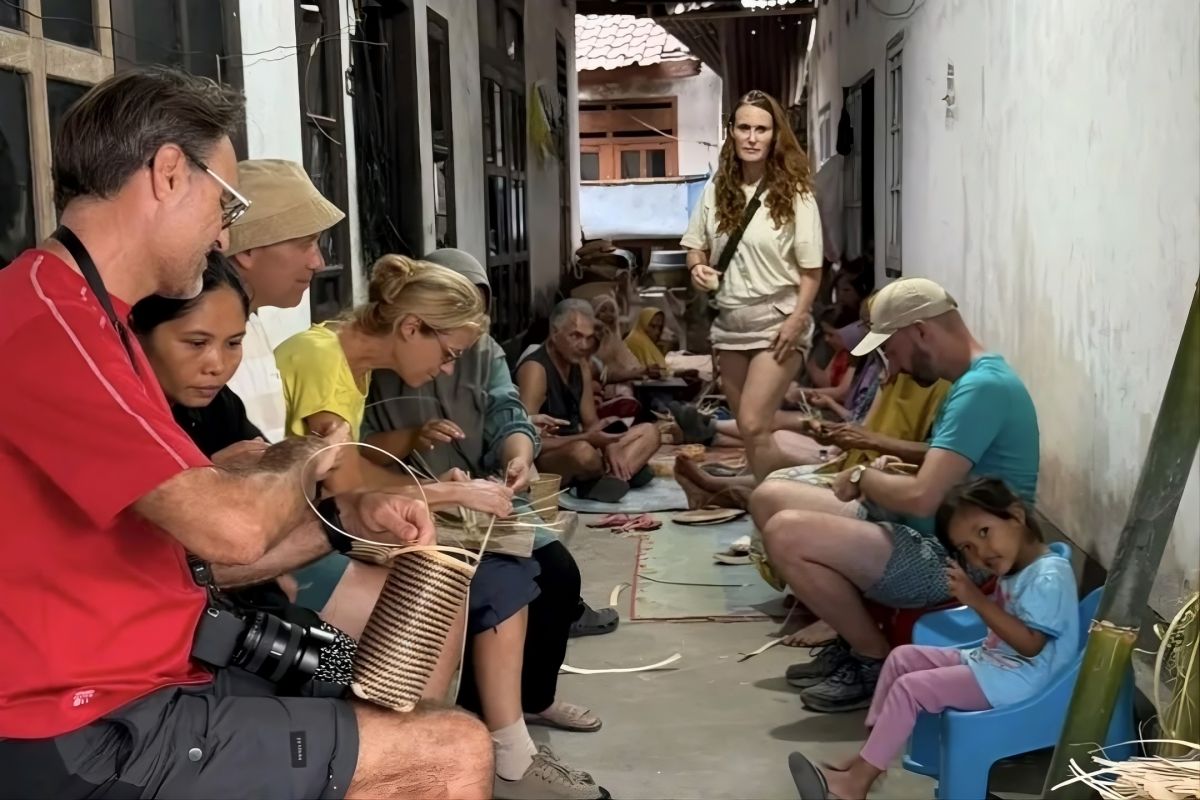
Mataram (ANTARA) - Strips of bamboo passed from one hand to another. Slowly, Baiq Idayatul Husni’s fingers crossed the pieces one by one, forming an increasingly distinct pattern.
The movement is nothing new to the 40-year-old, who has spent more than half her life working with bamboo strips, which have become part of her daily routine.
For the woman from Loyok village, Sikur district, East Lombok regency, West Nusa Tenggara (NTB), weaving is more than just a job.
A long journey has made the skill part of her life, through every drop of sweat—from learning as a teenager to making it one of her family’s sources of income.
Ida, as she is affectionately known, has worked as a bamboo weaver for more than 20 years. The techniques she first learnt when she was young have become skills she continues to practise.
Repeatedly weaving has made the activity feel like part of who she is, and something she enjoys.
Behind each craft is the need to provide for her family. The woven products are a source of income that helps support her children.
For bamboo weavers, carrying on the craft is not simply a matter of preserving a tradition passed down through generations; it is also about keeping their families’ livelihoods going.
Ida’s story is one example of the women in Loyok village who depend on bamboo weaving for their livelihoods while preserving a traditional skill.
In 2022, Loyok village, located south of Mount Rinjani at an altitude of 670 metres above sea level, was named among the Ministry of Tourism and Creative Economy’s Top 500 Tourism Villages.
The village, officially established on 15 November 1961, is the largest and only centre for bamboo weaving in West Nusa Tenggara. Its signature bamboo crafts include dedungki and gegandek.
A source of livelihood
At an arts shop and bamboo craft business run by Baiq Heni Kusmiyanti’s husband since 1997, the craft continues to find room to grow amid the area’s unspoilt rice-field landscape.
Thirteen women artisans are involved in making a range of products that are used not only for everyday needs but also have economic value.
Simple-looking bamboo strips can be transformed into bags, baskets, storage containers and various household items. Each product requires care in preparing the materials, adjusting their size and crossing the pieces one by one to create a strong, neat weave.
In the hands of the artisans, bamboo is more than a natural material. The plant, whose scientific name is Bambusoideae, is a source of livelihood and a means of preserving a skill long practised by the people of Loyok village.
Source: jawawa.id (https://jawawa.id/newsitem/preserving-the-cultural-heritage-of-bamboo-weaving-1793778857)
Originally published by Antara (Indonesian) (https://www.antaranews.com/berita/5831023/menjaga-warisan-budaya-anyaman-bambu), translated from Indonesian