
Preserving Ancestral Heritage: Indra's Story of Sustaining the Pis Bolong Kamasan Craft
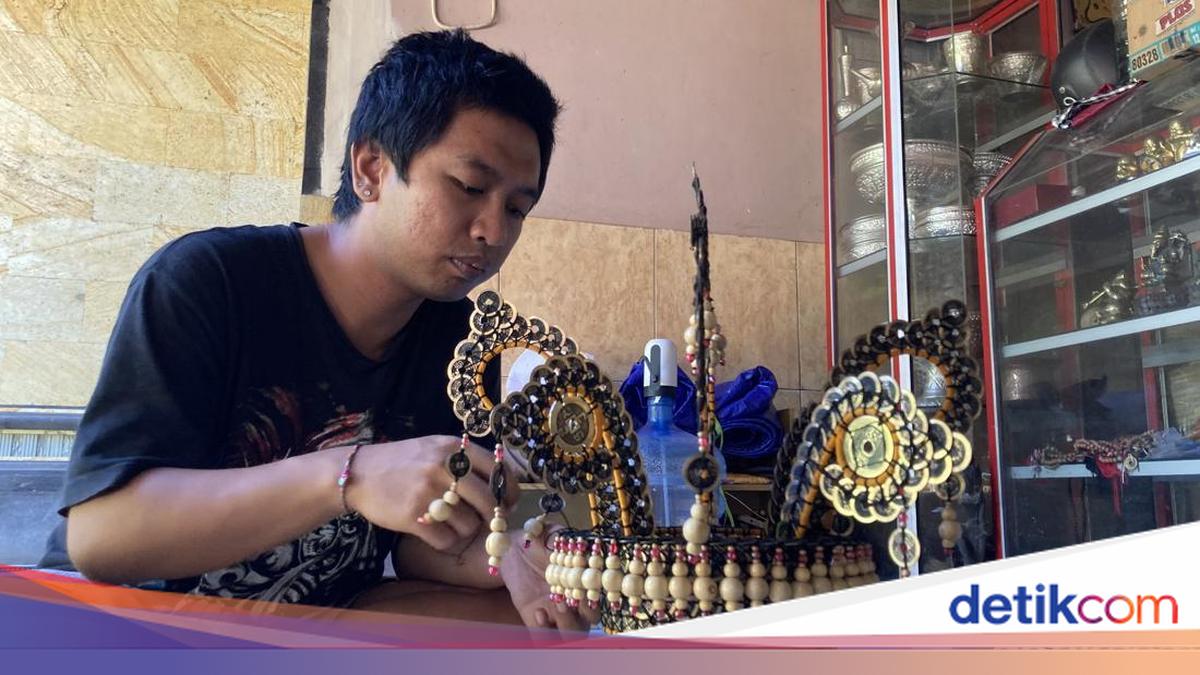
Amidst a shortage of young artisans for Pis Bolong in Kamasan Village, Klungkung, Bali, I Made Indra Kesumajaya (28) has chosen to follow the path pioneered by his family. He continues the business of his father, I Made Sanjaya, the owner of Taksu Agung Bali, who has dedicated decades to the metal Pis Bolong craft. For Indra, this choice is not merely about continuing a family enterprise; Pis Bolong is an ancestral heritage that must be preserved to remain alive amidst changing times.
When met on Saturday (20/6/2026), Indra was busy assembling hundreds of Pis Bolong pieces into a penyeneng. His hands moved nimbly arranging the metal pieces he has been familiar with since childhood. For him, the opportunity to continue the business his father built is an invaluable privilege. Indra’s interest in Pis Bolong grew since he was in kindergarten. He was accustomed to observing his father work in the workshop. That closeness to the crafting process eventually solidified his decision to continue the family business after graduating from high school.
The uniqueness of Kamasan Pis Bolong lies in its materials and the philosophy it embodies. The original Pis Bolong from Taksu Agung Bali is made from five metal elements: tin, copper, brass, silver, and gold. These five elements symbolise the Panca Mahabhuta, the elements that form the universe. The symbol also represents the five cardinal directions: East-Indra/Space, South-Brahma/Fire, West-Mahadewa/Water, North-Wisnu/Earth, and Centre-Siwa/Ether.
Indra does not only sell Pis Bolong as sacred ritual items for pedagingan; he also develops them into various high-value works of art. He assembles them into Penyeneng Serobong Daksina, Lamak, Capah, Sampiang, Tamiang, and even Cili and Rambut Sedane statues. Like any business, the Pis Bolong craft experiences income fluctuations. Orders typically increase significantly during certain moments, especially ahead of religious holidays. ‘It’s a business, so there are ups and downs. Usually, when there are ceremonies, there are many orders. Like now, during Galungan-Kuningan,’ he explained.
According to Indra, the price of Pis Bolong has risen considerably due to increasing raw material costs. Pis Bolong inscribed with script is sold per bundle, with one bundle containing 200 pieces priced at Rp 350,000. ‘The price used to be Rp 250,000. It has gone up quite a bit,’ he clarified. Meanwhile, Pis Bolong with images, such as the ‘moon coin’, is sold for Rp 1,100 per piece. The moon motif originally appeared due to a printing error that shifted the design, but it received a positive response from the market. Orders for pedagingan needs are the most sought after, with a single order sometimes reaching 10,000 pieces. For derivative products, the price is determined by the number of pieces used and the level of difficulty. The penyeneng Indra was working on, for instance, requires around 400 to 500 pieces and is sold for Rp 2.5 million for the large size and Rp 1.5 million for the medium size.
Works from Taksu Agung Bali Kamasan are regularly exhibited at the Bali Arts Festival (PKB) 2026 at the Art Centre in Denpasar. Indra noted that almost all of their items are currently on display there. He showed several works, including a Cili statue priced at Rp 2.5 million each and a pair of Rambut Sedane statues, which are the most expensive works, fetching up to Rp 27 million per pair. ‘The price depends on the level of difficulty and how much material is needed,’ he said.
Beyond preserving ancestral heritage, Indra also provides employment for other artisans. The wage system is calculated per piece. For a penyeneng containing around 400 pieces, the wage ranges from Rp 450,000 to Rp 500,000, excluding the installation of supporting accessories. Production time varies; a product like a penyeneng can be completed in as little as two days, but if worked on more leisurely, the process can take up to two weeks. As a young artisan, Indra hopes the youth of Kamasan will not hesitate to pursue the profession of Pis Bolong crafting. ‘I am not embarrassed, even though almost all of my peers choose to work in tourism. Because this is my identity and ancestral heritage. If we don’t preserve it, who will?’ he asserted while weaving a penyeneng from Pis Bolong. In Indra’s hands, the art of Wayang Kamasan and the Pis Bolong Kamasan metal craft continue to find space to survive. From Pis Bolong priced at Rp 350,000 per bundle to artworks worth tens of millions of rupiah, the heritage of the five ancestral elements remains alive and thrives through the touch of a new generation.
Source: jawawa.id (https://jawawa.id/newsitem/preserving-ancestral-heritage-indras-story-of-sustaining-the-pis-bolong-kamasan-craft-1781959856)
Originally published by detikBali (https://www.detik.com/bali/bali-bungah/d-8539845/menjaga-warisan-leluhur-kisah-indra-lestarikan-kerajinan-pis-bolong-kamasan), translated from Indonesian