
Preserving Aceh's Kasab Embroidery Tradition Amidst Modernisation with BRI Group's Ultra Micro Holding
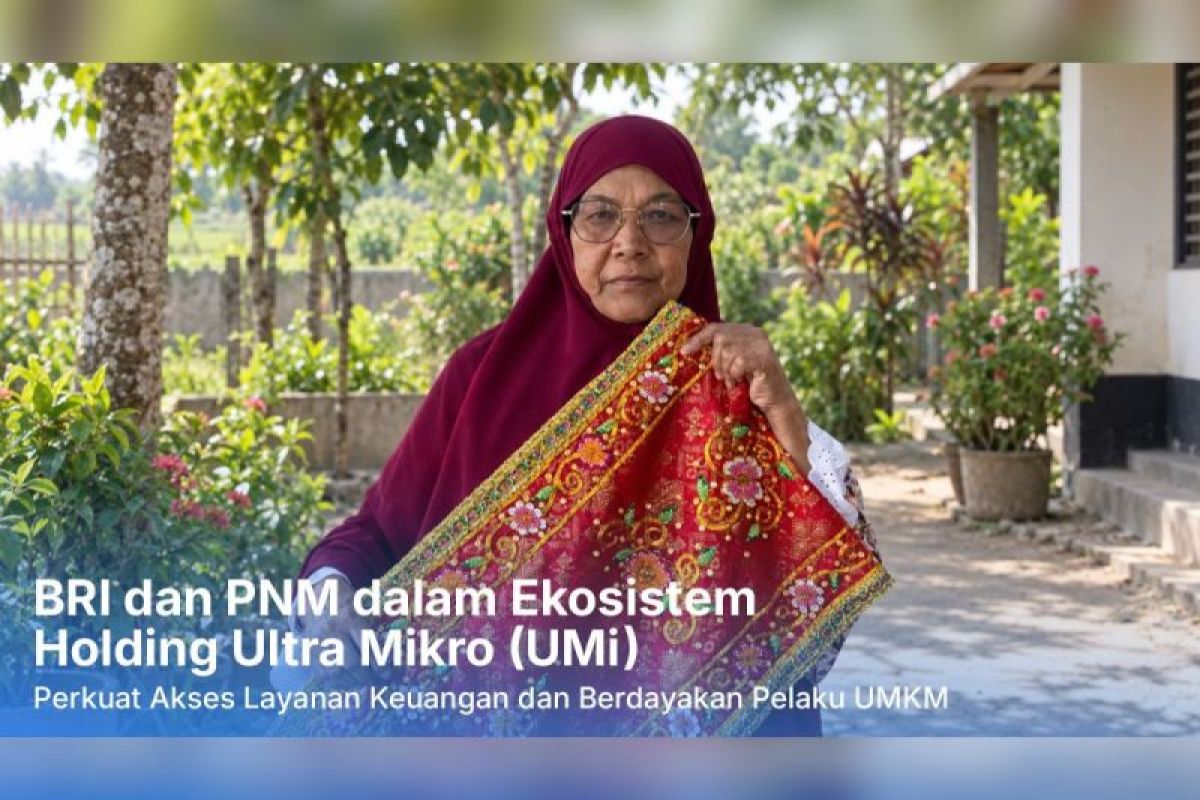
In the midst of modernisation and the increasing dominance of mass-produced goods, traditional crafts face significant challenges to remain viable. The lengthy production process, requirement for specialised skills, and extreme precision mean that not everyone is willing to carry on these traditions.
However, for some, preserving traditional crafts is about more than just maintaining a livelihood. It involves safeguarding cultural heritage, local skills, and regional identity for future generations.
This is the spirit upheld by Asra, a 63-year-old woman from Kuala Baru, Aceh. Since 1990, she has consistently dedicated herself to the Kasab embroidery business, a unique craft made by hand through a complex and patient process.
“Initially, this business stemmed from the Kasab thread embroidery culture, which is a long-standing tradition in our region. Because the production process is quite lengthy and requires precision, many residents gradually began to prefer buying Kasab bead embroidery rather than making it themselves,” said Asra.
Recognising this demand, Asra began offering her expertise by accepting orders from house to house. Her embroidery skills, which she initially practised alongside her duties as a housewife, eventually grew into a business that supports her family’s economy.
The business, which originally only served local orders, has continued to expand. Today, Asra’s Kasab bead embroidery products are marketed to various regions across Aceh.
Kasab bead embroidery involves a non-trivial production process. Every product is handmade and requires specialised skills. The tension of the thread must be applied carefully to ensure the resulting pattern appears neat.
The work cannot be rushed. Precision and patience are essential components, as an error in one section can affect the entire finished craft.
“The uniqueness of this business lies in its complex production process. Every pull of the thread requires extra precision and patience. It cannot be done in a hurry because every part must be carefully crafted to ensure a neat and beautiful result,” she explained.
Asra’s long business journey previously faced capital constraints. In 2020, she became a client of PNM Mekaar to obtain the additional capital needed to run and expand her business.
This financing was used to meet production needs, including purchasing larger quantities of materials. With more adequate capital, Asra was able to increase her production capacity and accept more orders.
“Alhamdulillah, the additional capital has helped me to continue running the business and meet production requirements,” she said.
In addition to financing, Asra received assistance in the form of training regarding Kasab thread, organised in Kuala Baru. This training enhanced her knowledge and skills in managing her craft business.
As production capacity increased, the impact of the business was also felt by the local community. Asra has been able to create job opportunities, allowing other residents to earn additional income from Kasab bead embroidery production.
The business, which was initially built to help meet family needs, now provides broader economic benefits. Simultaneously, the presence of these artisans helps ensure that embroidery skills remain alive within the Kuala Baru community.
Asra’s story illustrates how access to finance, accompanied by empowerment, can have a wider impact on ultra-micro entrepreneurs. Such efforts align with the spirit of the Ultra Micro (UMi) Holding, which integrates the strengths of BRI as the parent holding company alongside Pegadaian and PNM. Since its formation in 2021, the UMi Holding is designed to expand and deepen access to financial services for the public, particularly the ultra-micro segment, through an ecosystem that combines financing, savings, transactions, and business empowerment and mentoring.
BRI Corporate Secretary, Dhanny, stated that empowerment is a vital part of building a sustainable ultra-micro ecosystem.
“Through the Ultra Micro Holding, we want to ensure that financial access serves as a gateway to broader empowerment. Entrepreneurs like Ibu Asra demonstrate that when access to finance is paired with mentoring and the drive to grow, ultra-micro businesses can provide benefits that extend far beyond the business owners themselves,” said Dhanny.
For Asra, this support has been part of her long journey of maintaining Kasab embroidery for over three decades. Amidst changing times, every piece produced serves not only as a source of livelihood for her family and the community but also ensures that Aceh’s traditional skills remain alive and recognised by future generations.