
Preparations Underway for 24-Hour Full Pedestrianisation of Jogja's Malioboro
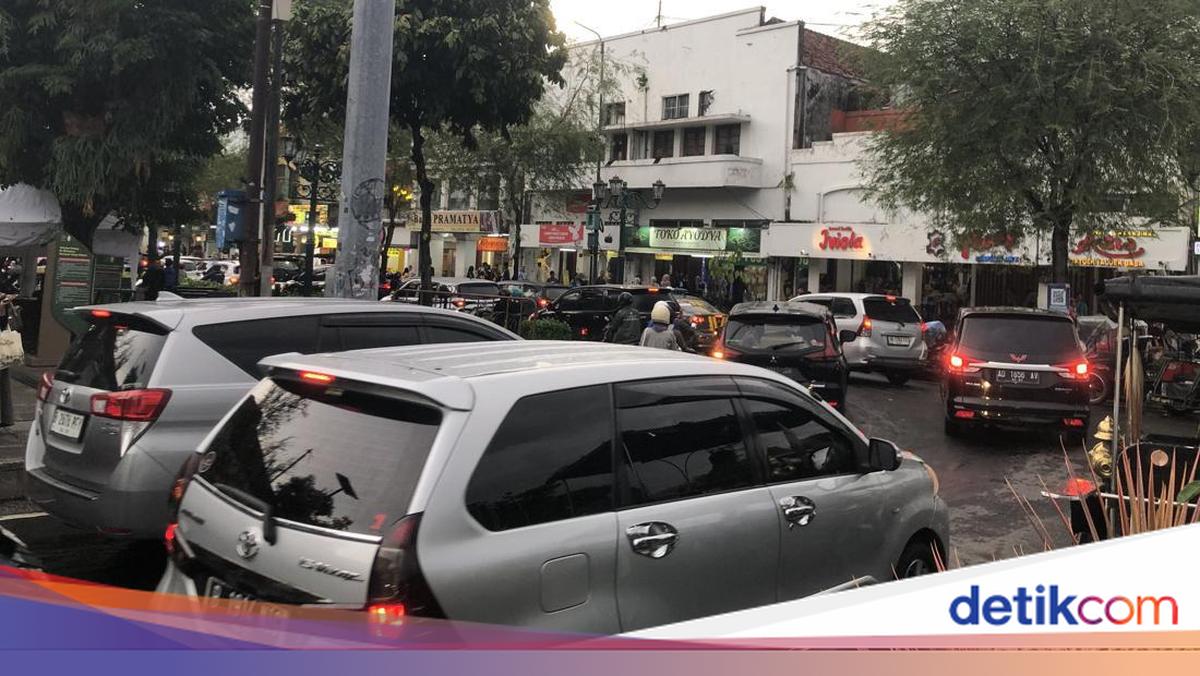
Starting next November, the Malioboro area in the city of Jogja will become a 24-hour full pedestrian zone. The Yogyakarta Special Region (DIY) government is preparing a series of schemes before the policy comes into effect.
Observations on Thursday (2/7) noted that portal posts have begun to be installed at several access roads branching off Malioboro. A portal was seen at the entrance to Jalan Suryatmajan, with the roughly two- to three-metre-long structure installed on both the north and south sides of the road. The green-and-yellow portal appeared unfinished, and the posts were locked so they could not be lowered. Besides Jalan Suryatmajan, a portal was also spotted on Jalan Pajeksan.
Head of the DIY Transportation Agency (Dishub), Chrestina Erni Widyastuti, confirmed the portal installation is part of the preparations for Malioboro to become a 24-hour full pedestrian area. Erni explained that her agency is currently busy preparing traffic network arrangements, developing parking pockets in buffer zones, improving TransJogja services, regulating logistics distribution, providing pedestrian facilities and access for persons with disabilities, and coordinating with government agencies and security forces.
“Our focus is not on chasing a percentage of readiness, but on ensuring the entire supporting ecosystem is truly ready so that policy implementation can run effectively, in stages, and without disrupting community activities,” Erni stated. “The main principle we hold is that the pedestrian area must still guarantee the smooth running of public service duties and security. Therefore, the planned portals are not permanent barriers, but part of an access management system whose operation is regulated through standard procedures drawn up together with all relevant agencies.”
Erni explained that under the traffic network arrangement, when full pedestrianisation is implemented, vehicles such as emergency vehicles, ambulances, fire engines, and public service vehicles will still be granted access according to operational needs. “The mechanism for opening and closing the portals, timing arrangements, and authorised officers will be determined through joint coordination so that the security of the area is maintained without hindering state duties,” she clarified.
Regarding parking, Erni explained that her agency is strengthening the park-and-ride and park-and-walk concept. “The paradigm we are building is ‘park once, experience more’, meaning visitors simply park their vehicles in the buffer zone, then continue their journey on foot, by TransJogja, traditional transport modes, or other environmentally friendly modes,” Erni said on Friday (3/7/2026).
To this end, Erni continued, the agency is focusing more on developing parking capacity in parking pockets outside the core Malioboro area. Additionally, these parking pockets will be supported by a smart parking system. “Through this system, the public will later be able to check real-time parking space availability, obtain navigation to the nearest parking location, and utilise a digital payment system. Thus, vehicles will not need to circle around looking for parking spaces, which only adds to congestion and emissions,” she explained.
Furthermore, the Transportation Agency will also strengthen the TransJogja service integration system to become the backbone of mobility towards Malioboro. “This includes improving bus stop connectivity, ease of modal transfer, and enhancing service quality. Our target is not merely to provide more parking spaces, but to build a mobility system that is more efficient, comfortable, and sustainable,” she said.
DIY Regional Secretary Ni Made Dwi Panti Indrayanti stated that the administration is finalising the scheme based on evaluations from previous trials. “Yes, full pedestrianisation starts in November. We are looking at it because if we want to postpone it, until when?” Made said on Wednesday (1/7).
Made expressed hope that the public will understand this policy. Besides Malioboro becoming a low emission zone, the vehicle load in Malioboro is also considered too heavy, often causing vehicle build-ups. “What are we actually doing this arrangement for? It is not that we dislike visits, but we want to create comfort. Because sustainability of an area is achieved when we regulate it,” Made explained. “If the vehicle volume is large, it will eventually have a negative impact on the area. The carrying capacity will be greatly affected if we do not regulate it. Moreover, there are many heritage buildings that may gradually be disturbed by external disturbances, vibrations, and so on,” she concluded.