
Prehistoric Giant Octopus Suspected as Top Predator of Cretaceous Oceans
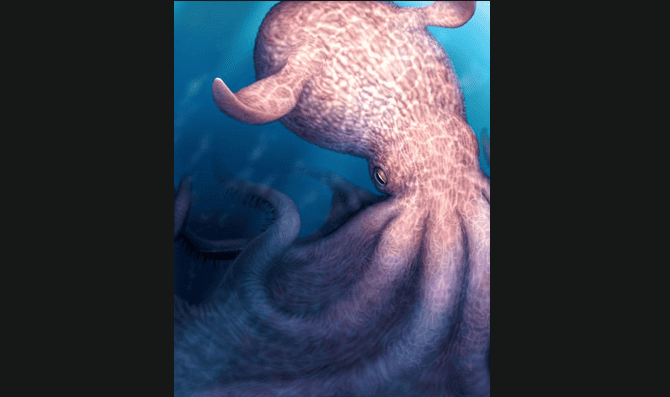
The world of palaeontology has been stunned by a discovery that challenges the long-held paradigm of vertebrate dominance in ancient oceans. For years, the narrative of top predators in the Cretaceous period has centred on giant marine reptiles like Mosasaurus. However, a recent study published in the journal Science reveals the existence of Nanaimoteuthis haggarti, a giant prehistoric octopus whose size surpasses that of a city bus.
The discovery not only provides new insights into the marine ecosystem 86 to 72 million years ago but also demonstrates how cutting-edge technology accelerates the uncovering of ancient natural secrets buried for millions of years.
Late Cretaceous Invertebrate Monster
According to research data, Nanaimoteuthis haggarti is estimated to have reached a body length of 18 metres (60 feet), significantly larger than modern giant squids. Scientists identified the species through analysis of beak fossils found in two separate locations: Japan and Vancouver Island, Canada.
Given that octopuses are predominantly composed of soft tissue that rarely fossilises, the beak is the only hard evidence remaining. Using comparative methods with modern octopus anatomy, the research team led by Yasuhiro Iba of Hokkaido University successfully projected the creature’s massive dimensions.
Estimated Length: Up to 18 metres.
Era: 86–72 million years ago (Cretaceous).
Discovery Locations: Japan and Canada.
Key Features: Bone-crushing beak and eight flexible arms.
Role of AI Technology in ‘Digital Fossil Mining’
One of the most revolutionary aspects of the discovery is the use of Artificial Intelligence (AI) technology. The research team applied a process termed ‘digital fossil mining’. This technology enables scientists to:
Conduct in-depth scanning of rock structures without damaging physical samples.
Detect microscopic or hidden fossils within hard sediment layers.
Reconstruct three-dimensional shapes from beak fragments to simulate bite force.
Analysis of the results showed that the Nanaimoteuthis haggarti’s beak exhibited extreme wear and deep scratches, indicating that this predator not only consumed soft-bodied prey but could also crush hard shells and likely bite through the bones of large marine reptiles.
Comparison Table: Cretaceous Marine Predators
Pros and Cons of Size Estimates
Although the discovery is highly significant, the scientific community maintains a critical stance. Christian Klug of the University of Zurich noted that the 18-metre estimate has a degree of uncertainty as it is based solely on jaw (beak) fragments. However, a general consensus agrees that Nanaimoteuthis occupied the apex position in ancient marine food chains.
The success of AI technology in uncovering this giant has opened doors to further exploration of uncharted ancient ocean depths. As stated by Adiel Klompmaker of the University of Alabama Museum, the discovery raises significant questions about what other mysteries remain hidden in the depths of Cretaceous oceans. (Source: National Geographic Channel)