
Pramono Reports DKI Jakarta Revenue of Rp44.98 Trillion in Third Quarter
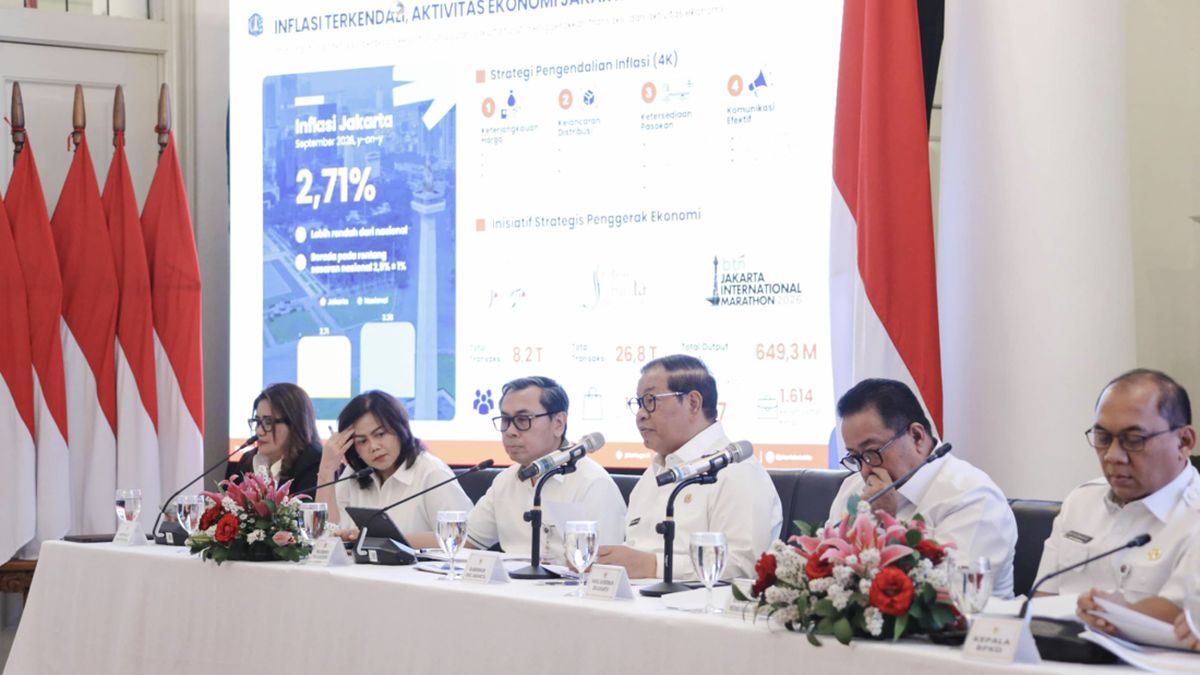
Jakarta Governor Pramono Anung said the management of the Regional Revenue and Expenditure Budget (APBD) should be assessed not only by the amount spent, but also by the benefits of development and improvements in the quality of public services.
The Jakarta Provincial Government is continuing to strengthen budget transparency and accelerate priority programmes for residents.
Pramono made the remarks at a press conference on the realisation of the 2026 third-quarter APBD at Jakarta City Hall on Wednesday (21 October). At the event, titled Jakarta Budget Talks, the provincial government presented regional revenue and expenditure performance, economic developments and progress on various development programmes.
“The APBD is not simply about figures: how much is allocated and how it is spent. What matters most is whether public services in Jakarta are improving, economic activity is becoming stronger and more transparent, and development is meeting residents’ needs,” Pramono said.
By 30 September 2026, Jakarta’s regional revenue had reached Rp44.98 trillion, or 62.95% of its Rp71.45 trillion target. Regional expenditure stood at Rp40.40 trillion, or 54.39% of the Rp74.29 trillion allocation.
Regional financing receipts amounted to Rp6.46 trillion, or 65.43% of the Rp9.88 trillion target, while financing expenditure reached Rp2.02 trillion, or 28.74% of the Rp7.04 trillion allocation. Jakarta’s total 2026 APBD was set at Rp81.33 trillion.
On the revenue side, locally generated revenue (PAD) reached Rp39.33 trillion, or 68.20% of its target. This was up 1.29% on the same period in 2025. Regional tax receipts totalled Rp34.58 trillion, an annual increase of 1.59%.
To maintain budget performance through the end of the year, the Governor called on all regional agencies to speed up the completion of programmes and activities without compromising quality or spending accountability.
“I have specifically asked regional agencies to complete their activities promptly so they do not pile up at the end of the year. Preparations need to be made earlier so that budget implementation runs better,” Pramono said.
Strengthening education, healthcare and transport services
By the third quarter of 2026, spending on programmes to improve the quality and accessibility of education had reached Rp4.99 trillion out of a Rp9.27 trillion budget. Spending on improving public health stood at Rp4.28 trillion out of Rp7.93 trillion.
In social protection, Rp829.06 billion had been spent, or 70.42% of the allocation. The programmes include assistance for vulnerable groups through the Jakarta Elderly Card (KLJ), Jakarta Disability Card (KPDJ) and Jakarta Children’s Card (KAJ), as well as social rehabilitation services.
Spending on programmes to improve the quality and coverage of integrated public transport reached Rp2.16 trillion. Support includes the development of transport networks and subsidies for Transjakarta, MRT Jakarta and LRT Jakarta services.
The increase in transport services is reflected in combined ridership across the three modes, which reached 368.4 million passenger journeys by September 2026, up 10.8% on the same period in 2025. Of these, around 23 million journeys used free transport services available to 15 groups of residents.
Public transport coverage in Jakarta stood at 93%. Connectivity is being strengthened through mass-transit development, including the Jakarta LRT route between Velodrome and Manggarai, which was inaugurated in September 2026.
The Governor also announced plans to expand eligibility for free public transport from 15 to 21 groups from 1 January 2027. The move is expected to improve access to mobility, including for jobseekers and people accompanying persons with disabilities.
Jakarta’s economy grows as inflation remains under control
Amid implementation of the APBD, Jakarta’s economy grew by 5.52% year on year in the second quarter of 2026. Construction was one of the contributing sectors, while the Consumer Confidence Index stood at 150 in August 2026, indicating public optimism.
“Growth is supported by various sectors. I hope construction continues to expand, as this shows that economic activity and optimism in Jakarta are improving,” Pramono said.
Jakarta’s annual inflation was 2.71% in September 2026, below the national rate of 3.28%.
Inflation control measures focus on affordability, supply availability, smooth distribution and effective communication. These include low-cost markets, subsidised food, interregional supply agreements and stronger food distribution.
Alongside maintaining price stability, the Jakarta Provincial Government is promoting economic growth by hosting events at national and international level.
Jakarta Fair 2026 recorded transactions worth Rp8.2 trillion and attracted 6.1 million visitors, while the Jakarta Great Sale Festival generated Rp26.8 trillion in transactions, with 104 shopping centres taking part.
The Governor said these events benefit trade, tourism, hospitality, transport and micro, small and medium-sized enterprises (MSMEs).
“Jakarta is now the epicentre of events in Indonesia. We support these activities because their economic multiplier effects are substantial,” he said.
The provincial government is also continuing to support international events, including the Jakarta Running Festival on 24–25 October 2026, which is expected to boost economic activity and strengthen Jakarta’s appeal as a destination for large-scale events.
Poverty falls and access to employment expands
As for public welfare, the share of Jakarta residents living in poverty fell to 3.96% in March 2026, down 0.07 percentage points from September 2025. For the first time, the figure was below 4%.
The open unemployment rate was 5.79% in May 2026, down 0.24 percentage points from February 2026. The labour force participation rate reached 66.05%, an increase of 0.57 percentage points.
To widen employment opportunities, the provincial government has provided skills training through Mobile Training Units and regular courses, attended by 6,720 participants. Job fairs involving 214 companies also offered 24,390 vacancies.
In sustainable development, six of the 17 Sustainable Development Goals (SDGs) had met their targets in 2025. Overall, 65.6% of assessed SDG indicator targets had been achieved.
Jakarta also improved its position in the 2026 Oxford Economics Global Cities Index, rising to 140th out of 1,000 cities, from 159th in 2025.
Governor Pramono said these achievements should spur further improvements in the quality of development and public services.
He said budget transparency and cooperation with stakeholders were important to maintaining public trust.
He also thanked the Jakarta Regional Legislative Council (DPRD), the Financial and Development Supervisory Agency (BPKP), Bank Indonesia, the Financial Services Authority (OJK), Statistics Indonesia (BPS) and all those contributing to Jakarta’s development.
“Public trust is the mainstay that makes development in Jakarta easier. We must therefore maintain transparency and coordination so that the APBD genuinely benefits residents,” Governor Pramono concluded.
Source: jawawa.id (https://jawawa.id/newsitem/pramono-reports-dki-jakarta-revenue-of-rp44-98-trillion-in-third-quarter-1792579936)
Originally published by CNN Indonesia (https://www.cnnindonesia.com/nasional/20261021170038-25-1418070/pramono-paparkan-realisasi-pendapatan-dki-rp4498-t-di-triwulan-iii), translated from Indonesian