
Pramono Highlights Major Impact of JIS Getting Its Own KRL Station
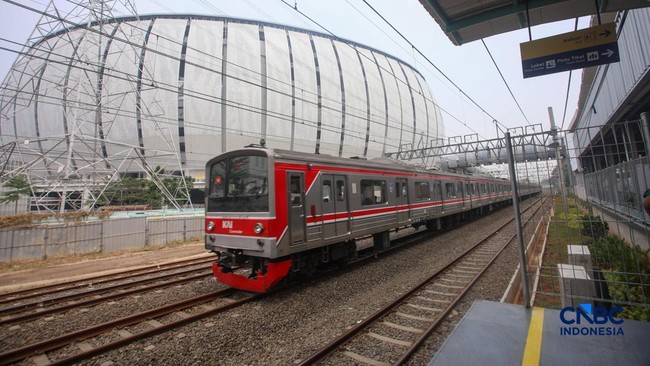
Jakarta Governor Pramono Anung stated that the presence of the KRL station at Jakarta International Stadium (JIS) will become a crucial point in the development of the North Jakarta area. He believes that more complete transport connectivity will allow JIS to be used more optimally for various activities, ranging from football matches and concerts to daily community activities.
Pramono conveyed this during the inauguration of the JIS Station’s operations on Monday (22/6/2025). He admitted to being one of the most grateful parties for the realisation of a station that is directly integrated with the stadium complex. "Ladies and gentlemen, no one is more grateful than I am. Once this was realised, it was one of my personal dreams. For that, I would like to specifically thank the Minister of Transportation (Dudy Purwaghandi), the Director General of Railways, and the Board of Directors of BTN for making this happen," Pramono said in his speech.
According to Pramono, the North Jakarta area will become one of Jakarta’s future growth centres. Therefore, the construction of transport access to the area is considered a necessity that cannot be postponed. "Because Jakarta’s future, one of them, is in the north, right here. Sooner or later, this place will become one of the areas or places that many people visit," he said.
He also assessed that development in North Jakarta has actually been quite massive. However, many people still question the area’s progress. "Many people ask, ‘When will North Jakarta be built?’ In fact, many facilities in North Jakarta have already been built," he stated.
Pramono hopes the new station will be a catalyst for maximising the utilisation of JIS. He even admitted to frequently asking the management of PT Jakarta Propertindo (Jakpro) about efforts to optimise the use of the stadium. "I really hope that this place can be utilised to its maximum potential as soon as possible," Pramono said. "Mr Minister, every time I meet the President Director of Jakpro, my question is simple. ‘When can the JIS pitch be used to its maximum potential?’" he continued.
He stressed that JIS should not be left idle for long periods after hosting one or two major events. "Don’t let it be that after a match, then a concert or two, it stops for two to three months. That must not happen anymore," he asserted. "And if that can be done, I am sure this place will become a venue that is in high demand by various community groups," he added.
Pramono said the biggest impact of activating the JIS Station is the increased choice of public transport for people heading to the stadium or the Ancol tourist area. Besides the KRL, the public can also use Transjabodetabek and Transjakarta services. "Ladies and gentlemen, if we can carry out this activation, connect JIS and Ancol, then anyone watching a concert, watching football, or wanting to go to Ancol will have the choice of taking the KRL, Transjabodetabek, or Transjakarta. So the options will be very, very many," Pramono said.
Furthermore, Pramono revealed that the JIS area is now starting to develop into a lively public space visited by residents, not only during matches or concerts. "In fact, I have seen for myself that this place (Jakarta International Stadium) has now become one of the favourite spots for people to jog, run, meet, socialise, and so on," he said.
Therefore, he hopes that the increasingly complete connectivity between JIS and Ancol can encourage more equitable development in Jakarta. "So once again, I am the happiest person and hopefully this is part of how equitable development in Jakarta can truly happen," Pramono concluded. "Thus, with the connection of Ancol and JIS through the BTN Joint Pedestrian Bridge, then the KRL can now enter here, and we also have the pedestrian bridge, its gate becomes the Ancol-JIS gate," he added.
As of today, JIS Station began serving KRL trips on the Jakarta Kota-Tanjung Priok route. The station, located between Ancol Station and Tanjung Priok Station, is expected to be a solution for access to Jakarta International Stadium, which has often faced traffic congestion during large-scale events. With the integration of KRL, Transjakarta, Transjabodetabek services, and pedestrian connections to Ancol, visitor mobility to the North Jakarta area is projected to become much easier.