
Prambanan to Borobudur: Historic Temples Revived as Spaces for Worship and Religious Tourism
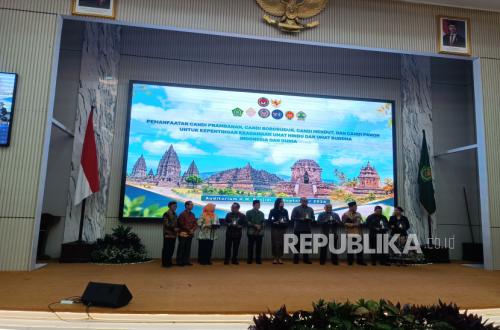
The Indonesian government has agreed to revive the religious functions of four historic temples in Indonesia. This agreement is formalised in a Memorandum of Understanding (MoU) regarding the utilisation of Prambanan, Borobudur, Mendut, and Pawon temples for the religious interests of Hindu and Buddhist communities, both in Indonesia and globally.
The MoU was signed in Jakarta on Thursday (17/09/2026) by the Ministry of Religious Affairs, the Ministry of Culture, the Ministry of Tourism, the State-Owned Enterprises Regulatory Agency, the Special Region of Yogyakarta Government, and the Central Java Provincial Government.
The Minister of Religious Affairs, Prof. Nasaruddin Umar, stated that this agreement is expected not only to restore the religious functions of the temples but also to develop their potential for various public interests. “In addition to religious interests, there are also economic, tourism, scientific, and educational interests,” Nasundaruddin said following the signing.
He noted that these temples possess the potential to become meeting points for various interests. Therefore, the government needs to develop the strength of these temple sites more comprehensively so that their existence provides broader benefits to the community.
Nasaruddin expressed hope that the temple areas would eventually become centres for religious tourism that bridge religious needs with societal development. “It serves as a meeting point for the marriage of religion, the people, and broader societal progress. This is not only for the benefit of Indonesia but also for the world,” he added.
The Director General of Buddhist Community Guidance at the Ministry of Religious Affairs, Supriyadi, stated that this latest agreement is a continuation of a memorandum of understanding previously initiated in 2022. He explained that the use of temples for religious activities is grounded in Law Number 11 of 2010 concerning Cultural Heritage.
This regulation allows cultural heritage sites to be utilised for religious, educational, social, cultural, tourism, and other interests. According to Supriyadi, the government intends to shift the perception of these temples from being merely monuments of the past to becoming ‘living heritage’ that remains relevant and beneficial to the community.
“We are not just talking about dead monuments or mere cultural heritage; we are attempting to bring them into the realm of living heritage so that the temples hold meaning, value, and can improve the welfare of the surrounding residents,” said Supriyadi.
Under the agreement, Prambanan Temple is designated as a place of worship for the Hindu community, while Borobudur, Mendut, and Pawon temples will be utilised for the Buddhist community. The four temples are also intended to support high-quality and sustainable Tirta Yatra and Dharmayatra pilgrimage centres.
Furthermore, these areas will be developed as centres for religious, cultural, and religious tourism, as well as hubs for research and innovation in the fields of religion, history, art, and culture.
Source: jawawa.id (https://jawawa.id/newsitem/prambanan-to-borobudur-historic-temples-revived-as-spaces-for-worship-and-religious-tourism-1789754011)
Originally published by Republika (https://rejogja.republika.co.id/berita/tlklnp320/candi-prambanan-hingga-borobudur-kembali-dihidupkan-sebagai-ruang-ibadah-dan-wisata-religi), translated from Indonesian