
PRAKARSA says restorative economy must be a top choice
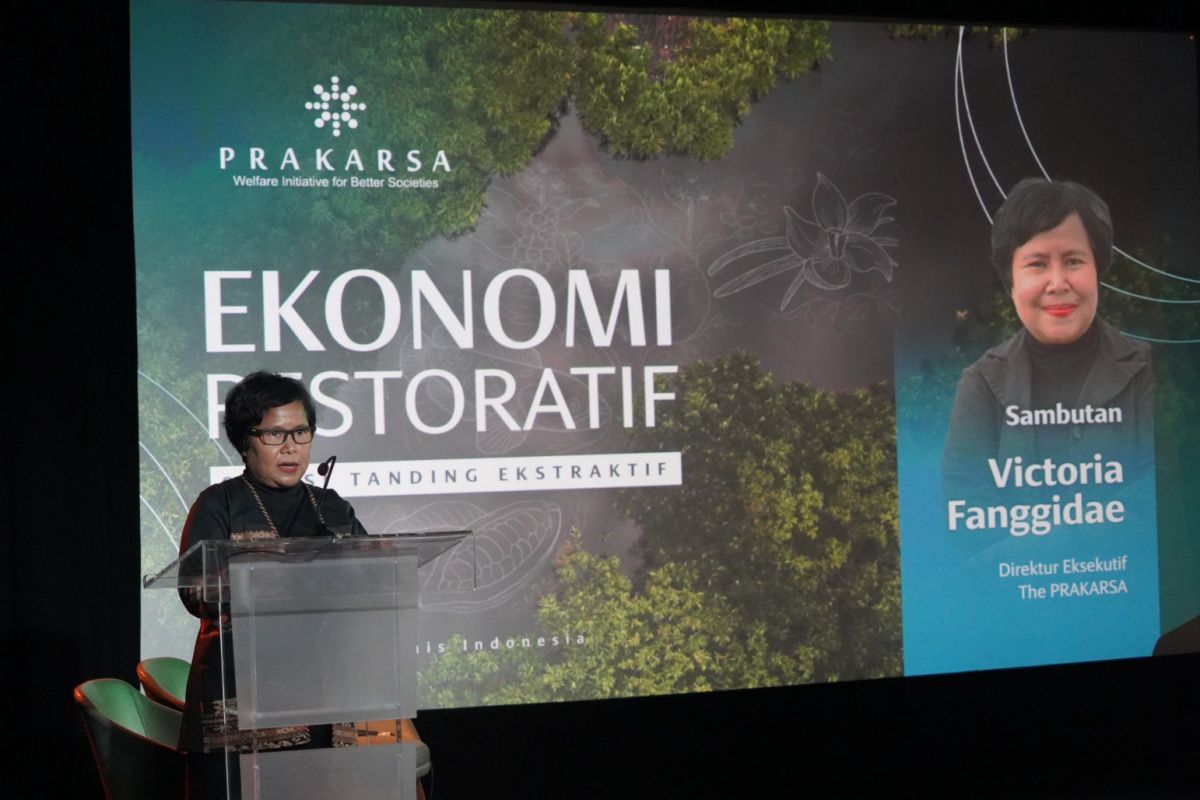
The restorative economy must become a development agenda capable of restoring nature, creating jobs, raising people’s incomes, and reducing dependence on the extractive economy.
Jakarta (ANTARA) - The PRAKARSA has stated that the restorative economy must be the primary choice in national development, as it can restore ecosystems, strengthen community livelihoods, and create sustainable economic value.
Executive Director of The PRAKARSA Victoria Fanggidae emphasised that the restorative economy — a development model that balances economic activity with environmental restoration — is no longer an option but a necessity.
“This is in line with the UN Decade on Ecosystem Restoration 2021-2030, Indonesia’s commitments in its Second NDC and the FOLU Net Sink 2030 target, and various other achievement targets,” Victoria said in a statement in Jakarta on Friday.
Victoria also stressed that a key finding of this research is that the restorative economy depends heavily on the strength of cross-party networks.
The PRAKARSA believes Indonesia already has many restorative initiatives that deserve to be scaled up. The next challenge is ensuring the state does not stop at targets and commitments, but builds the policies, financing, and institutions that allow local initiatives to become a real part of the national economic transformation.
“The restorative economy must become a development agenda that can restore nature, create jobs, increase people’s incomes, and reduce Indonesia’s dependence on extractive economic activities,” she said.
Minister of Environment Moh. Jumhur Hidayat reminded of the importance of a point of balance between growth maniacs (economic growth without regard for environmental impact) and blind environmentalists (environmental activism that is rigid or fanatical without considering socio-economic realities).
He emphasised that sustainable development is the best meeting point between economic growth, community welfare, and also the sustainability of nature.
“We are now in the second phase of (unconventional) development, which differs from the first phase in that our goal is to be more ‘intimate’ with nature while also generating economic value,” he added.
Director of Forest Enterprise Development and Utilisation at the Ministry of Forestry, Ilham, said the government is currently intensifying restoration projects, such as the rehabilitation of 12 million hectares of critical land, 8.3 million hectares of Social Forestry, and 1.4 million hectares of Customary Forests, in addition to Carbon Reduction covering 50 million hectares.
“The economic value that can be generated amounts to 13.4 billion tonnes of CO2, with total potential non-tax state revenue (PNBP) of Rp2 trillion,” he said.