
Pradi Supriatna Urges Expansion of Media Literacy to Schools
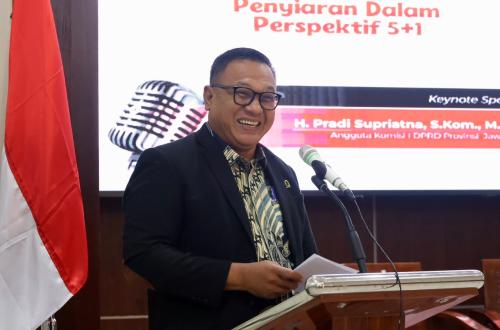
Pradi Supriatna, a member of Commission I of the West Java Regional House of Representatives (DPRD), stated that technological advancements have transformed how the public accesses and disseminates information. Whereas information previously underwent various stages of processing, it can now be accessed instantly via handheld devices.
“From a process-oriented approach, information is now at our fingertips. Anything can be viewed. Therefore, it is vital that we provide literacy to the public, especially to the youth of the future,” said Pradi after serving as a keynote speaker at a media literacy workshop held in Depok on Friday (18/09/2026).
According to Pradi, the public requires valid and educational information that can strengthen social cohesion amidst the heavy influx of global information. Media literacy is becoming increasingly critical for Millennials, Generation Z, and Generation Alpha, who are deeply integrated with digital technology and social media.
“Regulations are not yet in place, but the information has already arrived. We must ensure that inaccurate information does not become unhealthy consumption for the public,” he remarked.
He noted that incomplete information or fake news has the potential to cause misunderstandings. Consequently, the public must familiarise themselves with the practice of verification before accepting or sharing information.
Pradi encouraged the public to use the 5W+1H approach to scrutinise information, including tracing the source and the purpose of its dissemination. “Once this literacy is implemented and understood, we can certainly protect ourselves. For instance, when we receive information, we should not immediately re-share it. Find the source and ensure whether the information is true,” he said.
In addition to cities and regencies, Pradi is pushing for media literacy to be introduced into schools, specifically junior and senior high schools. He believes that schools are strategic environments for building the ability of the younger generation to filter information from an early age.
“We strongly encourage this, though it will certainly require support in terms of budgeting and other factors. We hope to begin at the junior and senior high school levels,” he added.
He expressed hope that collaboration between the West Java Regional Council for Broadcasting Ethics (KPID Jabar), local governments, the West Java DPRD, and educational institutions will continue to be strengthened so that the younger generation is well-equipped to face digital information developments.