
Practitioner Says Resort Business Model Determines Input Tax Credit Rights
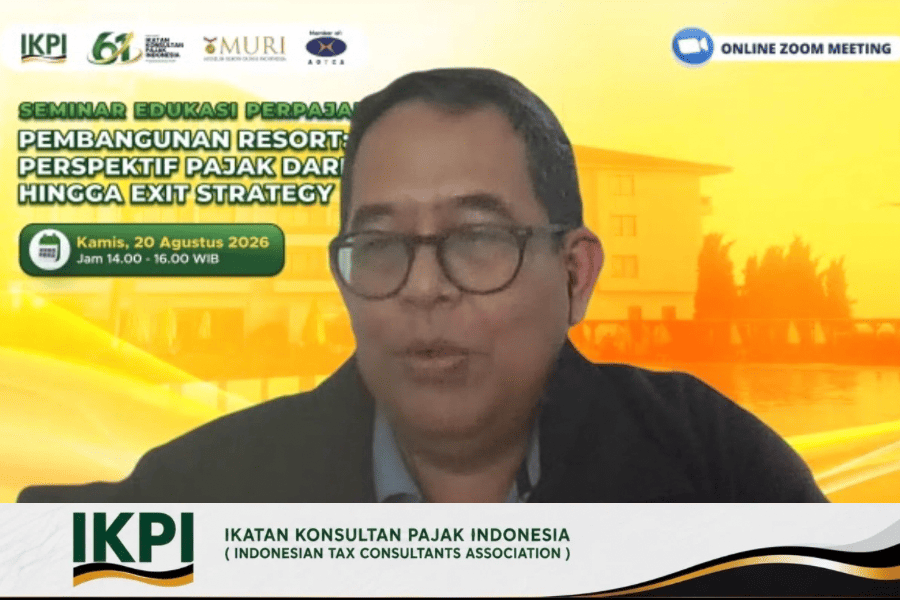
Tax practitioner and member of IKPI Denpasar Branch, Ketut Alit Adi Krisna, has said that the business model chosen in resort development determines the treatment of input Value Added Tax (VAT) credit rights. According to him, the difference between the traditional business model and the hybrid model not only affects the investment scheme but also determines whether input VAT on construction can be credited.
Adi made the remarks while speaking at an IKPI Tax Education Webinar themed ‘Resort Development: Tax Perspective from Start to Exit Strategy’, which was attended by around 450 participants from various backgrounds.
In his presentation, Adi explained that in the traditional business model, a company builds a hotel or villa along with supporting facilities to be managed itself as an accommodation business. Because hotel services are not subject to VAT, the treatment of input tax on construction is different.
He referred to the provisions of Article 9 paragraph (8) of the VAT Law, which stipulates that input tax cannot be credited if it is not related to a VAT-able supply. In the context of a traditional resort, VAT on construction, procurement of materials, and certain services cannot be credited because the supply of hotel services is not subject to VAT.
Conversely, in the hybrid model, the developer builds resort units or villas to sell to buyers, while the management of the units remains with a hotel operator. The sale of these units is a VAT-able supply, so input tax directly related to the production, marketing, distribution, and management processes can be credited as long as it meets the requirements.
‘This hybrid business model is currently popular and widely used,’ said Adi.
According to him, the hybrid model has developed because it offers two functions to buyers at once: as an asset that can be used personally for a certain period and as an investment instrument through profit sharing from the hotel operator’s management.
In addition to examining the VAT treatment, Adi outlined the tax stages that arise from land acquisition onwards. He explained that resort development does not always begin with the purchase of land by a company. In practice, land already owned by an investor can be contributed as company capital.
He reminded that the contribution of land as capital must use the fair value principle as stipulated in Article 34 of the Limited Liability Company Law. If a market price is not available, its value can be determined through an independent valuation, while valuation provisions for tax purposes are also regulated in PMK Number 79 of 2023.
Adi also highlighted changes in land tenure patterns in Bali. According to him, landowners in premium locations now tend to retain ownership and choose to lease land rather than sell it. Under this scheme, income from the rental of land and buildings is subject to final income tax of 10 percent, with a withholding mechanism that depends on the status of the lessee.
At the construction stage, he reminded of the importance of paying attention to tax provisions on construction services, whose rates differ according to the certification of the business entity and the competence of the service provider. He also touched on provisions regarding self-build activities, including the minimum building area of 200 square metres, which has its own VAT consequences.
Furthermore, Adi explained that tax treatment at the hotel operational stage is also not uniform. Accommodation services, including the provision of rooms, room service, laundry, extra beds, and certain facilities for guests, are subject to the Certain Goods and Services Tax (PBJT). Meanwhile, a number of other transactions such as the rental of space for certain commercial purposes and travel services may have different VAT treatment.
He also reminded that providing free accommodation to influencers or guests through promotional cooperation schemes does not mean being free from tax consequences. According to him, such transactions must still be viewed from the perspective of hotel revenue and the tax treatment of the benefits provided.
At the exit strategy stage, Adi explained that the form of the transaction will determine the type of tax imposed. He cited the sale of resort units as an example, which can give rise to income tax obligations on the transfer of rights, BPHTB, VAT, and other applicable provisions according to the nature of the transaction and the value of the object being traded.
According to Adi, understanding the transaction structure from the outset is key to ensuring that resort development is not only commercially viable but also compliant with tax provisions at every stage.