
Practitioner: Distance is a Crucial Aspect in Oil and Gas Field Development
Banda Aceh (ANTARA) - Indonesian oil and gas practitioner, Rudianto Rimbono, stated that distance and depth are among the vital aspects that must be considered in the development of oil and gas fields.
“Oil and gas development must take various aspects into account to ensure that the entire process, from exploration and exploitation to distribution, runs smoothly,” said Rudianto Rimbono in a statement in Banda Aceh on Friday.
For context, there are several oil and gas industrial fields in Aceh that are already in production, including Block A WK A managed by PT Medco E&P Malaka, WK B by PT Pema Global Energi (PGE), and WK Pase operated by Triangle Pase Inc.
Furthermore, a massive gas discovery has been made in the South Andaman block by Mubadala Energy. The production process for this discovery is still being decided between offshore or onshore methods.
Additionally, there are currently two oil and gas exploration sites. The first is in WK Bireuen-Sigui by PT Aceh Energy, followed by Conrad Asia Energy Ltd for the Offshore North West Aceh/ONWA (Meulaboh Block) and Offshore South West Aceh/OSWA (Singkil Block) working areas.
The former Deputy of Business Support Control and Head of Public Relations at SKK Migas explained that several factors must be considered in the development of gas fields, both offshore and onshore.
For offshore gas fields, Rudianto noted that sea conditions, water depth, reservoirs, and distance from the coast can influence development decisions.
“The distance between the offshore gas source and the mainland is an initial consideration in determining whether the gas is processed offshore or piped to land,” he said.
According to him, if a gas field is close to the mainland, onshore processing is generally considered cheaper by default. However, this assumption is not always true as onshore technical conditions must also be considered.
“Land conditions, such as swamps and protected areas, can become obstacles to facility construction,” said the President Commissioner of PT Energi Mega Persada Tbk.
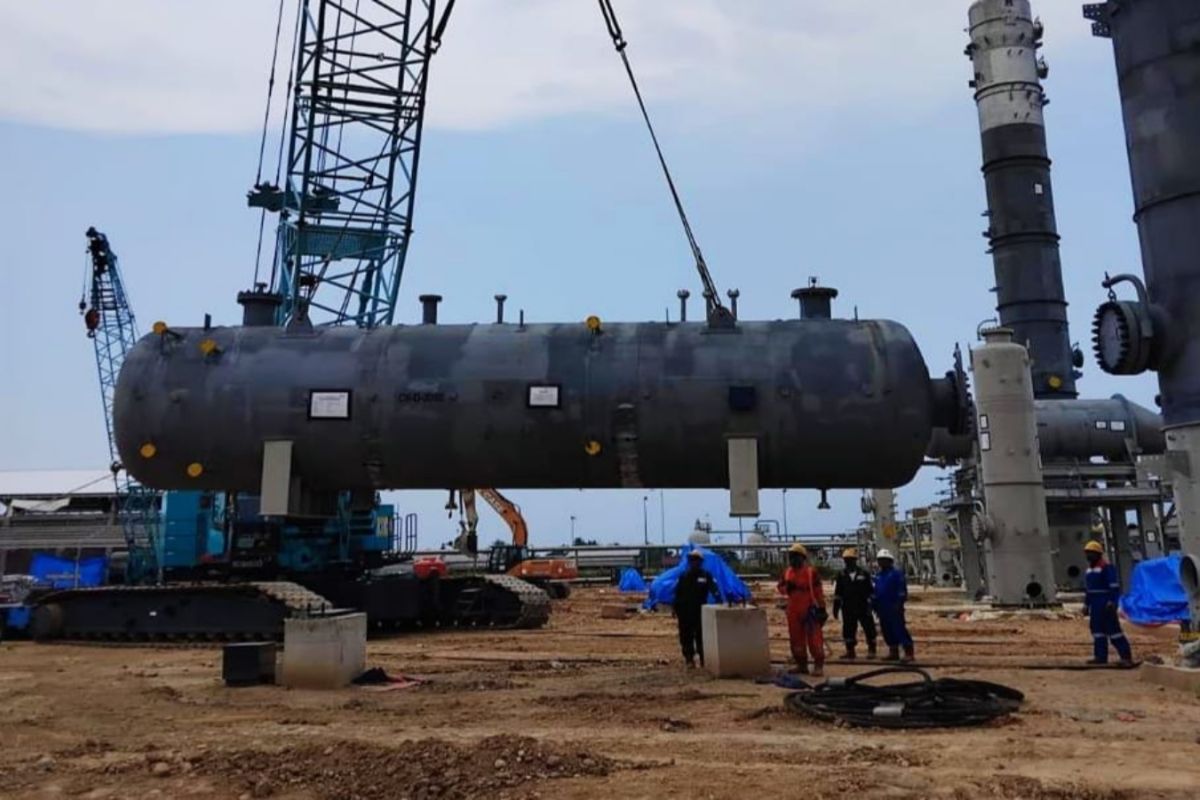
Rudianto noted that, in general, processing facilities are aimed to be as close to the reservoir as possible, because increasing distance can cause a drop in pressure, which could reduce the amount of reserves recoverable through natural flow.
To increase pressure, compressors are typically installed to ensure that the declining pressure can still be maintained.
“However, compressors certainly require supporting facilities to function effectively,” he added.
He continued that sea depth significantly affects costs and the choice of offshore facility types. In shallow waters, platforms can be built directly above the well location. However, in deep waters, the construction of platforms and foundations becomes more expensive.
“If the sea is too deep, the choices for offshore platforms—such as tension leg platforms orTLP, or TLP platforms—will be weighed against subsea wells,” said Rudianto.
He added that every technical alternative must be analysed alongside Capital Expenditure (Capex) and Operational Expenditure (Opex). Other aspects to consider include onshore conditions, local communities and social factors, as well as maritime traffic.
He noted that there are several options for gas processing before shipment. The first involves processing the gas to remove impurities, and then drying the gas without removing all impurities.
“If the gas has not been processed, it still contains many impurities, meaning the materials used for distribution must be specialised. One solution is to perform processing offshore first. Once the gas is processed, it can then be transported via pipeline,” concluded Rudianto Rimbono.