
Prabowo's Semester II-2026 Stimulus Package Totals Rp 26.34 Trillion
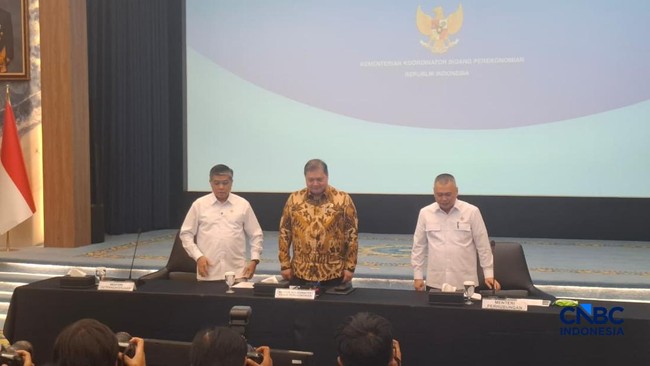
Jakarta, CNBC Indonesia - Coordinating Minister for Economic Affairs Airlangga Hartarto announced that the value of the stimulus package launched by the government in the second semester of 2026 reached Rp 26.34 trillion. The package is being rolled out to safeguard the domestic economy from the impact of global turmoil in the Middle East.
“The total stimulus issued by the government in this second semester amounts to approximately Rp 26.34 trillion, comprising transport stimulus of around Rp 2.04 trillion, internships of around Rp 6.26 trillion, and food assistance of Rp 18.04 trillion,” Airlangga said during a press conference at the Coordinating Ministry for Economic Affairs office on Monday (22/6/2026).
Today, the government announced six stimulus measures to be implemented in the second half of 2026. The following is a list of the six stimulus packages rolled out by President Prabowo Subianto’s administration:
- Writer Tax Incentive
The government is preparing an economic stimulus from the fiscal side. According to Airlangga, these policies are under the direction of the President. “One of the first main pillars is the writer tax, a final PPh royalty of 1.5% for writers, compared to the existing rate of 35%,” Airlangga stated. The government is implementing a special incentive for writers in the form of a reduction in the final Income Tax (PPh) on royalties to 1.5%. This incentive policy applies to written works possessing an official ISBN, replacing the normal/progressive tax scheme (ranging from 5% to 35%).
- Zero Percent Import Duty for LPG
The government has set a 0% import duty for LPG destined for the petrochemical industry. Airlangga stated that this incentive is a direct directive from the President. The incentive is believed to provide an economic benefit valued at Rp 2.2 trillion. “With this, it is hoped that an economic benefit of Rp 2.2 trillion can be obtained, in the form of reduced industrial costs and a multiplier effect,” Airlangga explained.
- Transport Discounts
- School Holiday Incentive:
School Holiday Period Transport Discounts: A 30% fare reduction for train tickets (20 June-5 July) and a 30% reduction on the base fare for Pelni ships (20 June-15 August), along with free port service fees at ASDP (20 June-5 July), with a budget of Rp 190.5 billion targeting 3 million passengers.
Air Transport Holiday Incentive: A full 100% VAT subsidy on scheduled domestic economy class flight tickets, with a budget of Rp 472.7 billion targeting 2.3 million passengers.
- Christmas and New Year 2026/2027 Incentives:
Nataru Holiday Period Transport Discounts: A 30% fare reduction for train tickets (22 December 2026-4 January 2027) and a 30% reduction on the base fare for Pelni ships (17 December 2026-10 January 2027), along with free port service fees at ASDP (22 December 2026-10 January 2027), with a budget of Rp 161.4 billion targeting 2.8 million passengers.
Nataru Air Transport Incentive: A full 100% VAT subsidy on scheduled domestic economy class flight tickets, with a budget of Rp 722 billion targeting 3.7 million passengers.
National Internship Programme
The National Internship Programme, or MagangHub, will be continued in the second half of this year. “The internship programme will be pushed in the second half, so that it becomes a driver of the people’s economy,” Airlangga said. He noted that the programme will commence in July 2026 with a fund allocation of Rp 4.14 trillion, targeting a total of 150,000 participants.
- Food Assistance
Airlangga confirmed that food assistance will be continued for the next three months. This assistance consists of 10 kilograms of rice per month, starting in July 2026. The estimated budget is Rp 17.54 trillion, excluding operational costs.
- Food Price and Supply Stabilisation Assistance (SPHP)
This soybean SPHP assistance was previously announced. The subsidy is provided to tofu or tempeh producers at a maximum of Rp 2,000 per kilogram for a total quota of 250,000 tonnes in this first phase, targeting regions where soybean prices exceed the Purchase Reference Price (HAP), with a budget of Rp 500 billion.