
Prabowo’s Palace Speech: From His Broad Coalition to His Anger with MSCI
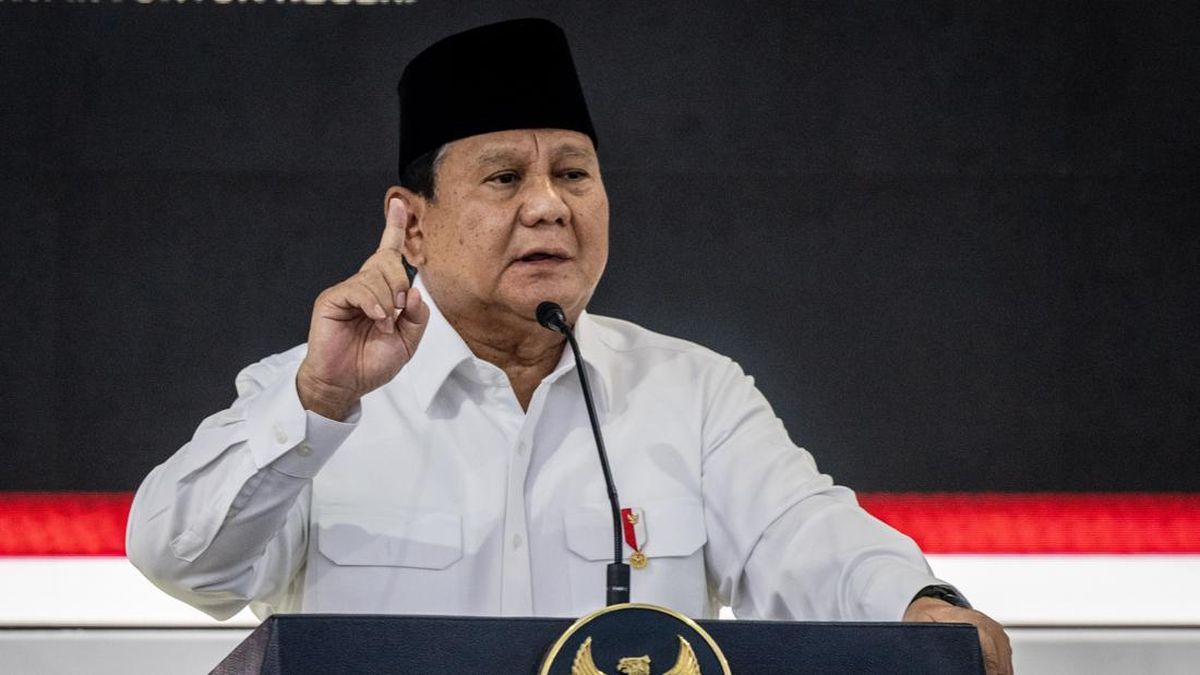
President Prabowo Subianto delivered a speech at a plenary Cabinet meeting at the Presidential Palace in Jakarta on Wednesday (21 October).
In his briefing, Prabowo addressed a range of political and economic issues concerning Indonesia. He praised the performance of his ministers, describing it as satisfactory during the first two years of his leadership, and said the Merah Putih Cabinet had worked hard and done its best for the Indonesian people.
Prabowo said his government had faced significant challenges, including global tensions, open warfare and trade wars.
“As your leader, entrusted with a mandate by the people, I feel that you, as my key aides, have carried out your duties for the nation and the people. I feel that you have worked very hard,” Prabowo said.
Defending a broad coalition
In his speech, Prabowo acknowledged that his political coalition was very large. He said this reflected his intention to bring as many political forces together as possible to improve people’s lives.
“Our coalition is large, that is true, because I want as many forces as possible to unite in order to improve the lives of our people,” he said.
Prabowo said one of Indonesia’s weaknesses was that its elites remained divided and put sectoral interests first. He also acknowledged that political competition in a country as large as Indonesia could be intense, while the number of leadership positions was limited.
“They accuse us of having an oversized Cabinet, don’t they, and of being inefficient. But I remind you that our country has almost 300 million people and is physically as large as Europe,” he said.
Prabowo said differences and competition were necessary in a democracy, but that national unity was also essential. He referred to what he described as chaos in Western countries, including Europe.
“If we follow Western-style democracy, just look at the television news: what is happening every day in France, Italy and Europe, the birthplace of democracy that taught us about human rights,” he said.
Indonesia ‘constantly’ facing foreign interference
Prabowo also said that foreign powers had often intervened in past rebellions because, he claimed, they did not want Indonesia to become a developed country.
“Major nations have always intervened, always troubled us, always incited division, financed rebellions and riots, and set us against one another,” he said.
He cited several movements and rebellions, including Darul Islam/Indonesian Islamic Army (DI/TII), the Army of the Righteous King (APRA), the Republic of South Maluku (RMS), the Revolutionary Government of the Republic of Indonesia/Universal Struggle (PRRI/Permesta), and the 1948 Madiun uprising.
Prabowo said Indonesia had nevertheless remained strong and resilient. He recalled that in 1997 and 1998 many people predicted the country would soon break apart, but that those predictions had proved wrong.
Food and trade as weapons
Prabowo warned that food could now be used as a weapon in global competition. He said changing international conditions required Indonesia to consider the links between economic, political and defence interests.
“Currency is now a weapon. Exports and imports are now weapons. Food is now a weapon; rice is a weapon. So we cannot view business as purely business,” Prabowo said.
He said that from the beginning of his government, and even before he was formally inaugurated, when he was defence minister under President Joko Widodo, he had sought to maintain good relations with neighbouring countries.
Forest and land fires blamed on human activity
Prabowo said forest and land fires affecting parts of Indonesia were not purely natural events and had been caused in part by human activity. He ordered the police and intelligence agencies to investigate companies and others considered responsible.
“We regard this as environmental terrorism, a crime against humanity, because what they are doing is endangering the health of millions of our people,” he said.
Prabowo instructed his ministers to revoke all permits held by companies found to have violated the law or been involved in the fires.
“We must not take this lightly. We will now deal with it on a massive scale, and we will investigate it thoroughly. This time, I’m afraid, we can no longer act as usual. If the evidence is clear, we will act and revoke the permits of all companies that have violated the rules,” he said.
Prabowo takes aim at MSCI
On the economy, Prabowo sent an open message to global index provider Morgan Stanley Capital International (MSCI) amid the threat of a downgrade to Indonesia’s capital market status. He said Indonesia would not be intimidated by pressure, while acknowledging that the country still faced major challenges and disruption.
“MSCI wants to scare us. I would only say to MSCI: the Indonesian nation fears no one and will not be daunted,” Prabowo said.
He said the government recognised that many challenges remained and that the public expected greater results. Disruptions would continue to arise, he said, but Indonesia had to face them with resolve.
Prabowo’s remarks came after MSCI announced on 16 October 2026 a proposal to reclassify Indonesia from an emerging market to a standalone market. A final decision is due by 30 June 2027 at the latest.
MSCI said the proposal reflected market participants’ concerns about transparency in share ownership structures and alleged coordinated trading. It also said reforms announced by Indonesian authorities had not yet shown consistent progress or a significant impact.