
Prabowo's Giant Sea Wall Dream: What Does the Netherlands' Massive Dyke Look Like?
The construction of the Giant Sea Wall along the north coast of Java has become one of the major projects highlighted by President Prabowo Subianto in his speech on the Financial Note and the 2027 State Revenue and Expenditure Budget Draft on Friday (14/8/2026).
Based on the government’s presentation, the Giant Sea Wall is designed to stretch 575 kilometres along Java’s north coast with an estimated cost of around US$100 billion or approximately Rp 1,800 trillion (US$1 = Rp 18,000). The project, planned to be divided into 15 segments, is expected to require 15 to 20 years of construction.
‘A large dyke to secure the north coast of Java is absolutely necessary. We must not wait for disaster to come; we must learn from other countries such as the Netherlands, which built long-term protection infrastructure without waiting for disaster,’ Prabowo said at the MPR/DPR RI Building in Senayan, Jakarta, on Friday (14/8/2026).
‘This project will take 15 to 20 years to complete. That is a long time; I do not know which president will inaugurate it. I am determined that the 8th president will start this project,’ he added.
The Giant Sea Wall is intended to protect around 50 million coastal residents along the north coast. The area also contributes around 38% of Indonesia’s GDP and is home to 70 industrial estates, five economic zones, and the national logistics corridor.
However, Prabowo stressed that the project will not merely be a coastal protection dyke. The Giant Sea Wall is also designed to become clean water infrastructure, a new growth corridor, and an engineering project that develops national technological capabilities.
‘Moreover, our Giant Sea Wall on the north coast must become clean water infrastructure, must become a new growth corridor, a project engineered by the nation’s own people,’ Prabowo explained.
In his speech, Prabowo cited the Netherlands as one of the countries that can serve as an example.
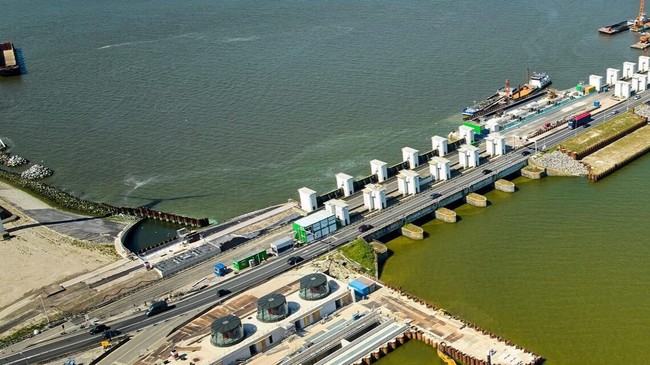
One of the most famous water protection projects in the Netherlands is the Afsluitdijk, a 32-kilometre dyke separating the Wadden Sea and the IJsselmeer. The infrastructure has protected parts of the Netherlands from sea flooding since 1932.
The Afsluitdijk is one of the most iconic water engineering projects in the Netherlands, separating the Wadden Sea from Lake IJssel (IJsselmeer).
The construction of the Afsluitdijk cannot be separated from the threat of sea flooding that has long haunted the Netherlands. One turning point occurred in 1916, when a major flood struck the Netherlands, causing casualties, leaving thousands homeless, and resulting in economic losses.
The disaster prompted the Dutch government to take a major step. In 1918, the government passed the Zuiderzeewet, a law that became the basis for a project to close off the Zuiderzee, control water, and simultaneously create a freshwater area and new land.
Construction of the Afsluitdijk then began in the 1920s. After years of work, the final section of the dyke was closed on 28 May 1932.
Since then, the Afsluitdijk has not only become the Netherlands’ fortress against the sea but also an example of how flood protection infrastructure can be designed as a long-term project.
However, more than 90 years after its construction, the Afsluitdijk now has a much broader function than merely a dyke.
The Afsluitdijk combines a flood protection system with water management. The Netherlands is improving the discharge capacity from the IJsselmeer to the Wadden Sea through additional sluice gates and high-capacity pumping stations.
The dyke also serves as a transport corridor because the A7 motorway connects Noord-Holland and Friesland via the Afsluitdijk. The area is also used for the development of energy technology based on wind, solar, and water, as well as the meeting point of fresh and salt water.
The Netherlands has also faced ecological consequences from the construction of the Afsluitdijk. The separation of the saltwater Wadden Sea and the freshwater IJsselmeer has hindered fish migration. To address this, a Fish Migration River is now being built, an artificial river that allows fish to migrate between the two bodies of water without reducing the flood protection function.
The Afsluitdijk experience shows that large-scale sea dykes can be developed into multifunctional infrastructure. However, such projects also require adaptation and long-term management. The Afsluitdijk itself continues to be reinforced after more than nine decades to face rising sea levels and extreme weather.
Prabowo estimates that the construction of the Giant Sea Wall along the north coast will take a long time. Although the process is lengthy, he stressed that the project must begin immediately. ‘We must not wait for disaster to come,’ Prabowo said.
He even admitted he does not yet know which president will eventually inaugurate the project. However, as Indonesia’s 8th president, Prabowo stressed that he is determined to be the president who starts the construction of the Giant Sea Wall.