
Prabowo's Complete Directives to Purbaya and BI Chief Following Dollar at Rp17,400
The rupiah exchange rate closed at its all-time weakest level against the US dollar on Tuesday (5/5/2026) trading. This pressure occurred alongside the announcement of Indonesia’s first-quarter 2026 economic growth data.
According to Refinitiv data, the rupiah closed 0.26% weaker at Rp17,410/US$. This position also became the rupiah’s weakest closing level ever.
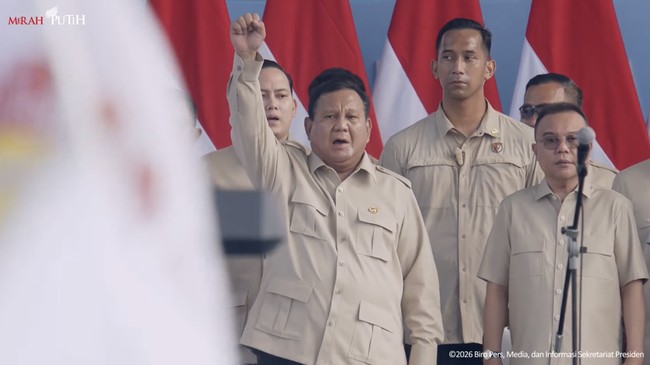
This matter drew attention from President Prabowo Subianto. In a limited meeting of ministers from the Red and White Cabinet and the Financial System Stability Committee (KSSK) at Merdeka Palace, Jakarta, on Tuesday (5/5/2026).
According to Coordinating Minister for the Economy Airlangga Hartarto, the President highlighted the dynamics of capital outflows occurring in the financial markets. Therefore, the government, together with relevant authorities, has examined the causal factors and prepared mitigation steps against this condition.
“And it was agreed earlier, reported to Mr President, an agreement of cooperation between BI and the Minister of Finance so that going forward this can be maintained regarding capital outflow,” said Airlangga, quoted on Wednesday (6/5/2026).
Bank Indonesia Governor Perry Warjiyo added that inflows to Indonesia’s financial markets have already begun. However, compared year-to-date, the condition is still an outflow.
“Meanwhile, stocks experienced an outflow, so we agreed for now to make SRBI need inflows, so that SRBI’s inflows can cover the outflows from SBN and stocks. That is our coordination with the Minister of Finance, so as to truly maintain foreign portfolio inflows which year-to-date are still inflows and that strengthens the rupiah exchange rate,” said Perry.
Therefore, BI has set seven steps that the central bank will take to curb capital outflows while safeguarding the rupiah.
First, BI continues to intervene in the foreign exchange market, both domestically through spot and domestic delivery transactions, and abroad through non-delivery forward (NDF) instruments. Interventions are carried out in several global financial centres such as Hong Kong, Singapore, London, and New York.
“We will continue to carry out spot and domestic delivery interventions domestically and also non-delivery forwards in overseas markets,” Perry emphasised.
Second, BI and the Ministry of Finance are encouraging foreign fund inflows through SRBI instruments to cover outflows from SBN and the stock market. Third, Perry revealed BI’s commitment to continue purchasing SBN in the secondary market to maintain bond market stability. To date, BI’s SBN purchases have reached Rp123.1 trillion year-to-date.
Fourth, Perry continued, BI will keep banking and market liquidity loose. According to BI, indications of loose liquidity are already reflected in double-digit primary money growth.
“We also, with the Minister of Finance, are keeping liquidity in banking and markets more than sufficient, indicated by primary money growth that is always double-digit. The latest primary money growth is 14.1%,” he said.
Next, Perry stated that BI will limit US dollar purchases in the domestic market without underlying from the previous US$100,000 to US$50,000 per person per month. This step is taken to maintain rupiah stability and curb speculators.
“So dollar purchases up to or above 25,000 must use underlying. That is what we will strengthen domestically,” said Perry.
Sixth, BI will continue to strengthen offshore market interventions through NDF by expanding domestic bank participation to conduct transactions abroad.
“In addition to the interventions we continue to carry out, we also allow domestic banks to participate in selling offshore NDF abroad so that the supply is greater, thus strengthening the stabilisation of the rupiah exchange rate,” he said.
Finally, BI will increase supervision of dollar buying activities by banks and corporations. Perry said the supervision is conducted jointly with OJK to ensure financial system stability remains intact.
“We send supervisors there, coordination with Ms Friderica Widyasari,” he said.
Finance Minister Purbaya added that the Ministry of Finance will issue debt securities denominated in Chinese yuan, or Panda Bonds. This policy is taken to reduce reliance on the US dollar.
“So we are not too dependent on the dollar anymore. So our diversification will be better going forward. So our prospects are good, no need to be afraid. Mr President also told me earlier to convey the message that my money is sufficient, there’s plenty of money. So you don’t need to be afraid,” Purbaya emphasised.
Regarding the capital market, Purbaya said Indonesia’s economic growth is experiencing acceleration. He assured that Indonesia can now turn around its economy.
Therefore, he added, investors who choose to stay in Indonesia’s capital market and accumulate purchases will gain big profits.
“Compared to before, 5 or slightly below 5, right. So our economy is experiencing acceleration. That’s what many people don’t realise, so people are a bit scared and exit the capital market,” said Purbaya after a meeting with President Prabowo Subianto at the State Palace on Tuesday (5/5/2026) evening.
“I said before, scoop, scoop, scoop it up. If they follow, they should profit a lot going forward,” he said.
He also emphasised that the government will focus on maintaining economic growth in the second quarter of 2026. Including through continued economic stimulus.
“What is clear is that the economy is heading towards faster growth figures and we will maintain it for the second quarter with various policies, coordination with the Central Bank also maintaining system liquidity conditions,” said Purbaya.