
Prabowo's Brother Wants to Turn CO2 into a High-Value Asset
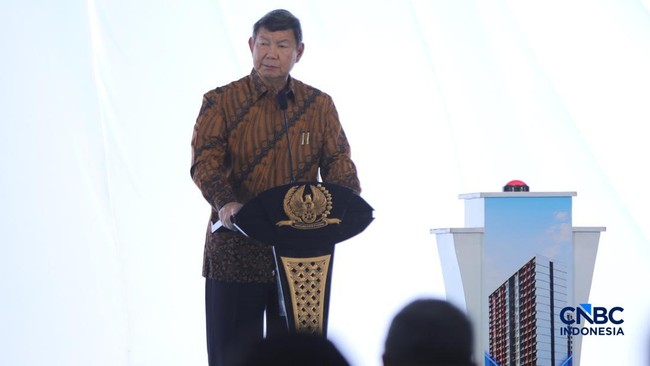
The government is committed to achieving net zero emissions by 2060. However, the President’s Special Envoy for Climate and Energy, Hashim Djojohadikusumo, acknowledged that Indonesia’s economic growth is inseparable from its abundant natural resources, including its mineral wealth.
Hashim expressed optimism that the Indonesian government can continue to pursue the net zero emission target for 2060 without sacrificing the national economic growth agenda, which is targeted to reach 8%. “Mr Prabowo feels that we can accelerate it, but Indonesia does not want to commit economic suicide. We want to have growth of at least 8% in the coming years, and one of the ways is by utilising and using everything we have, including fossil fuels and energy sources,” he said at the International Indonesia CCS Forum 2026 at Hotel Mulia Jakarta on Wednesday (26/8/2026).
Hashim explained that amid dependence on natural resources, he sees carbon capture, utilisation and storage (CCUS) technology as one of the solutions to maintain the energy industry while reducing emissions. He outlined that technological development can begin by changing the perspective on carbon dioxide (CO2). If CO2 has so far been considered a burden for industry, particularly the oil and gas industry, the gas now has the potential to be utilised as a raw material to produce economically valuable products.
He further explained that microalgae can be developed to produce biofuel as well as animal feed. A number of experiments have also been carried out to utilise CO2 in microalgae production. According to him, CO2 can actually increase microalgae production. This is supported by Indonesia’s geographical conditions, which offer several advantages for developing the industry. One of them is Indonesia’s position on the equator, which provides abundant sunlight exposure, in addition to the availability of water, land and labour as supporting capital.
Hashim noted that a previous obstacle was the limited availability of cheap carbon dioxide sources. With new technology, CO2 from industrial activity can become one of the inputs for microalgae production. “So those of you who produce or try to produce gas but see carbon dioxide as a major problem, that is the answer for you. That is the answer for Exxon, the answer for Pertamina, the answer for everyone here who faces the problem,” he said.
Hashim even sees the opportunity as capable of changing the position of CO2 in the energy industry. The gas that has so far been a problem for oil and gas companies, according to him, can turn into an economic asset. “In fact, your carbon dioxide will become a positive asset, not a liability on your balance sheet. This is something I want to share with you,” he said.
The utilisation of microalgae, he continued, not only has the potential to produce biofuel and animal feed. The technology can also be used to produce spirulina and chlorella, which have high protein content and can be utilised as a source of food and feed.
In addition to CO2 utilisation through microalgae, the development of carbon capture technology was also demonstrated through an experiment with Japanese technology at Petrokimia Gresik. Hashim said the technology was reported to be capable of reducing carbon emissions by around 90%-95%. “One of them is a new technology reported to me by our Minister of Industry, Mr Agus Gumiwang. The Minister of Industry, through one of the companies under his purview, conducted an experiment with technology from Japan, a carbon capture technology at Petrokimia Gresik, which is one of our fertiliser companies,” he said. “This technology is capable of reducing carbon emissions by 90% - 95%,” he added.
Interestingly, Hashim said, the process also produces a by-product in the form of baking soda or soda ash. Hashim noted that Indonesia still imports these products, so the use of carbon capture technology has the potential to create additional economic value. In fact, a number of Japanese companies have reportedly shown interest in taking the by-product for re-export to other countries.
According to Hashim, similar technology in the future can be applied not only to industrial facilities or fertiliser plants. The technology also has the potential to be used at coal-fired power plants operated by PT PLN (Persero). “So this is something that I think is a reason for optimism, the fact that we can actually install similar devices, not only in factories or fertiliser plants, but also in coal-fired steam power plants operated by PLN and by private companies, the independent power producers,” he concluded.