
Prabowo’s Big Plan to Rival China and Make Indonesia the World’s Top Fish Producer
Jakarta, CNBC Indonesia – With around 70% of its territory comprising seas, Indonesia has enormous potential in its marine economy. Yet its fisheries production remains far behind China’s.
Data from the Ministry of Marine Affairs and Fisheries show that China averaged about 86 million tonnes of fisheries production a year between 2019 and 2023. Indonesia’s production stood at 22.32 million tonnes a year.
India ranked third, at about 14.8 million tonnes a year, followed by Vietnam with 8.23 million tonnes.
Fisheries production consists of capture fisheries, aquaculture and seaweed production.
Notably, aquaculture accounts for the largest share of fisheries production in China, India and Vietnam. In Indonesia, production is still dominated by fish caught at sea.
The government led by Prabowo Subianto, through the Ministry of Marine Affairs and Fisheries, therefore has major plans to develop the fisheries economy, particularly aquaculture.
From 2025 to 2029, Marine Affairs and Fisheries Minister Sakti Wahyu Trenggono said the government would revitalise 14,000 hectares of fish farms on Java’s north coast (Pantura). During the same period, it would also establish 2,000 hectares of integrated shrimp-farming areas.
“Growth in the world’s population will increase demand for food,” Trenggono said at a meeting at his office on Thursday (29 October 2026).
In his presentation, Trenggono said the world’s population was projected to rise from 8.23 billion in 2025 to 9.66 billion in 2050. This increase would raise global food demand by 50–60%, while demand for meat and fish protein would grow by as much as 67%.
Global demand for fish is expected to rise by 66% to 179 million tonnes as a result of population growth.
In Indonesia, Trenggono’s data show, the population is projected to increase from 285.7 million in 2025 to 320.7 million in 2050. This would bring protein requirements to 7.62 million tonnes a year, equivalent to 35 million tonnes of fresh fish.
Trenggono said land-based food systems would become increasingly constrained. This is because more than 100,000 hectares of rice fields are converted each year. Indonesia’s rice-field area is forecast to shrink to just 5.1 million hectares by 2045.
Revitalising fish farms on Java’s north coast
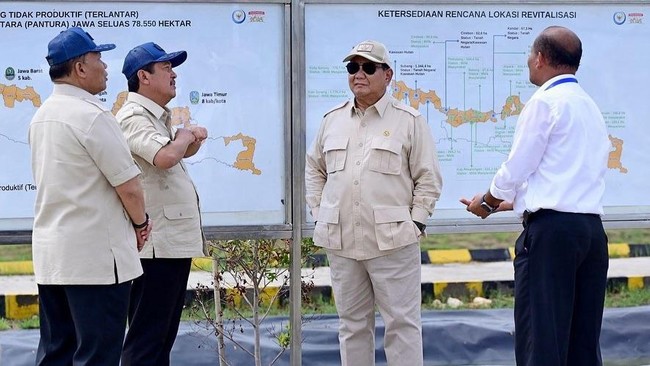
One major programme being carried out by the Ministry of Marine Affairs and Fisheries in 2025–2027 is the revitalisation of 78,550 hectares of idle fish farms on Java’s north coast to make them more productive.
Trenggono outlined the programme’s stages. “In 2025, 20,000 hectares will be revitalised, with a production target of 1.56 million tonnes. In 2026, it will be 30,000 hectares, with a target of 2.34 million tonnes. Then in 2027, 28,550 hectares, with a target of 2.22 million tonnes,” he said. The revitalisation of 78,550 hectares is expected to yield 6.1 million tonnes of fish, worth a substantial Rp162.24 trillion per harvest cycle.
The large-scale pond revitalisation programme will cover almost every province along Java’s north coast: Banten (1,800 hectares), West Java (34,500 hectares), Central Java (15,250 hectares) and East Java (27,000 hectares).
Trenggono said the programme would raise fisheries productivity to 130 tonnes per hectare of production area per cycle and employ around 40,000 people. It would spur economic growth and create upstream and downstream industries for fish-based products.
He stressed that the programme would not involve clearing the environment. As an example, he cited the initial design for Phase I of the fish-farm revitalisation in four West Java regencies—Bekasi, Karawang, Subang and Indramayu—covering 14,090 hectares. Of this area, 7,882 hectares (56%) would be used for fish farming and the remaining 6,246 hectares (44%) for mangroves.
Under the revitalisation plan, Trenggono said the government would strengthen the ecosystem through mangrove restoration and the development of production ponds, reservoirs and other facilities. It would also build area infrastructure, including roads, embankments, green spaces and offices, as well as supporting industrial facilities.
If successfully implemented, the programme could have a major economic impact on the four regencies. Farmed-fish production could reach 402,000 tonnes a year: 86,000 tonnes in Bekasi, 239,000 tonnes in Karawang, 16,000 tonnes in Subang and 61,000 tonnes in Indramayu. The value of production is estimated at US$1.2 billion a year, or around Rp20 trillion.
The programme is projected to create 83,300 jobs across the four regencies. “This will foster upstream industries such as feed and improved seed, as well as downstream industries such as fish processing and cold-chain logistics,” Trenggono said.
However, the programme also faces challenges. Trenggono said that fish farming on this scale would require billions of fish fry, which Indonesia is currently unable to produce in sufficient quantities.
Shrimp farms in eastern Indonesia
The second aquaculture programme the Prabowo government plans to develop in 2025–2027 is a 2,000-hectare integrated shrimp-farming area in Waingapu, East Sumba. It is located in Palakahembi village and Watumbaka urban ward, Pandawai district, East Sumba regency, East Nusa Tenggara (NTT).
Trenggono said the programme aims to produce 52,000 tonnes of shrimp a year, worth US$240 million, or around Rp4 trillion. It is expected to employ 7,000 people.
Trenggono also said the government established a model area-based shrimp-farming project in Kebumen, Central Java, in 2023, covering 75 hectares. Productivity rose from 0.6 tonnes per hectare per cycle to 40 tonnes per hectare per cycle. Shrimp exports also increased, alongside employment and farmers’ welfare. Supporting facilities for production and post-production were developed in the area. The government plans to replicate this model at the Waingapu shrimp farms.
Thematic inland fish farming (Mini Recirculating Aquaculture System/Mini RAS)
Finally, Trenggono said the government would establish thematic inland fish-farming sites at 40,000 locations across Indonesia by 2029. The species to be farmed include tilapia, jade perch, pangasius, barramundi and grouper.
The programme aims to increase Indonesia’s fisheries production by 1.2 million tonnes a year by 2029, with an estimated value of Rp28.8 trillion a year. Trenggono expects it to create around 80,000 jobs.
By 2026, the government plans to have established 2,000 thematic inland fish-farming sites, with pilot models in Java and Lampung. This year, the programme is estimated to produce 60,000 tonnes of fish worth Rp1.44 trillion and employ 4,000 people.
The remaining challenges include the need for 5.03 billion fish fry, which cannot yet be supplied domestically, as well as 62,000 tonnes of fish feed.
Source: jawawa.id (https://jawawa.id/newsitem/prabowos-big-plan-to-rival-china-and-make-indonesia-the-worlds-top-fish-producer-1793357555)
Originally published by CNBC Indonesia (https://www.cnbcindonesia.com/news/20261030135605-4-780932/rencana-besar-prabowo-saingi-china-bikin-ri-penghasil-ikan-terbesar), translated from Indonesian