
Prabowo's 100 Gigawatt Solar Power Project: Where Will the Electricity Go?
Jakarta - The Ministry of Energy and Mineral Resources (ESDM) has outlined plans to absorb electricity generated from the planned construction of Solar Power Plants (PLTS) with a total capacity of 100 Gigawatts (GW) over the next three years. The massive programme is a directive from President Prabowo Subianto.
Director General of New, Renewable Energy and Energy Conservation (Dirjen EBTKE) at the Ministry of ESDM, Eniya Listiani Dewi, stated that the government will create demand domestically. The accelerated PLTS programme will also be synergised with national industrialisation and energy transition programmes.
“The final element is demand creation. So, when we implement the 100 GW PLTS, which will be spread across various regions, we must also introduce downstreaming programmes to increase electricity demand through electric vehicles, carrying out electric vehicle conversions, and also encouraging the increased use of electric stoves,” she said during a Hearing Meeting (RDP) with Commission XII of the House of Representatives (DPR RI) in Jakarta on Thursday.
The government targets accelerating the development of this solar power absorption starting in 2027. The strategy includes efforts to accelerate the adoption of electric vehicles and the utilisation of electric household appliances.
“And this will be a programme that will also be implemented in 2027,” Eniya emphasised.
Additionally, the government is promoting a de-dieselisation programme that combines PLTS with battery systems to replace Diesel Power Plants (PLTD).
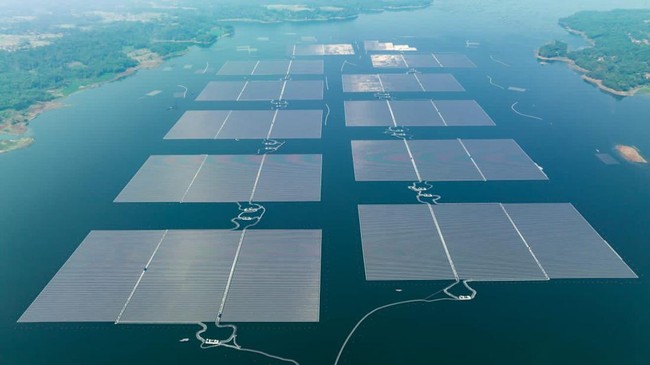
“Within this, we are also collaborating with the Ministry of Public Works for the development of floating PLTS and hydropower plants (PLTA). Floating PLTS is one of our efforts to realise the 100 GW PLTS. In addition, off-grid PLTS is also a component that can support the realisation of 100 GW,” she added.
To achieve the solar power implementation target, the government is finalising regulations in the form of a Presidential Regulation (Perpres) and revising the pricing for new and renewable energy. This is aimed at simplifying business processes and attracting large-scale private investment to achieve the national energy mix target.
“The strategy being built by the government currently to face the challenges of global geopolitical conditions, we are targeting the renewable energy mix achievement range for 2026 to be 17-21%,” she concluded.