
Prabowo's 10 Major Breakthroughs for 2027: From Community Health Centres to Dual Citizenship
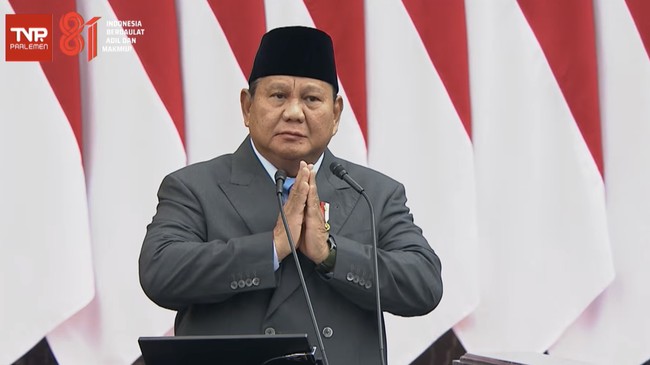
President Prabowo Subianto has prepared ten major transformation drives that the government will implement from 2027. The agenda stretches from health and education services to state asset management, energy, development financing, and dual citizenship.
The plans were delivered by Prabowo in his speech presenting the 2027 State Budget Bill (RAPBN) and its Financial Note at the Parliament Complex in Senayan, Jakarta, on Friday (14/8/2026). Some agendas are targeted to run in 2027, while several programmes are designed to extend beyond that period. The government wants the transformation to deliver measurable results, not merely enlarge the budget.
Prabowo stressed that all agendas must have accountable benefits. The government does not want projects with large budgets that only produce small impacts. “Every rupiah must have a purpose, every policy must have a measure and accountability,” he said.
The following are the ten major transformation drives presented by Prabowo:
- Renovation of 10,000 Community Health Centres
The first agenda touches the health facilities closest to the population. In 2027, the government plans to renovate 10,000 community health centres (puskesmas) spread across 7,285 sub-districts. Each puskesmas will receive a budget of Rp4 billion. Facilities in remote, outermost, and underdeveloped regions are planned to receive greater support according to their needs.
The government will also renovate around 514 public health laboratories (labkesmas) across all regencies and cities. The entire puskesmas renovation programme is targeted for completion by 2030 at the latest.
Prabowo emphasised that access to basic health services must not be hindered by distance. The government is therefore preparing air ambulances using helicopters and small aircraft that can land on grass fields, beaches, or riverbanks. Flying doctor teams are also included in the plan for services in remote areas. The idea was put forward after Prabowo received reports of pregnant women having to travel seven to nine hours to obtain childbirth assistance.
- Construction and Revitalisation of 441 Regional General Hospitals
From community health centres, the improvements continue to regional hospitals. The government is targeting the construction and revitalisation of 441 regional general hospitals (RSUD). As an initial step, 66 hospitals have been built in underdeveloped, frontier, and outermost (3T) regions. Of that number, 22 hospitals are now operational.
The facilities are equipped with cardiac examination equipment, CT scans, mammography, ultrasonography, and modern health services. RSUD revitalisation will be prioritised to handle cancer, heart disease, stroke, kidney disorders, and maternal and child health services. Facility improvements will also be accompanied by the addition of medical personnel.
Based on figures presented by President Prabowo, Indonesia still needs 84,781 general practitioners, 127,580 dentists, and 55,712 specialist doctors across 481 regencies and cities. The government has opened nine new medical faculties, both university-based and hospital-based, to help address the shortage.
- School Renovation
In the education sector, the government has set 2029 as the final deadline for completing the renovation of all schools requiring repairs. Implementation will be accelerated in 2027 and 2028. The programme targets schools with leaking or collapse-prone roofs, cracked walls, unsafe classrooms, and damaged or unavailable toilets.
“There must be no more stories of schools collapsing, damaged classrooms left neglected for years,” said Prabowo.
In addition to repairing buildings, the government is continuing the digitalisation of learning spaces. By the end of December 2026, every school is targeted to receive three additional interactive flat panels (IFP). With this addition, each school will have four rooms equipped with IFPs. The devices will be used to support learning activities as well as distance learning from the best teachers teaching through studios in Jakarta and provincial capitals.
The government will also strive to ensure that all state schools do not charge education fees.
- Establishing the Indonesian Commodity Exchange
The next transformation concerns Indonesia’s position in world commodity trade. The government will establish a strategic mineral and commodity exchange under the supervision of the Financial Services Authority (OJK). The exchange is designed to trade Indonesia’s main commodities, including palm oil, nickel, tin, coal, gold, coffee, and rubber.
Prabowo has assessed that the prices of several commodities produced by Indonesia are largely determined on foreign exchanges. The government therefore wants to build an Indonesia Reference Price as a benchmark price for major export commodities. Producers, farmers, exporters, investors, and buyers will later be brought together in a single supervised trading system. The government is targeting transactions to become more transparent and liquid, and to narrow the room for manipulation.
Prabowo still acknowledges the operation of market mechanisms in price formation. However, he stressed that the trading centre needs to be located domestically. “What matters is that the exchange is on the soil of the Republic of Indonesia,” he said.
Provisions for the operation of the strategic mineral and commodity exchange are targeted to be issued by 17 September 2026 at the latest. Once the regulation is complete, the exchange is targeted to begin operating on 1 January 2027.
- Optimising State-Owned Enterprise Assets
After streamlining the number of state-owned companies, the government will accelerate the optimisation of SOE assets that have not yet delivered returns commensurate with their value. These assets may include land, buildings, networks, areas, airports, and other facilities that have not been utilised to their full potential.
The government does not want these assets left idle when the economy needs investment and jobs. The private sector will be given the opportunity to operate SOE assets through an open, competitive, and accountable process. Ownership of strategic assets remains in the hands of the state.
One example cited by Prabowo is airports that have not been operated optimally. The private sector can be involved to manage them more efficiently, including through integration between airlines, hotels, and airports. Capital obtained from the utilisation of these assets can then be used to build new infrastructure. The government will study public asset management practices implemented in other countries, including India.
- Building 100 GW of Solar Energy
The energy agenda carries a target of building solar power plants with a capacity of 100,000 megawatts or 100 gigawatts (GW). The construction of solar power plants will be followed by the gradual phasing out of diesel power plants. Prabowo said the government will build 30 GW of solar power and shut down diesel plants with a capacity of 13 GW.
According to Prabowo, the use of diesel on remote islands is inefficient because the fuel must be shipped from other regions. Solar energy is considered capable of strengthening energy independence in those areas. In the government’s ideal design, every village could have a 1 MW solar power plant if land is available. The construction of 100 GW of solar power is estimated to save electricity production costs of at least Rp73.9 trillion annually.
The use of solar power is also expected to reduce fuel oil imports and save foreign exchange.
- Establishing the Indonesian International Financial Centre
The government will also establish the Indonesian International Financial Centre (PFII). Jakarta has been chosen as the initial location, and it may later be expanded to Bali. The PFII is designed as a centre for finance, investment, financial technology, arbitration, and dispute resolution of international standard.
Its activities will include banking, insurance, capital markets, derivatives trading, carbon exchange, gold bullion, financial technology, Islamic finance, family offices, treasury centres, and investment management. The PFII ecosystem will be equipped with a management institution, financial services institutions, an arbitration body, and a court under the Supreme Court. English may be used in contracts, while commercial law principles and international standards may be adopted.
The government will still apply anti-money laundering rules, beneficial ownership transparency, tax obligations, and information exchange. The PFII is expected to attract capital as well as international talent while ensuring that transactions over Indonesia’s wealth can be conducted domestically.
- Danantara Development Management Fund
Not all strategic projects can rely on short-term commercial investment or the state budget. To fill this need, the government is introducing the Danantara Development Management Fund (DDMF). The DDMF is prepared as a financing instrument for long-term strategic projects deemed important but not yet commercially attractive in the short term. Its fund management is promised to be disciplined and professional.
One project that can be financed is the national car, which is planned to enter the mass production stage by the end of 2028. Its production facility has been built in Subang, West Java. The DDMF can also support the construction of a giant sea wall along the North Coast of Java. The project is designed in 15 segments from Banten to Gresik and is estimated to require around 15-20 years.
In addition to protecting areas threatened by land subsidence and rising sea levels, the sea wall is designed to support the provision of clean water and form new growth areas.
- Electrification of People’s Mobility
The transformation is also directed at vehicles used daily. The government will provide major incentives to Indonesian companies capable of producing one million electric motorcycles domestically. The policy has three objectives: reducing household expenditure, reducing imported fuel consumption, and building a national motorcycle industry.
The development of electric motorcycles is also expected to grow downstream industries, from batteries and software to aftersales services. Based on estimates presented by Prabowo, the cost of using an electric motorcycle can be 50% lower than a fuel-powered motorcycle. Under certain conditions, expenditure could potentially fall to around 30% of current costs.
In addition to reducing energy imports, domestic electric vehicle production is expected to create jobs and new sources of income.
- Opening Limited Dual Citizenship
The list of transformations closes with a proposal to open dual citizenship on a limited basis for certain talents needed by Indonesia. The government sees that millions of Indonesian diaspora members have expertise in various fields, including scientists, doctors, engineers, artificial intelligence experts, researchers, artists, athletes, and professional football players.
Some of them have taken citizenship of other countries to obtain work opportunities and develop their careers. The government considers that this condition should not sever their ties with Indonesia. “We must not force our best talents to choose between opportunities to work in the world and ties to their homeland,” said Prabowo.
The government will propose amendments to the law to open dual citizenship on a limited basis. Its implementation is designed to be selective and measurable, accompanied by integrity checks and obligations to safeguard national security and interests.
Source: jawawa.id (https://jawawa.id/newsitem/prabowos-10-major-breakthroughs-for-2027-from-community-health-centres-to-dual-citizenship-1786722706)
Originally published by CNBC Indonesia (https://www.cnbcindonesia.com/research/20260814172225-128-759479/10-gebrakan-besar-prabowo-di-2027-puskesmas--kewarganegaraan-ganda), translated from Indonesian