
Prabowonomics: transforming market share into market power
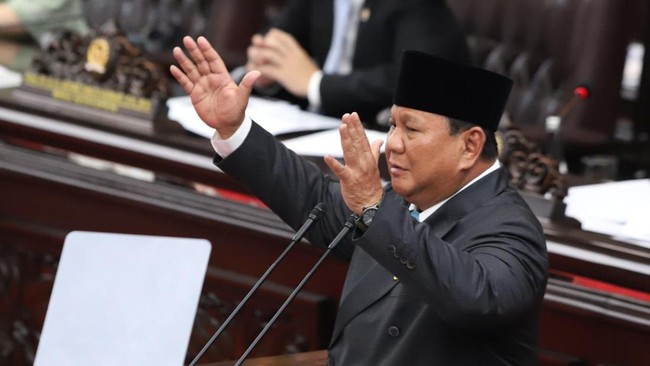
President Prabowo Subianto delivered a speech on the macroeconomic framework and key fiscal policy principles for the 202 state budget during a People’s Representative Council plenary session on Wednesday (20 May 2026). During the event, Prabowo expressed concern over Indonesia’s position as the world’s largest producer of several natural resources, with a market share exceeding 50% of global production. Despite having a large market share, Indonesia’s market power remains weak. Market power refers to the ability to set international prices, but commodities such as crude palm oil (CPO), natural rubber, and nickel are subject to pricing dictated by buyer countries ( oligopoly).
A similar phenomenon occurred in crude oil. The global oil price was controlled by a handful of major exploration companies known as the Seven Mayors, based in Europe, Japan, and the United States. The Seven Mayors operated in countries with vast oil reserves such as Saudi Arabia, Iran, Iraq, Kuwait, and Venezuela. These companies were from the UK, Japan, the US, and Germany. The Seven Mayors’ dominant market position led to oil being sold at unfair prices, as they abused their market power by unilaterally setting international crude oil prices, which harmed producing nations.
The Seven Mayors’ abuse of market power prompted oil-exporting nations to form a global oil cartel, formalised as the Organization of Petroleum Exporting Countries (OPEC). OPEC was established in Baghdad, Iraq, in 1961, initially with five major producing nations: Saudi Arabia, Iran, Iraq, Kuwait, and Venezuela. The organisation aimed to counter The Seven Mayors’ control over global oil prices, managing production, pricing, and concession rights with international oil companies. Since 1961, OPEC’s formation has resulted in higher and more stable oil prices, allowing oil-producing nations to generate significant revenues, which were invested in financial instruments in developed countries.
For example, following increased oil revenues, the Kuwaiti government established the Kuwait Investment Authority (KIA) in 1961 to manage and invest its oil profits, known as the Future Generation Fund (FGF).
Indonesia is the world’s largest palm oil producer, accounting for 43-46 million tonnes annually, or 57% of global production. Malaysia ranks second with 19-20 million tonnes (25% share). With a 57% market share, Indonesia should be a price maker, but OPEC, with only 40% of global oil production, wields significant market power. A study by Next Indonesia published on 10 April 2026 revealed that Singapore captures the majority of palm oil margins. Singapore’s import prices from Indonesia for refined palm oil (RPO) range between $600-$1,300 per tonnes, while re-export prices to other destinations are $1,000-$1,900 per tonnes. Singapore consistently maintains a profit margin of $52-$634 per tonnes, while Indonesia, as the largest producer, sells RPO at only $1,100 per tonnes. The highest margin recorded in 2022 was $634 per tonnes, when Singapore’s export price reached $1,979 per tonnes against an import price of $1,345 from Indonesia.
This situation is unfair to Indonesian palm farmers, as the value added from palm oil is largely captured by Singapore despite no significant physical or code changes in the traded product. A more pronounced example is crude palm oil (CPO). Between 2015 and 2019, Singapore’s import-export margin ranged from $294-$797 per tonnes. In 2015, Indonesia’s export price was $534 per tonnes, while Singapore’s re-export price was $1,331, a $797 margin. This practice raises concerns about transfer pricing, which reduces state revenue from taxes and palm oil export duties.
so what can the Indonesian government do to halt harmful natural resource export practices? First, centralising natural resource exports through state-owned enterprises (BUMNs) should be supported. This centralisation would create a single entity with substantial market volume, enhancing Indonesia’s international market power. Centralising exports also addresses Prabowo’s concerns regarding price formation.