
Prabowo Wants Monthly Meetings with Professors and Rectors for Policy Input
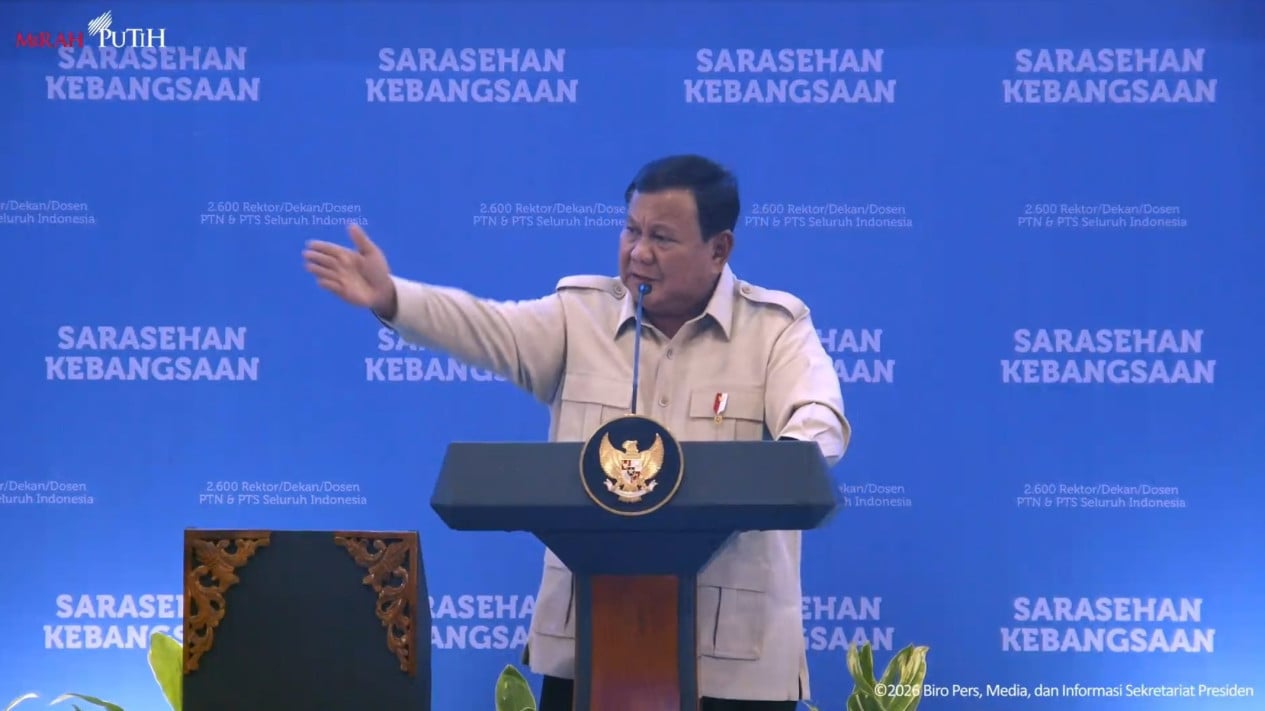
President Prabowo Subianto has stated his desire to meet more frequently with university rectors and professors to obtain input aimed at advancing the lives of the Indonesian people.
“In my view, meeting rectors four times is not enough. If necessary, we shall meet every month,” said Prabowo while closing the National Seminar of the Indonesian Science, Technology, and Industry Convention (KSTI) in Jakarta on Sunday, 28 June 2026.
The President noted that technological advancements have tightened international interdependencies, meaning conflicts in other parts of the world can directly impact Indonesia. Consequently, the government requires perspectives from the academic community when formulating policies.
He added that, as Head of State, he needs to discuss matters with many intellectuals to exchange views on various national issues.
During the event, Prabowo received several proposals from rectors, lecturers, researchers, scientists, and university representatives. These proposals included the provision of doctoral scholarships for lecturers in both public and private universities, increased allocations from State-Owned Enterprises (SOEs) for research and innovation, and the strengthening of cooperation between Indonesian universities and foreign institutions.
“I will follow up on these immediately. Because I believe that difficulties must be faced; we must be brave enough to face difficulties, brave enough to acknowledge difficulties, and work hard to find solutions to those difficulties,” the President stated.
Prabowo also joked that not only the proposals from professors would be considered, but also input from the general public, including voices from rural villages shared via social media.
The KSTI National Seminar took place from 26–28 June 2026, under the theme “Strategies for Economic Independence and Indonesian Welfare.” The event included symposia and panel discussions regarding agriculture, energy, economy and finance, food security, marine and fisheries, downstreaming, and industry. The seminar was attended by approximately 2,600 rectors, lecturers, researchers, scientists, and university representatives alongside the National Research and Innovation Agency (BRIN).