
Prabowo to Address Eight Key Issues in State Address and Budget Speech
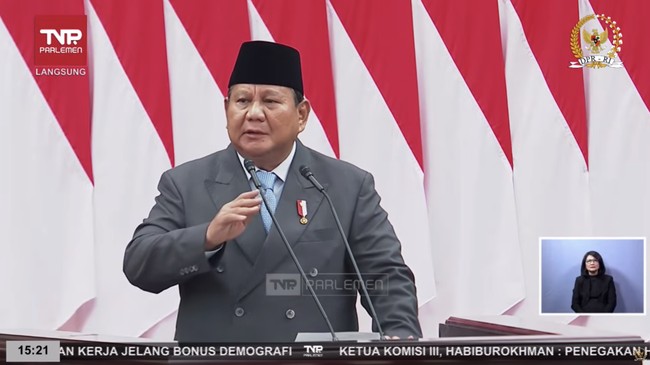
President Prabowo Subianto will deliver the state address along with the Financial Note and the 2027 State Budget Draft (RAPBN) at the House of Representatives (DPR) building today, Friday (14/8/2026).
In addition to presenting the state revenue and expenditure plan, Prabowo is expected to touch on a number of economic issues and strategic policies that have developed throughout this year.
Beyond various issues that remain speculative, the national self-reliance agenda is almost certain to be one of the common threads of the speech. One of these is food self-sufficiency, which is a priority programme of the Prabowo administration.
Rice production performance further strengthens this discussion. Statistics Indonesia (BPS) recorded national rice production reaching 34.69 million tonnes in 2025, an increase of 13.29% compared to 2024. Meanwhile, rice production from January to August 2026 is estimated to reach 25.28 million tonnes, up slightly by 0.05% compared to the same period last year.
In addition to food self-reliance, there are at least eight topics that could potentially be included in the State Address or the presentation of Prabowo’s Financial Note.
- The Middle East War and Its Impact
The war in the Middle East has the potential to be one of the global issues raised by President Prabowo in the series of state addresses and the presentation of the 2027 Financial Note. The conflict has caused suffering not only for Indonesia but for the entire world.
This is because the war affects rising energy prices, disruption to global trade, rising inflation, weakening of the rupiah exchange rate, and impacts on the fiscal position.
Tensions involving the United States, Israel, and Iran have yet to show any signs of certainty that the war will end. Negotiations to reopen the Strait of Hormuz that are currently underway are also still at an impasse, while shipping activity through the route is far below normal conditions.
The Strait of Hormuz itself is a route for about one-fifth of the world’s oil and liquefied natural gas supply.
Indonesia has also felt the impact of the strait’s blockage because it still imports around 1 million barrels of oil per day. Around 31% of Indonesia’s oil supply also passes through the Strait of Hormuz.
The impact of the conflict is visible in the Indonesian Crude Price (ICP). Amid the 2026 state budget assumption of US$70 per barrel, the ICP had surged to US$117.31 in April and US$106.56 per barrel in May 2026.
The ICP then fell to US$83.45 in June and US$81.68 per barrel in July 2026. Although easing, its position is still above the state budget assumption. Brent oil prices were also around US$87 per barrel on Thursday (13/8/2026), indicating that risks from the Middle East conflict have not fully subsided.
- Rare Earth Elements, Mineral Exchange, and Single-Door Exports
Rare earth elements (REE) have the potential to be raised again by Prabowo. The commodity was previously mentioned in the speech presenting the 2026 RAPBN and Financial Note on 15 August 2025, which was Prabowo’s first financial note as president.
“We have minerals called rare earth,” Prabowo said at the time. He emphasised that REE play an important role in high-tech industries, modern life, and defence.
REE are a group of 17 chemical elements used in various products, ranging from smartphones, electric vehicles, wind turbines, to defence equipment.
In Indonesia, these minerals are found as associated elements in tin, nickel, copper, and bauxite mining.
The government’s seriousness in managing this commodity was demonstrated through the establishment of the Mineral Industry Agency in August 2025. The government also established PT Perusahaan Mineral Nasional or Perminas as a state-owned enterprise handling strategic minerals, critical minerals, and REE.
The government has identified eight blocks with REE and other strategic mineral potential in Kalimantan, Sulawesi, and Bangka Belitung.
Perminas will handle these blocks, while an REE processing research project is being prepared in Mamuju, West Sulawesi.
Most recently, Minister of Energy and Mineral Resources Bahlil Lahadalia said the government is drafting technical regulations for REE management and exports. An export ban will be imposed on REE as a primary product, while mineral products that only contain REE as associated elements can still be exported.
The government is also mapping REE content in mining products while building its industrial ecosystem. This is necessary because Indonesia does not yet have a specialised industry capable of separating and processing REE commercially.
Mineral governance improvements are also being carried out through the preparation of the Mineral and Strategic Commodities Exchange (BMKS).
The exchange was established to improve trading governance while creating more transparent commodity price formation domestically.
Based on Law Number 4 of 2026 concerning amendments to the Financial Sector Development and Strengthening Law, the BMKS will be under the regulation and supervision of the Financial Services Authority (OJK) starting 1 January 2027.
Prabowo has also sent the names of prospective OJK Board of Commissioners members who will oversee the exchange to the DPR.
Other steps are being carried out through a single-door export system via PT Danantara Sumberdaya Indonesia (DSI). This policy is designed to curb under-invoicing and transfer pricing practices, while ensuring export proceeds are recorded and enter the domestic financial system.
The transition period began on 1 June 2026 covering coal, crude palm oil (CPO), and ferroalloy.
Exporters continue to carry out shipments, while documents, prices, volumes, export destinations, and transaction values are reported through PT DSI. Full implementation is targeted to begin on 1 September 2026.
Prabowo on 20 July 2026 said PT DSI had managed foreign exchange of more than US$10.5 billion in about one and a half months. According to him, before PT DSI operated, there was a difference of around 30% to 45% between commodity selling prices in Indonesia and prices on the international market.
- PNM Mekaar Programme
The policy to reduce PNM Mekaar interest rates has been completed and has the potential to be raised by Prabowo. Most recently, the Ministry of State-Owned Enterprises, BPI Danantara, and the Coordinating Ministry for Economic Affairs finalised the interest rate reduction scheme for around 14 million PNM Mekaar customers.
Financing interest will be cut to 8% from the previous range of 18%-24% or an average of around 20%. The policy is Prabowo’s directive so that financing for underprivileged women is not too burdensome.
Head of the Ministry of State-Owned Enterprises and COO of Danantara Dony Oskaria said implementation preparations include accelerating supporting regulations, reallocating the People’s Business Credit (KUR) budget, and issuing the Programme Credit Information System (SIKP).
The PNM Mekaar programme provides unsecured financing to underprivileged women who have or want to start ultra-micro businesses. In addition to capital, customers receive mentoring to run and develop their businesses.
The government is targeting the new 8% interest rate to take effect in early September 2026. The large number of recipients and the need for budget support make the continuation of the programme likely to be included in the presentation of the 2027 Financial Note and RAPBN.
- Indonesia International Financial Centre
The Indonesia International Financial Centre (PFII) also has the opportunity to become a topic discussed in Prabowo’s speech.
As a note, the DPR passed the PFII Bill into law on 21 July 2026. Previously, its deliberation was accelerated so that it could become material for the state address in August.
The PFII is designed as an international-standard financial zone to attract global banks, asset management companies, insurance firms, family offices, and trust managers. Its activities may include trading in stocks, bonds, foreign exchange, digital assets, commodities, carbon exchanges, and gold.
The government estimates the PFII can attract investment of around Rp300 trillion to Rp500 trillion. Its initial capital is said not to come from the state budget, but may be sourced from Danantara.
The government is also preparing a 0% corporate income tax facility for up to 50 years for business activities that meet certain requirements. The PFII is planned to be primarily located in Bali and will have special provisions in licensing, use of foreign currency, and dispute resolution.
The scale of these facilities makes supervision of money laundering, transparency of asset ownership, and tax compliance an important part of its implementation.
- PPPK Teachers May Be Pulled to Central Government
A major change may occur in the management of teaching staff in Indonesia. The government is studying the option of transferring PPPK teachers from regional governments to become central government civil servants.
Minister of Home Affairs Tito Karnavian said the option is being discussed to address problems in the management and financing of teachers in the regions. Status as central civil servants also allows teachers to be placed in areas that still lack teaching staff so that distribution is more even.
The government is now calculating the number of teachers that can be transferred, including the possibility of appointing part-time PPPK teachers to full-time status. Budget requirements for teachers in public schools and religious schools are also included in the calculation.
This plan is directly related to the 2027 RAPBN because the transfer of status will shift part of the employee expenditure burden from regional budgets (APBD) to the state budget (APBN). If teachers remain regional civil servants, the central government also needs to calculate additional budget that must be given to the regions.
The large number of teachers and the costs that must be prepared make the development of this discussion likely to find a place in Prabowo’s speech and the presentation of the 2027 Financial Note.
- Transfers to Regions
Fiscal pressure experienced by a number of regional governments makes Transfers to Regions (TKD) one of the important parts of the 2027 RAPBN. Most recently, the central government prepared assistance of Rp20.5 trillion to help regions pay civil servant and PPPK salaries.
The assistance was given to around 490 regional governments through Minister of Finance Decree Number 198 of 2026. However, this budget is not an addition to regular TKD, but rather special assistance to support regional employee expenditure.
Previously, Minister of Home Affairs Tito Karnavian revealed that 79 regional governments faced fiscal difficulties and needed around Rp14 trillion. The pressure stems partly from the large need to pay PPPK salaries.
This condition is inseparable from the decline in TKD. Its budget fell from Rp919.9 trillion in 2025 to around Rp693 trillion in 2026. This decline narrows regional fiscal space to pay employees, provide public services, and carry out development.
For 2027, Minister of Finance Purbaya Yudhi Sadewa opened the possibility of increasing TKD by around Rp40 trillion to Rp90 trillion. The government’s initial framework places the 2027 TKD budget in the range of Rp710 trillion to Rp810 trillion. However, this figure is not yet final and will only be confirmed in the Financial Note and the 2027 RAPBN.
The TKD topic is also related to the plan to transfer PPPK teachers to central civil servant status.
If teachers remain managed by regional governments, additional budget needs to be channelled through the APBD. Conversely, transferring them to central civil servant status will shift part of the salary burden from the regions to the APBN.
- Online Motorcycle Taxi Presidential Regulation
Protection for online motorcycle taxi (ojol) drivers could also be one of the topics discussed in Prabowo’s speech.
Most recently, the government together with the DPR are finalising a Presidential Regulation concerning the online transportation ecosystem.
The Presidential Regulation will become the legal umbrella governing the relationship between drivers, application companies, MSME actors or merchants, and consumers.
The government will also designate ojol drivers as micro-entrepreneurs because they provide vehicles and bear operational costs independently.
This status allows drivers to gain access to protection, empowerment, training, and financing programmes available to micro-business actors. Nevertheless, drivers maintain a partnership pattern to have flexibility in determining working hours.
One of the main points is a revenue share of at least 92% for drivers and a maximum of 8% for application companies. The policy was previously announced by Prabowo at the Labour Day commemoration on 1 May 2026.
The Presidential Regulation will also divide authority among ministries.
The Ministry of Transportation handles passenger fares and safety, the Ministry of Communication and Digital Affairs regulates goods delivery services, while the Ministry of Manpower handles drivers’ social protection.
This regulation is needed to provide certainty regarding income, partnership status, occupational safety, and social security for drivers.
- Civil Servant Salaries
The fate of civil servant (ASN) salaries in 2027 also has the potential to be discussed by President Prabowo.
This is because the basic salary of civil servants has not increased in the past two years.
The last adjustment was made in 2024 through Government Regulation Number 5 of 2024. At that time, the government raised ASN salaries by 8% after no adjustments throughout 2020-2023.
In the past decade, ASN salary increases have only occurred three times, namely 5% in 2015, 5% in 2019, and 8% in 2024.
The 2027 KEM-PPKF document has not specifically included plans to increase ASN basic salaries. The government has only stated that employee expenditure policy will be directed at maintaining the purchasing power and welfare of ASN, TNI, Polri, and pensioners through the provision of holiday allowances and the 13th salary or pension.
Currently, civil servant basic salaries range from Rp1.68 million to Rp6.37 million per month, depending on rank and length of service. Because there is no certainty in the initial document, the direction of ASN salary policy in 2027 may only become visible in the speech presenting the 2027 Financial Note and RAPBN.