
Prabowo to Accelerate Clean Energy Push, Here's the Scenario
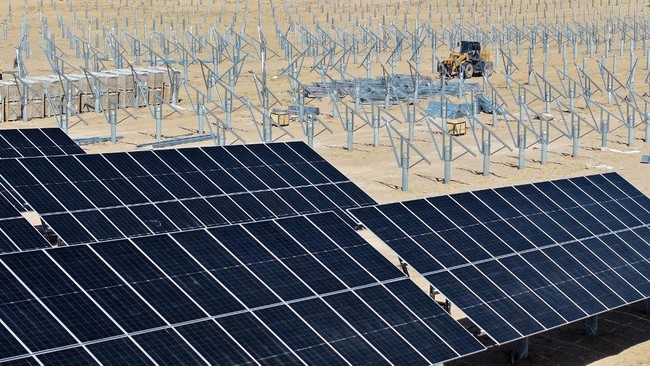
President Prabowo Subianto has outlined the government’s policy direction for 2027 during the submission of the Draft Law on the 2027 State Budget (RAPBN) and Financial Note. One of the key policies is strengthening national energy, particularly new and renewable energy (EBT). EBT, including solar power, is positioned as a foundation for development in the coming years. The agenda is part of the government’s priority to bolster energy independence while reducing the fiscal burden from fuel oil consumption. Prabowo explained that the government has commenced the construction of large-scale solar power plants (PLTS). The target set is 100 gigawatts (GW), with initial construction of 30 GW this year. Concurrently, the government is accelerating the decommissioning of diesel power plants (PLTD). “This year we will build 30 GW of solar power and immediately retire 13 GW of diesel power plants,” Prabowo stated during his speech at the DPR/MPR Building on Friday (14/8/2026). The statement signals the government’s intention to shift generation away from fuel-dependent plants towards cheaper long-term energy sources. For years, PLTD have been the backbone of electricity supply in various remote areas, but their operational costs are high due to reliance on diesel distribution, especially to archipelagic regions. The President assessed that Indonesia possesses natural advantages that have not been optimally utilised. He noted that sunlight available almost year-round should be the primary asset for building the national electricity system. “We are blessed by God Almighty with sunlight throughout the year. It is illogical for remote islands to transport diesel fuel to obtain electricity. The economic cost is inefficient. With PLTS, we can build our energy independence,” Prabowo said. This view underpins the government’s shift in approach to electricity provision in remote areas. Many island regions still depend on fuel shipments via sea routes with high logistical costs. Utilising PLTS is projected to slash operational costs while reducing dependence on fuel supplies. The next agenda is expanding PLTS construction to the village level. Prabowo presented an ideal scenario of building 1 megawatt (MW) capacity plants in every village with adequate land. The concept reflects a more decentralised electrification policy direction, positioning villages as electricity production centres to meet local needs. Such a scheme could potentially improve supply reliability in areas previously difficult to reach by large transmission networks. Prabowo also linked solar energy development to state budget efficiency. Based on government calculations, constructing 100 GW of PLTS capacity could yield significant savings in electricity production costs. “The Coordinating Minister for Economic Affairs has calculated that with 100 GW of PLTS, the state will save at least Rp73.9 trillion annually from the reduction in our basic electricity production costs,” Prabowo said. The savings stem from lower generation costs as fuel oil consumption decreases. In the electricity system, fuel costs are one of the largest components for diesel generators. As solar generation takes a larger share, the need for subsidies and operational generation costs is expected to decline. Beyond production cost savings, the government also views the transition to solar energy as improving the national energy balance. Indonesia still imports a portion of its fuel needs, so changing the energy mix is seen as reducing pressure on foreign exchange reserves. The link between EBT and reduced energy imports was a common thread in the speech. The government views investment in solar power as not only related to environmental issues but also touching on aspects of energy security, fiscal efficiency, and balance of payments stability. This direction demonstrates that EBT development in the 2027 RAPBN is positioned as a long-term investment. The government associates it with efforts to strengthen national energy independence through the utilisation of domestic resources available year-round.