
Prabowo Tilts Toward Washington
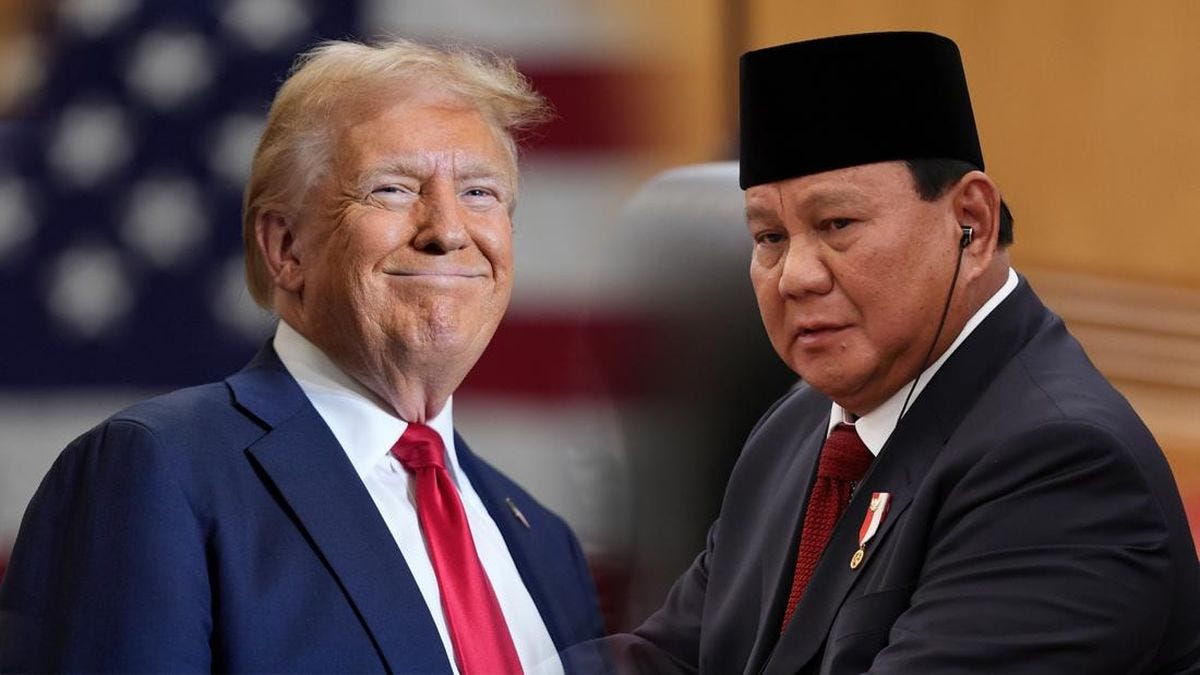
By: Ainur Rohmah
In a moment of mounting global uncertainty marked by intensifying great-power rivalry, persistent conflicts in the Middle East, and the recalibration of alliances across the Indo-Pacific, Indonesia appears to be quietly adjusting the compass of its foreign policy. Under President Prabowo Subianto, Jakarta’s diplomatic posture is showing signs of a subtle but discernible shift toward the United States, even as it maintains formal ties with other major powers, including China and Russia.
The shift is not proclaimed in sweeping speeches or formal declarations. Rather, it emerges through a series of decisions, symbolic gestures and strategic alignments that, taken together, suggest a departure—however incremental—from the more equidistant approach pursued by Prabowo’s predecessor, such as an apparent quiet decision forged between Provo and US President Donald Trump to allow overflights of US military craft above Indonesian territory. Where Joko Widodo often leaned toward Beijing, particularly in infrastructure investment and trade, Prabowo appears to be navigating closer to Washington, especially in matters of defense and geopolitical alignment.
This evolving orientation has not gone unnoticed. Analysts, diplomats and critics at home have begun to question whether Indonesia’s long-held doctrine of a “free and active” foreign policy—one that avoids entanglement in major power blocs—may be undergoing a quiet transformation.
A Tale of Two Visits
The contrast was striking. On April 13, 2026, as President Prabowo was received with full honors by Vladimir Putin at the Kremlin in Moscow, his defense minister and close confidant, Sjafrie Sjamsoeddin, was in Washington holding talks at the Pentagon. The dual-track diplomacy appeared carefully choreographed: engagement with Russia on one hand, and a deepening strategic embrace of the United States on the other.
In Moscow, Prabowo and Putin agreed to expand cooperation across a broad spectrum of sectors, including energy, agriculture, industry, pharmaceuticals and even space exploration. Indonesia, recently welcomed into the BRICS grouping with strong backing from Moscow, expressed gratitude for Russia’s support and signaled its desire to learn from Russia’s resilience in navigating geopolitical turbulence.
“I would like to consult (with President Putin), as the global geopolitical situation is evolving and changing very rapidly,” Prabowo said, in remarks that suggested a search for strategic guidance from a leader long at odds with the West.
Yet, at nearly the same moment, a different narrative was unfolding in Washington.
There, Sjafrie met with the US Defense Secretary Pete Hegseth to announce a new strategic defense partnership—one that goes beyond symbolic cooperation and ventures into operational, technological and structural collaboration.
The agreement rests on three pillars: strengthening military capacity and institutional frameworks, expanding professional military education and training, and enhancing operational cooperation through joint exercises. More notably, it includes plans to explore advanced defense technologies, such as autonomous systems, next-generation maritime capabilities and asymmetric warfare strategies—areas that place Indonesia more firmly within the orbit of US-led security architecture in the Indo-Pacific.
For a country that has historically guarded its strategic autonomy, the depth of this engagement represents a significant development.
Concerns Over Sovereignty
The defense partnership quickly became the subject of intense domestic scrutiny after reports surfaced of a draft agreement that would allow US military aircraft to access Indonesian airspace with fewer restrictions.
The document, which circulated widely on social media, sparked concern among critics who warned of potential infringements on national sovereignty. While the Defense Ministry did not deny the existence of such discussions, it emphasized that any agreement remained in an early stage and had not been finalized.
Still, the episode underscored a broader anxiety: that Indonesia’s growing alignment with Washington could come at the cost of its independence in strategic decision-making.
Such concerns are amplified by the scale and direction of Prabowo’s diplomatic engagements since taking office. Of his 48 overseas visits as of February, a significant portion –16 – have been to Western countries and their allies, including the United States, Britain and France. In total, Prabowo has spent nearly 39 days in Western countries, including almost two weeks in the United States alone.
By contrast, visits to China and Russia—two central players in the evolving global balance of power—have been relatively limited, with only two trips each. While Indonesia continues to invoke the language of Global South solidarity and South-South cooperation, its diplomatic footprint suggests a persistent, if not strengthening, Western orientation.
The BoP Factor
Perhaps the clearest indication of Indonesia’s shifting alignment came with its decision to join the Board of Peace, an initiative spearheaded by US President Donald J Trump. The government framed its participation as a pragmatic move aimed at accelerating peace efforts in Palestine. But analysts have offered a more skeptical interpretation, pointing to economic considerations—particularly concerns over potential US tariff policies—as a key driver. Membership in the Board of Peace, critics argue, has constrained Indonesia’s ability to take an independent stance on contentious issues involving the United States and its allies.
This tension became evident in Indonesia’s response to the escalating conflict between the United States, Israel and Iran. In the days following the outbreak of hostilities, Prabowo refrained from issuing a strong public statement, even as regional tensions intensified and global reactions mounted.
For some observers, the restraint reflected diplomatic caution. For others, it signa