
Prabowo, the Poll and the Verdict of 205 Respondents
Jakarta (ANTARA) — A failing grade can be given to anyone. No one is exempt, including the president and his administration. But a report card without clear categories and parameters, representative students or a tested measuring instrument is not a robust evaluation. It risks turning opinion into a number and then inflating that number into a political verdict. That is highly dangerous and risky.
That was the impression left after reading two articles in RayaTimes’ special report: Ardian Taufik Gesuri’s piece on the RayaTimes poll results, and Dhimam Abror Djuraid’s article entitled “Surveys as Political Weapons”. Both adopt a sharp tone. Yet when their methodologies and lines of argument are examined, some of that sharpness feels hollow. The writing seems to cut, but the blade does not fully reach the facts it is supposed to establish.
This review does not argue that the President should be immune to surveys. On the contrary, a confident government should be willing to consider both pleasing and uncomfortable results. But being prepared to hear criticism does not mean that every figure should carry equal weight. A random national survey of around 1,200 respondents cannot be equated with an online poll of 205 people who chose to take part.
The RayaTimes poll was conducted online from 13 to 18 October 2026. Of its 205 respondents, 184, or 89.8 per cent, said they were dissatisfied; 6.3 per cent were neutral, and just eight people, or 3.9 per cent, said they were satisfied. Those findings were then framed as a “failing grade” for the first two years of the Prabowo–Gibran administration. That is rather simplistic, isn’t it?
The first and most fundamental problem is whom those 205 respondents actually represent. They were plainly not selected at random from Indonesia’s entire population. Nor was there an adequate explanation of where the survey link was shared, who saw it, who was motivated to respond, or how respondents were distributed by region, age, education, occupation, income and political preference. Many questions hang in the air without answers.
Leslie Kish, the Hungarian-born statistician who later became a professor at the University of Michigan, explained in his classic book Survey Sampling that a sample can speak for a population when every member of that population has a known chance of being selected. This is the basis of probability sampling. In voluntary internet polls such as RayaTimes’, those chances are unknown. People who are angry, disappointed or already hold strong political views are generally more likely to respond than those who are neutral.
The figure of 89.8 per cent can therefore only properly be read as the proportion of RayaTimes poll participants—184 out of 205—who were dissatisfied. It must not be transformed into a claim that 89.8 per cent of Indonesians are dissatisfied. RayaTimes itself acknowledged that its sample was not random and that the results could not be used to claim that a majority of Indonesians were dissatisfied. That admission is honest, but it also undermines the broad generalisation implied by the headline.
The second problem is the lack of clarity about whether respondents were among the intended recipients of the programmes they were asked about. Some 73.2 per cent of participants reportedly said they had not experienced benefits from the Free Nutritious Meals programme (MBG), while 77.1 per cent said the same of the Red-and-White Village/Sub-district Cooperatives (KDMP). The questions are: were they, or their children, MBG recipients? Did they live in a village where a cooperative was operating? Were they members, suppliers, buyers, farmers or small businesses connected to the cooperative?
If they were not programme recipients, it is unsurprising that they said they had not experienced its benefits. But that answer does not prove the programme is of no benefit. Assessing MBG’s impact should involve pupils, parents, teachers, nutritionists, staff at Nutrition Service Fulfilment Units (SPPG), local suppliers and recipient schools. An assessment of People’s Schools should hear from pupils from low-income families, parents, teachers and children who previously left school. Evaluating KDMP requires going into villages to meet cooperative members, farmers, fishers and small traders, while distinguishing cooperatives that have only obtained legal status from those actually operating.
The government says MBG has reached about 62 million beneficiaries. In October 2026, the National Nutrition Agency recorded around 57.49 million beneficiaries, more than one million workers and 26,385 SPPG units; figures may differ because the data were updated on different dates. People’s Schools have expanded to 166 schools across 34 provinces. The government has also established the institutional framework for 80,081 KDMP/KKMP cooperatives, although the number actually operating must continue to be verified and should not be confused with the number of registered legal entities.
It is precisely these groups of beneficiaries who should be specifically sampled. Do not ask people who have not received a meal whether it tastes good or benefits them, then conclude that the meal is useless. That is bias.
School meal programmes are not unusual internationally. The World Food Programme says at least 466 million children receive school meals in countries around the world. The World Bank has found benefits spanning education, social protection, health and local agricultural markets, estimating economic returns of US$7 to US$35 for every dollar invested, depending on context and implementation quality. Evidence of improved school attendance is relatively strong, while evidence for some nutritional outcomes is mixed. MBG should not be praised uncritically, but neither should it be judged solely on the perceptions of respondents who may not have received it. The result is confusion.
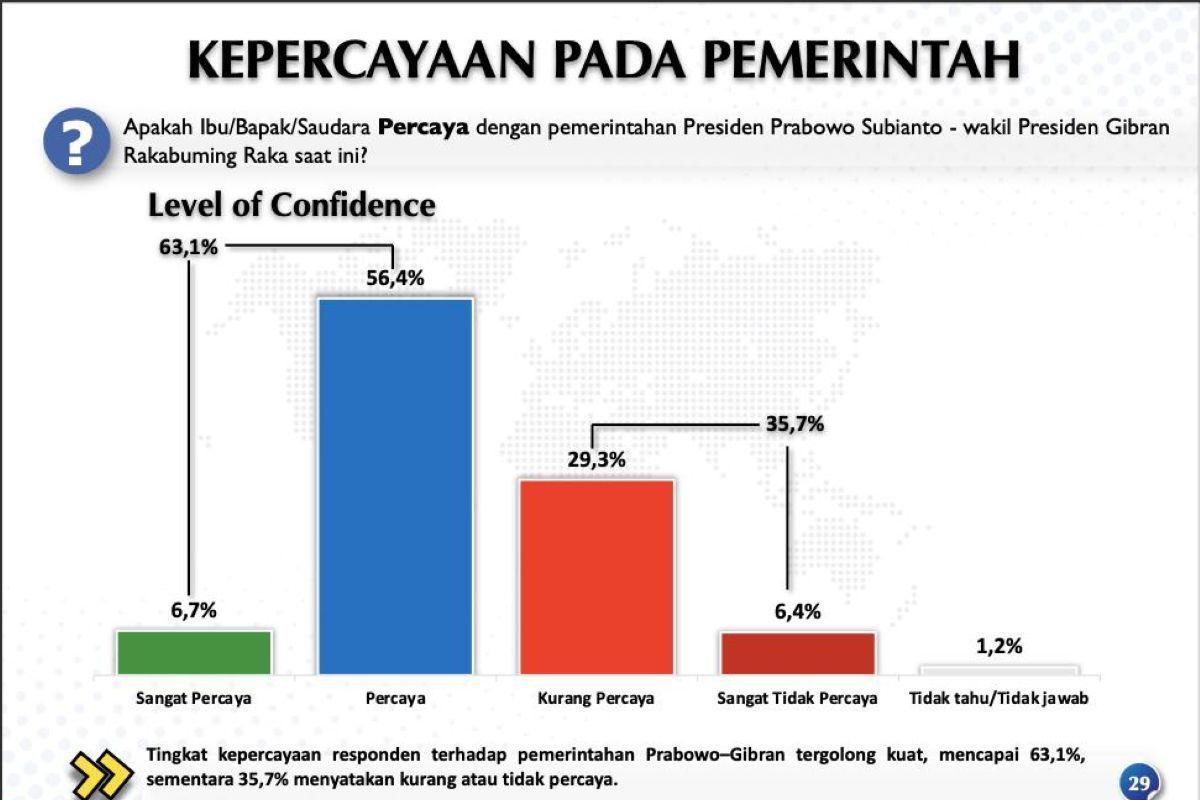
The third problem is that RayaTimes’ findings differ sharply from national surveys conducted around the same period. SMRC recorded 44.5 per cent satisfaction with the President. Poltracking found 55.3 per cent satisfaction with the Prabowo–Gibran government, while Parameter Politik Indonesia recorded 65.4 per cent. The questions and methodologies differed, but all those figures are far removed from the 3.9 per cent satisfaction rate among RayaTimes poll participants.
That difference does not mean the government can congratulate itself. Figures ranging from 44.5 to 65.4 per cent still signal concerns about household finances, jobs, the law, corruption and the quality of programme delivery. But a warning is not the same as a verdict. RayaTimes also conducted only one measurement, so it cannot establish a downward trend without comparable data gathered using the same methods and questions.
What, then, of Dhimam Abror’s article? It has three main problems. First, its thesis that surveys have become “political weapons” is not supported by concrete cases. Who commissioned them, who paid, which questions were leading, what results were concealed, and which policies were justified by the surveys? Without that chain of evidence, “political weapon” remains a compelling metaphor that is, in fact, hollow.
Second, the article conflates image-making with a false reality. The concept of simulacra developed by Jean Baudrillard, the French philosopher and sociologist, can explain how media construct images. But it does not automatically prove that a leader’s work, visits to the grassroots or closeness to the public are all false. Claims about image must be tested against achievements, policy impacts and people’s experiences—not established by applying a philosophical label.
Third, there is an irony: the article warns that surveys are not absolute truth, yet the report itself elevates a non-random poll of 205 people into a failing grade. Pierre Bourdieu, the French sociologist and professor at the Collège de France, argued in his essay Public Opinion Does Not Exist that surveys can “create” public opinion when researchers assume that everyone has an opinion, that all answers have equal value, and that everyone agrees on which issues deserve to be asked about. Howard Schuman and Stanley Presser, two American survey-methodology experts, also demonstrated that the wording, order, context and tone of questions can change respondents’ answers.
This article does not reject RayaTimes’ criticism. Cases of food poisoning under MBG must be reduced to zero. Problematic SPPG units must be closed or improved. Corruption must be punished. KDMP cooperatives that exist only on paper must be made to operate in practice. People’s Schools must be assessed by the changes they bring to their pupils’ lives. Support for the President should not mean applause without scrutiny. That is not the point.
But criticism must also treat data fairly. Small numbers should not be inflated, limited groups should not be turned into “the people”, and perceptions should not be sold as national reality. I support surveys that are rigorous, transparent and willing to reach beneficiaries directly.
The purpose of a survey is not to praise or denigrate those in power. It is to establish what is happening. Reality is too important to be entrusted to 205 people who were never intended to represent Indonesia. Agreed?
*Dr Ramadhan Pohan, MIS, commentator, veteran journalist and former deputy chair of Commission I of the House of Representatives.
Source: jawawa.id (https://jawawa.id/newsitem/prabowo-the-poll-and-the-verdict-of-205-respondents-1793001215)
Originally published by Antara (Indonesian) (https://www.antaranews.com/berita/5811791/prabowo-survei-dan-vonis-dari-205-responden), translated from Indonesian