
Prabowo Targets 100 GW Solar Power, Land Issues Become One of the Challenges
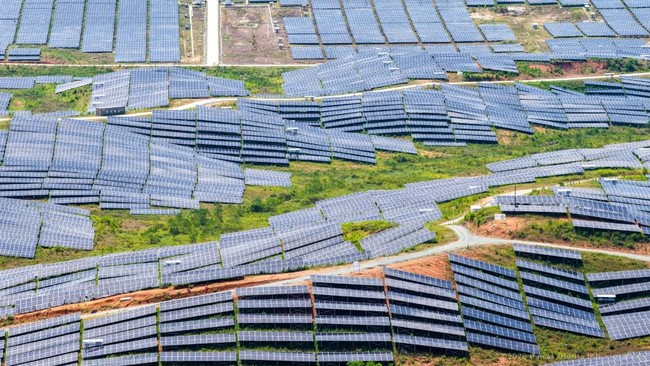
The Ministry of Energy and Mineral Resources (ESDM) has revealed that land availability is one of the obstacles in developing Solar Power Plants (PLTS) in Indonesia. This is due to the high cost of land acquisition and competition for land with other industrial sectors in areas with high electricity demand.
As is known, Indonesian President Prabowo Subianto targets that Indonesia can develop PLTS with a capacity of 100 Gigawatts (GW) within a period of 2-3 years.
The Director of Strategic Electricity Development at the Ministry of ESDM, Andriah Feby Misna, explained that the development of PLTS, both rooftop and ground-mounted types, is still difficult to accommodate. She assessed that her side needs to integrate energy development plans with industrial zones to minimise physical land obstacles and permitting issues.
“Demand for renewable energy, particularly PLTS, both rooftop PLTS and ground-mounted PLTS for their own use, is still quite high from industries, but we are still somewhat struggling to deliver it,” she stated during the Public Discussion on Renewable Energy Zones (REZ) as an Enabling Instrument by INDEF, in Jakarta on Tuesday (28/4/2026).
The land provision obstacle is also acknowledged by national electricity infrastructure developers. In dense areas like Java, there is an economic dilemma regarding the limited use of land for industrial zone developers or housing.
Meanwhile, PLN’s EVP of Electricity System Planning, Arief Sugiyanto, revealed that developers often face choices between building power plants or other commercial facilities. He stated that economic factors are the main determinant of whether a piece of land will be allocated for clean energy or for factories.
“The challenge again, if we talk about PLTS, if we build in one industrial zone and there is also PLTS there. Well, from the developer’s side, whether this land is more profitable to build PLTS or more profitable to build another factory or perhaps settlements or real estate,” Arief explained on the same occasion.
The government’s mitigation step being studied is through the Renewable Energy Zone concept or integrated renewable energy zones. This scheme is expected to make it easier for investors because land provision is planned to be facilitated directly by the state to reduce initial investment costs.
“Hopefully from us, of course from the government, we can facilitate this land. So land is not something that is competed for,” Arief concluded.