
Prabowo Reshuffles Ministers; Two Business Leaders Warn Against Policy Instability
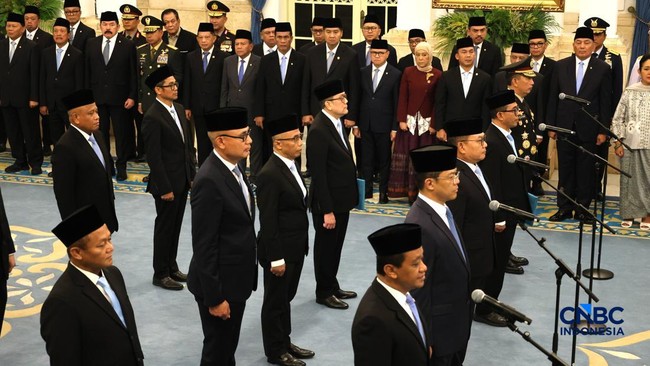
President Prabowo Subianto has once again restructured the Red and White Cabinet in his seventh reshuffle, conducted on Thursday (1/10/2026). Several strategic positions in the economic sector have changed for the remainder of the 2024-2029 term. This includes the Minister of Industry, now held by M. Sarmuji, and the position of Coordinating Minister for Downstreaming and Energy Transition, which has been entrusted to Bahlil Lahadalia in a dual role.
These changes have drawn significant attention from the business community. The Chairwoman of the Indonesian Employers Association (Apindo), Shinta Widjaja Kamdani, stated that the most important factor for businesses is not merely who occupies the positions, but how the government maintains policy continuity and regulatory certainty.
“Cabinet changes or adjustments are the prerogative and authority of the President. From a business perspective, the most vital aspects are how stability, the continuity of existing good policies, regulatory certainty, and the effectiveness of government coordination and execution are maintained following these changes,” Shinta told CNBC Indonesia on Friday (2/10/2026).
According to her, certainty is a crucial factor for the business world because decisions regarding investment, production capacity expansion, and job creation are made based on medium- and long-term calculations. Therefore, Shinta hopes the transition process following the reshuffle occurs swiftly and does not create a hiatus in the implementation of ongoing economic policies.
Shinta also highlighted the importance of cross-ministerial coordination. She noted that many challenges currently faced by the business sector are not isolated but involve multiple sectors simultaneously.
“The change in officials should serve as a momentum to further strengthen cross-ministerial coordination. Many business issues today are cross-sectoral, ranging from investment, industry, trade, energy, and fiscal matters to labour,” she said. “Therefore, the consistency of policy direction and inter-agency coordination is just as important as the policies themselves.”
Avoid Changing Regulations
Shinta mentioned several agendas that must be maintained by the new ministers. One of these is safeguarding purchasing power and domestic demand, which remains a primary pillar of the Indonesian economy.
Additionally, the government needs to strengthen the competitiveness of the real sector and industry. This includes ensuring the certainty of energy supply and prices, the availability of raw materials, logistical efficiency, access to financing, and trade policies capable of supporting increased domestic production capacity.
The business community, she added, is also focused on the certainty and simplification of regulations and licensing.
“Certainty and the simplification of regulations and licensing are key. The business world requires predictable policies and consistent implementation. Frequent policy changes or inconsistent implementation can increase the cost and risk of doing business,” Shinta explained.
Shinta emphasised that ongoing agendas—including downstreaming, industrialisation, increased investment, export expansion, and job creation—must continue without losing momentum.
Meanwhile, the Vice Chairman for Organisation, Communication, and Regional Empowerment of the Indonesian Chamber of Commerce and Industry (Kadin), Erwin Aksa, also requested that official changes do not cause existing government programmes to revert to square one.
“With the significant number of changes in ministerial and coordinating ministerial positions recently, we hope that inter-ministerial coordination becomes even stronger. The business world requires consistent and integrated policies, as investment decisions typically have a long-term horizon,” said Erwin when contacted separately.
“We must ensure that changes in officials do not cause well-running programmes to start from the beginning, or lead to overly frequent policy changes,” he added.