
Prabowo Prepares New Regulations to Accelerate 100 GW Solar Power Programme
The Ministry of Energy and Mineral Resources (ESDM) is currently preparing new regulations regarding the implementation of solar power plant (PLTS) construction with a total capacity of 100 Gigawatts (GW). This massive development plan aligns with the directives of President Prabowo Subianto.
The Director General of New, Renewable Energy, and Energy Conservation (EBTKE) at the Ministry of ESDM, Eniya Listiani Dewi, stated that the legal umbrella for these regulations will take the form of a Presidential Regulation (Perpres). In addition to drafting new rules, the government is also evaluating the provisions for electricity purchase prices from renewable energy sources.
“At this time, we are discussing the strengthening of regulations to realise the programme directed by the President, namely the 100 GW solar power programme. We are creating regulations for the 100 GW solar programme in the form of a Presidential Regulation and are also conducting revisions to Presidential Regulation 112 of 2022 regarding the pricing of new and renewable energy,” Eniya said during a Hearing with Commission XII of the Indonesian House of Representatives (DPR RI) in Jakarta on Thursday.
The planned addition of 100 GW solar capacity will encompass various development schemes across Indonesia. These schemes include solar plants connected to the PLN grid (on-grid), the strengthening of rooftop solar installations, and the acceleration of diesel-decommissioning programmes that combine solar power with battery systems.
“In our monitoring of the Electricity Supply Business Plan (RUPTL) implementation, we have identified that the realisation of this 100 GW solar power plant will cover all solar power activities,” she added.
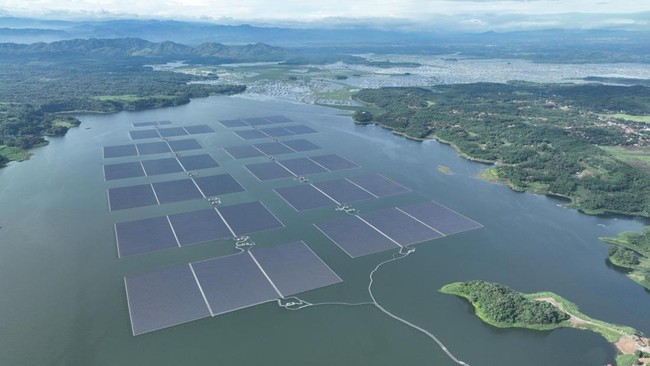
One of the current efforts involves cross-ministerial cooperation, such as with the Ministry of Public Works (PU), to utilise dams and reservoirs. The government plans to increase the construction of floating solar plants in various strategic locations to optimise solar energy potential.
“We are also collaborating with the Ministry of Public Works for the development of floating solar and hydropower plants. Floating solar is one of our efforts to realise the 100 GW solar programme. Additionally, off-grid solar power will be a component that supports the 100 GW realisation,” she further explained.
On the other hand, the government is also preparing demand creation strategies to ensure that the electricity supply from solar power is absorbed to its maximum potential. Increasing the use of electric vehicles, converting industrial machinery, and encouraging the use of electric stoves are part of the government’s roadmap to ensure the success of this programme.
“When we implement the 100 gigawatt solar power plants spread across various regions, we must also present downstreaming programmes to increase electricity demand, such as using electric vehicles, conducting vehicle conversions, and encouraging the increased use of electric stoves,” she concluded.