
Prabowo Orders Zulhas and Team to Assist Bulog, Here Are Their Tasks
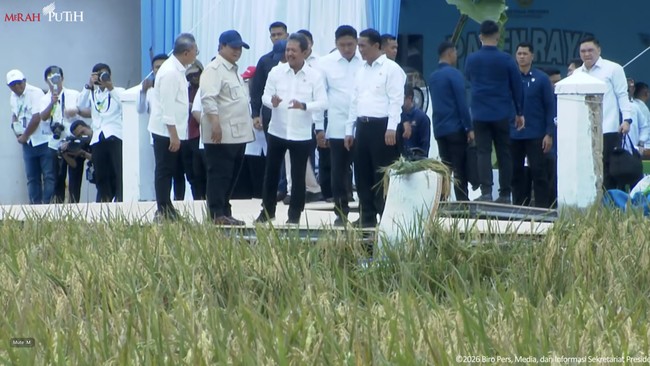
The government is accelerating the development of post-harvest infrastructure as part of a major strategy to strengthen national food security. This step is directly affirmed through Presidential Regulation (Perpres) No. 14 of 2026 on the Acceleration of the Provision of Post-Harvest Infrastructure for National Food Security.
To ensure the project runs quickly, President Prabowo Subianto has tasked Perum Bulog as the main implementer in the field. This assignment also positions Bulog as the spearhead in ensuring infrastructure readiness ahead of the harvest season.
“The government assigns Perum Bulog to carry out the provision of IPP (Post-Harvest Infrastructure),” states Perpres 14/2026.
This acceleration is not done all at once, but in stages to meet urgent needs this year.
“The acceleration of IPP provision is carried out in stages to anticipate IPP needs during the 2026 harvest season,” states the Perpres.
Behind this assignment, several ministers and agency heads are asked to directly assist Bulog. The main coordination is under the control of the Coordinating Minister for Food Affairs, Zulkifli Hasan (Zulhas).
“The Coordinating Minister for Food Affairs coordinates the acceleration of IPP provision and provides approval for IPP location points,” it states.
The technical role is then strengthened by the Ministry of Agriculture, which is tasked with ensuring project feasibility aspects run according to standards.
“The Minister of Agriculture provides technical considerations on simple feasibility studies to Perum Bulog,” states the Perpres.
Meanwhile, land and spatial planning matters are accelerated through the Ministry of Agrarian Affairs and Spatial Planning/BPN so that the project does not get stuck in the early stages.
“The Minister of Agrarian Affairs and Spatial Planning/Head of the National Land Agency facilitates the issuance of Spatial Utilisation Activity Suitability (KKPR),” it states.
From the investment side, the government is also opening fast-track licensing channels so that the project can be executed immediately.
“The Minister of Investment and Downstreaming/Head of BKPM facilitates the acceleration of business licensing based on risk,” it states.
Not only that, the Ministry of Home Affairs has a strategic task in coordinating regional support as well as financing schemes, including state capital participation for Bulog.
“The Minister of Home Affairs coordinates the state capital participation process to Perum Bulog,” states the Perpres.
Project supervision is also tightened to avoid potential deviations. BPKP is tasked with overseeing financial aspects to risk management.
“The Head of the Financial and Development Supervisory Agency carries out internal supervision of financial accountability, governance, risk management, and internal control,” it states.
From the legal side, the Attorney General is asked to provide support so that all processes remain in accordance with regulations.
“The Attorney General provides legal opinions and legal assistance in civil and state administrative fields,” it states.
Even the TNI is involved to strengthen logistical support, especially in remote and hard-to-reach areas.
“The Commander of the Indonesian National Armed Forces provides logistical support and assistance in the outermost, underdeveloped, and outermost regions,” it states.
At the regional level, governors to regents/mayors are asked to actively support project acceleration, from spatial planning adjustments to land provision.
“Governors and regents/mayors carry out spatial planning adjustments for the region and provide ease and acceleration of the licensing process,” states the Perpres.
With this detailed division of tasks, the government wants to ensure that post-harvest infrastructure development no longer runs slowly. The target is clear: to maintain supply stability while strengthening national food security amid production and distribution challenges.