
Prabowo Orders Weather Modification to Prevent Further Disasters in Sumatra
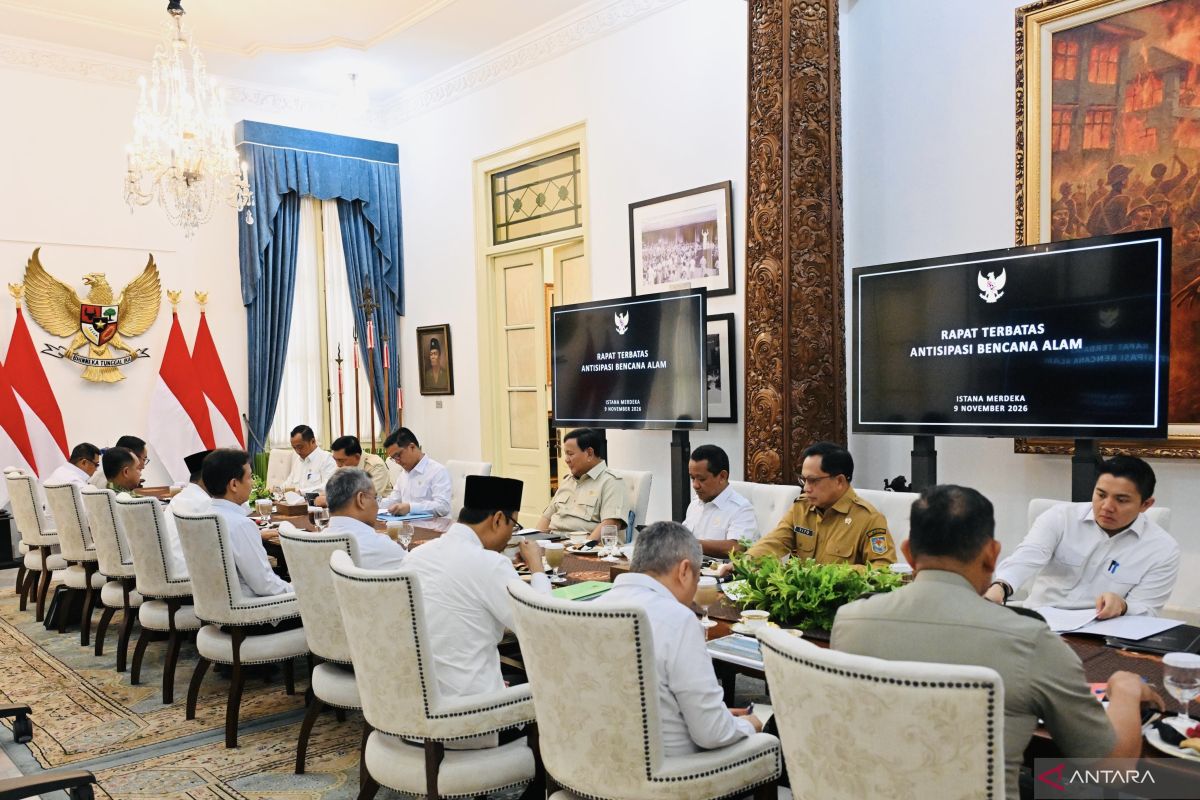
Jakarta (ANTARA) – President Prabowo Subianto has ordered the Meteorology, Climatology and Geophysics Agency (BMKG), the National Disaster Mitigation Agency (BNPB) and other relevant institutions to conduct weather-modification operations (OMC) in several disaster-affected areas of Sumatra to prevent further disasters.
Home Affairs Minister Tito Karnavian, who also heads the Task Force for the Acceleration of Rehabilitation and Reconstruction (Kasatgas PRR) following the Sumatra disasters, said 41 further disasters occurred in affected areas of Sumatra between April and November 2026.
Disaster mitigation measures, including river normalisation and weather modification, are therefore a focus of the task force’s work, as directed by President Prabowo.
“Our basic principle is to try to prevent this. We do not want rain falling there [in affected areas] and will use weather-modification operations. If there is rainfall, it should be minimal. If flooding does occur, we will be ready with all the facilities and infrastructure, tents, food and other supplies for affected communities,” Tito said at a press conference at the Presidential Office in Jakarta on Monday evening (9 November), restating the President’s instructions at a meeting.
President Prabowo chaired a limited meeting at the Palace to discuss, among other things, two agenda items: an evaluation of the task force’s performance in the post-disaster recovery and reconstruction effort in Sumatra, and preparations for and mitigation of disasters in several areas ahead of the peak rainy season.
At the same press conference, BMKG chief Prof. Teuku Faisal Fathani said he had briefed the President on forecasts for the peak rainy season in several parts of Indonesia. Most of the country entered the rainy season in November and December, Faisal said. The peak is expected to last three months, from December to February.
The BMKG is preparing and issuing early-warning information for several high-risk areas, which is available on its official website.
The website provides early warnings on extreme rainfall, tropical cyclones, tidal flooding, air quality, earthquakes and tsunamis. “It can be accessed down to the sub-district level, showing which sub-districts across Indonesia are under alert, standby or warning status,” Faisal said.
He said the BMKG was working with the BNPB to identify high-risk areas and implement mitigation plans in places vulnerable to flooding and landslides caused by extreme rainfall.
Weather-modification operations
The BMKG chief also explained that local governments, particularly those affected by disasters, can declare their areas to be under a disaster emergency alert. This would enable the BNPB to carry out weather-modification operations there under BMKG supervision.
“We can conduct weather-modification operations in two ways. First, we direct rainfall to occur upstream, where clouds form, so that it falls over waters or areas where it will not cause harm. Second, we use small seeding materials, smaller than two microns, or flares, or quicklime to prevent condensation, so that clouds disperse and rain does not occur,” Faisal said.
He said the BMKG was also seeking to ensure that rain did not fall in areas where river normalisation had yet to be completed.
“We know there are about 38 rivers that have not yet been normalised or are still undergoing the process. We are trying to keep rain from falling in areas that are not yet ready. Construction projects are being accelerated, and we will also try to protect those areas from extreme rainfall that could cause further disasters,” he added.
Source: jawawa.id (https://jawawa.id/newsitem/prabowo-orders-weather-modification-to-prevent-further-disasters-in-sumatra-1794253822)
Originally published by Antara (Indonesian) (https://www.antaranews.com/berita/5842875/prabowo-perintahkan-omc-untuk-cegah-bencana-susulan-di-sumatra), translated from Indonesian