
Prabowo Orders Acceleration of Garlic Self-Sufficiency, Rp400 Billion Prepared
Jakarta, CNBC Indonesia - The government is accelerating efforts to achieve garlic self-sufficiency, a commodity that has long depended on imports. One of the steps being prepared is allocating a budget of nearly Rp400 billion to increase domestic garlic seed production.
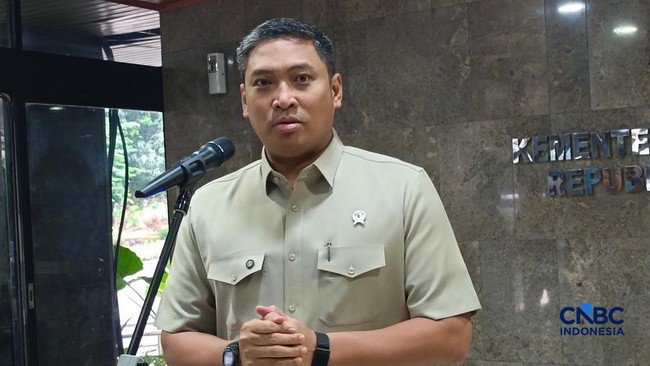
Deputy Minister of Agriculture Sudaryono stated that the budget will be used to support a seed breeding programme covering 5,000 hectares this year. The programme serves as an initial foundation to boost national production and reduce dependence on imported supplies.
“The President’s desire is for garlic, as an essential staple food, to become self-sufficient,” Sudaryono said during a press conference at his office in Jakarta on Wednesday (17/6/2026).
According to him, the target of garlic self-sufficiency is more achievable compared to several other food commodities because the land requirement is relatively modest. The government estimates that around 100,000 hectares of planting area are needed to meet the entire national demand for garlic.
However, the biggest challenge at present is not land availability or farmer interest in planting. The main issue, he explained, lies in the availability of large quantities of seeds suitable for Indonesia’s agro-climatic conditions.
Sudaryono explained that garlic can only grow optimally in certain areas, particularly highland regions. Several areas such as Sembalun in West Nusa Tenggara, Temanggung in Central Java, and Humbang Hasundutan in North Sumatra will become the focus of national seed breeding development.
“The challenge is how we provide sufficient seeds. So these three locations will be directed more towards mass seed breeding,” he said.
The government also considers reliance on imported seeds not a long-term solution. Besides limited quantities, imported seeds also require an adaptation process before they become suitable for planting in Indonesia.
Therefore, the Ministry of Agriculture has chosen to strengthen the seed breeding system at the farmer level. Under this scheme, the government provides initial seeds which are then further developed by farmers into new seeds.
“The government provides bridging seeds. So farmers are given seeds, then after harvest they return one and a half times the amount and can sell the rest,” he explained.
Through this pattern, the government hopes that seed availability can grow sustainably from season to season without continued dependence on imports.
Sudaryono revealed that the cost of garlic seed breeding is not cheap. For one hectare of land, the capital requirement reaches around Rp120 million, with the largest portion derived from seed procurement valued at approximately Rp75 million per hectare.
Based on the Ministry of Agriculture’s calculations, the funding requirement to support 5,000 hectares of seed breeding reaches around Rp375 billion, or close to Rp400 billion. The budget will come from the state budget (APBN).
The programme begins this year. In addition to state budget support for 5,000 hectares, the government is also encouraging the involvement of state-owned enterprises (BUMN) and the private sector to expand seed breeding development to 20,000 hectares.
“It starts this year. APBN for 5,000 hectares. BUMN and the private sector are expected to cover 20,000 hectares because we are heading towards 100,000 hectares,” Sudaryono said.
The government estimates that results from the programme will begin to be visible within the next three to four years. During that period, the need for imports is expected to continue shrinking as domestic production increases.
“We hope that within three to four years, consumption that has been met by imports will gradually decrease. Hopefully it will reach zero and we can achieve self-sufficiency,” he said.
This push for self-sufficiency comes amid a declining trend in garlic imports over recent years. Data from the Central Statistics Agency (BPS) shows Indonesia’s garlic import volume fell from 602,745 tonnes in 2021 to 450,339 tonnes in 2025.
Despite the downward import trend, national garlic supply is still dominated by imported products, particularly from China. Therefore, the government considers strengthening domestic seed breeding as the key to realising the self-sufficiency target set by President Prabowo Subianto.