
Prabowo Optimistic Indonesia Can Follow India and Brazil in Developing Sugarcane Petrol
President Prabowo Subianto has stressed that Indonesia must immediately follow the lead of India and Brazil in implementing a blend of petrol with bioethanol. The raw materials for this bioethanol can be sourced from sugarcane molasses, sorghum, cassava, sugar palm, corn, and others.
This initiative is seen as a way to strengthen national energy self-sufficiency and ensure that foreign exchange circulates within the country. Prabowo has instructed the construction of up to 50 new bioethanol plants to pursue a higher blending target. India has already implemented a 20% bioethanol blend (E20), while Brazil has reached E100.
Indonesia has not yet issued a mandate for the use of bioethanol blended with petrol. However, in practice, Pertamina has already introduced an E5 blend at several fuel stations across the country.
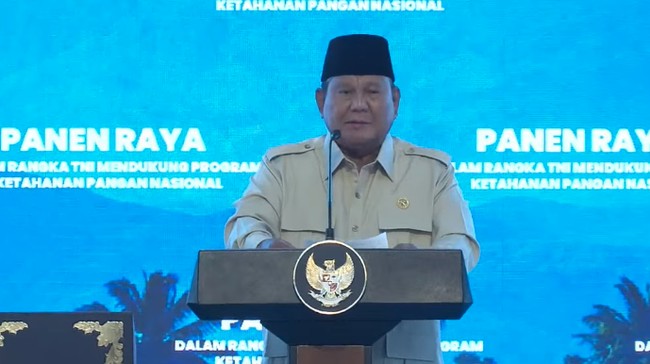
“India is already at E20, India is already at E20. Brazil is at E100. How can Indonesia not be able to? We can, right? We can? We can, we can, we can,” Prabowo said during a simultaneous harvest event with the Indonesian National Armed Forces (TNI) in Malang, East Java, on Friday.
He explained that Indonesia has successfully achieved self-sufficiency in diesel through the processing of palm oil into biodiesel. This success has freed Indonesia from dependence on diesel imports and has had a direct economic impact on farmers.
“Now we produce diesel from palm oil, so starting this July we no longer import diesel from abroad. It is better that the money circulates in Indonesia and is enjoyed by palm oil farmers throughout the country,” he asserted.
Currently, Indonesia only has one operational bioethanol plant to support the petrol blending programme. To reach the E20 target, Prabowo is targeting a massive addition of bioethanol plants in the near future.
“We need factories; currently we only have one factory. I have decided we will build at least 30 factories. If necessary, up to 50 factories,” Prabowo stated.
Prabowo also addressed those who still doubt the nation’s ability to achieve energy sovereignty. He urged the country to stop depending on foreign powers and to focus on its own natural resources.
“We can do it. Those who don’t want to, that’s fine, just sit down. Sit down and watch, but don’t be a follower. Don’t keep bowing to foreign powers. Saying Indonesia is bad, Indonesia is what, Indonesia is dark. If you wear dark glasses, of course it will always be dark,” he concluded.
Pertamina New & Renewable Energy (NRE) highlighted several countries that have successfully implemented bioethanol-petrol blends. CEO John Anis noted that nations like Brazil and India are far more advanced in developing bioethanol mixed with fuel.
“Here is an example of the product, Sir, this is E100. This is E100, Sir. From Brazil. And this is E20, Sir, from India,” he said during his presentation at the event in Malang.
He explained that India has far surpassed Indonesia by implementing a 20% ethanol blend policy, while Indonesia has only reached a 5% blend, available in Jakarta and East Java.
“India is already at E20, Sir. We don’t want to lose, Sir, we must catch up with them. We are only at E5. This E5 is available at 170 of our outlets in East Java and Jakarta,” he revealed.
Pertamina NRE is ambitious to match these countries’ achievements by developing various local raw materials. John stressed that the country should not continue to spend foreign exchange on fuel imports.
“Rather than spending money on imports, Sir, give it to the farmers,” he emphasised in response to Prabowo’s question about the policy’s impact on reducing imports.
Pertamina is currently mapping the potential of plant-based raw materials across Indonesia. The development of bioethanol is expected not only to strengthen energy security but also to provide a direct economic impact on local communities.
“What’s interesting, Sir, is that this energy can be produced here. Unlike refineries, which are only in a few places, this can be decentralised everywhere depending on local wisdom,” he added.
John also reminded that the success of other countries in implementing bioethanol-petrol blends must be supported by regulation. Therefore, Pertamina requires a mandatory policy and certainty regarding feedstock prices to achieve the E20 target.
“There are two things, Sir: a mandate and certainty of feedstock and its price,” he concluded.