
Prabowo Monitors Dollar at Rp17,400: BI Governor's Explanation
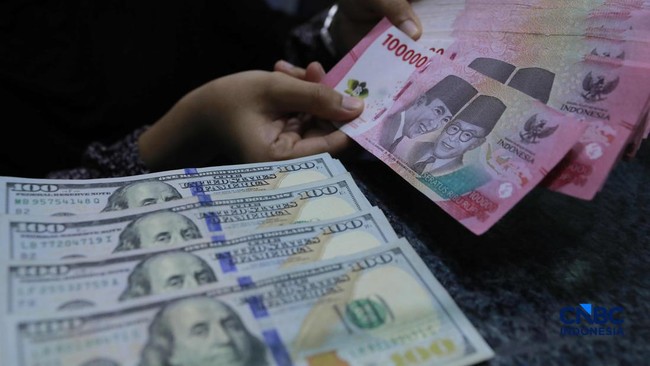
President Prabowo Subianto is paying special attention to the condition of the rupiah exchange rate against the US dollar. This is especially the case since the rupiah rate has been under pressure throughout the day yesterday, breaching above Rp17,400 per US dollar.
The Head of State even summoned Bank Indonesia Governor Perry Warjiyo to the State Palace in Jakarta on Tuesday (5/5/2026). He also provided directions to the central bank to maintain the stability of the rupiah exchange rate movement against the US dollar.
This was revealed by Perry after attending the meeting with the Head of State last night. Also present at the meeting were Finance Minister Purbaya Yudhi Sadewa, Coordinating Minister for the Economy Airlangga Hartarto, OJK Chairman Friderica Widyasanti, and LPS Chairman Anggito Abimanyu.
“Yesterday, we discussed and received directions from Mr President regarding the exchange rate. Related to two important things about the exchange rate. First, the current exchange rate is undervalued. Undervalued, and going forward, we are confident it will stabilise and strengthen,” said Perry, quoted on Wednesday (6/5/2026).
In the meeting with the President, Perry Warjiyo said he had reported seven steps that will be taken to strengthen the rupiah. This includes tightening restrictions on dollar purchases.
“What we have issued is a restriction on dollar purchases in the domestic market without underlying. Previously US$100,000 per person per month, we reduced it to US$50,000 per person per month. That is what we immediately coordinated with KSSK for strengthening,” he said, explaining the fifth step taken by Bank Indonesia.
“Including domestically, the Yuan market, Chinese Yuan with Rupiah, has developed domestically because the local currency with China and Rupiah is very high. And now a domestic Yuan-Rupiah market is starting to form, including this local currency, so it reduces or diversifies from the dollar, thus it can strengthen,” he explained.
The restriction, Perry continued, is being prepared to be lowered again to US$25,000.
“So purchases of dollars up to or above 25,000 must use underlying. That is what we will strengthen, we will strengthen this domestically,” said Perry.
Another step that Bank Indonesia will take to strengthen the Rupiah is to conduct cash interventions and domestic non-deliverable in the country, as well as non-deliverable forward (NDF) in foreign markets.
“In Hong Kong, Singapore, London, New York, we will continue to intervene to stabilise the Rupiah both domestically and from abroad. Our foreign exchange reserves are more than sufficient to carry out stabilisation of the Rupiah exchange rate,” he said.
“Second, Mr Coordinating Minister mentioned earlier because for now SBN is outflowing, then stocks, although in recent weeks the results of coordination with the Finance Minister have started inflow but year to date still outflow. Meanwhile, stocks have outflow, so we agreed for now SRBI is made to need inflow, so the SRBI inflow can cover the SBN and stock outflow,” he continued.
That step, he said, is coordinated with the Finance Minister so as to truly maintain foreign portfolio inflows.
“So year to date there is still inflow and that strengthens the Rupiah exchange rate,” he said.
The third step, coordinating with the Finance Minister, BI will continue to purchase SBN from the secondary market.
“This coordination has been done since the beginning of the year and we do it. We have purchased SBN from the secondary market year to date amounting to Rp123.1 trillion. And we will coordinate, including the Finance Minister can do buybacks and so on, very close coordination between fiscal and monetary,” he said.
The fourth step, maintaining liquidity in banking and the market more than sufficient, indicated by the double-digit primary money growth. Lastly, he said, the primary money growth is 14.1%.
“Sixth, strengthening our intervention market in offshore non-delivery forward so we are more able to control exchange rate developments offshore, abroad. In addition to the interventions we continue to do, we also allow domestic banks to participate in selling offshore NDF abroad so the supply is more, more abundant thus it will strengthen stabilisation of the Rupiah exchange rate,” said Perry.
And seventh, increasing supervision of banks and corporations, especially we see corporate banks with high dollar buying activity.
“We send supervisors there, coordinate with Ms Friderica Widyasari from OJK Chair to ensure financial system stability is maintained,” said Perry.