
Prabowo: Leakage of National Wealth Causes Low Salaries for Teachers and Civil Servants
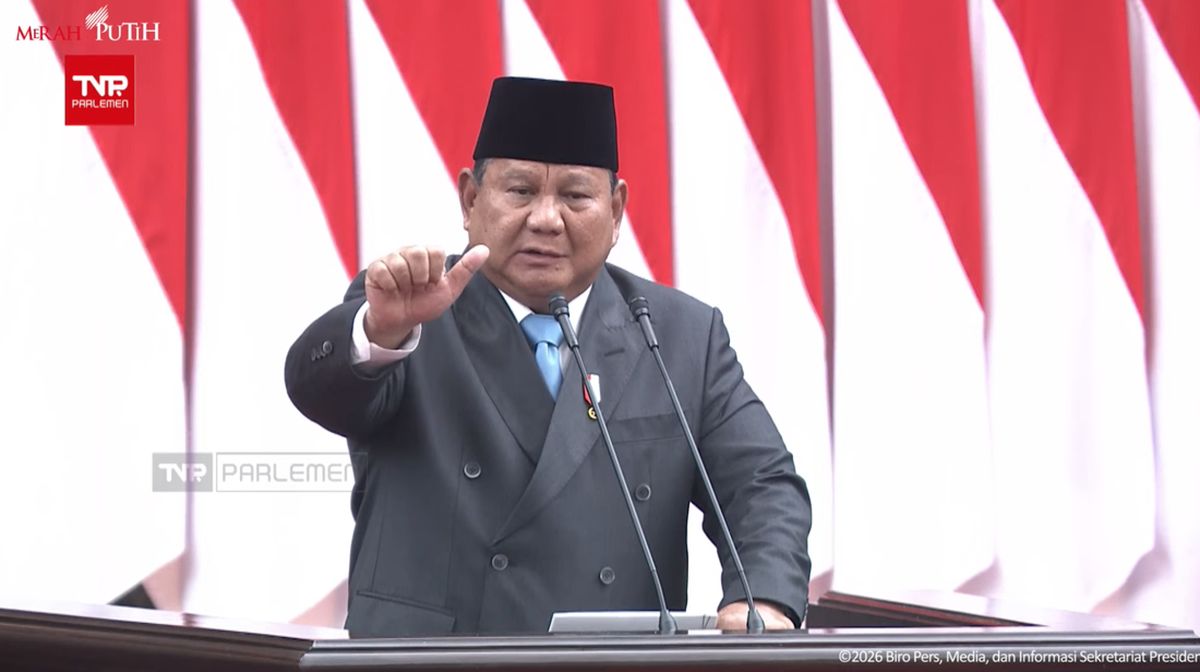
President Prabowo Subianto said that wealth leakage abroad over decades has been one of the reasons for small salaries for teachers, other civil servants, and law enforcement officers. He delivered these remarks while presenting the Macro Economic Framework and the Key Principles of Fiscal Policy (KEM-PPKF) at the 19th Plenary Session of the DPR RI Session V for the 2025-2026 legislative year in the DPR/MPR complex in Senayan, Jakarta, on Wednesday (20 May).
Prabowo stated that according to United Nations data, Indonesia’s outward gains over the last 22 years were estimated at USD 436 billion. However, funds leaking out of Indonesia totalled USD 343 billion. “That means, over 22 years, the wealth that remained in Indonesia is USD 436 billion minus USD 343 billion. This is why teachers’ salaries are small, as are the salaries of civil servants and law enforcement officers. This is why the budget is never sufficient; the budget is not strong enough,” Prabowo said in his speech cited by Antara.
He noted that there has been an outflow of national wealth dating back to the New Order era under President Soeharto. Prabowo also highlighted practices of under-invoicing in which exporters declare export values below actual values, a form of fraud. In front of hundreds of lawmakers, he said the practice involved selling commodities from domestic companies to their own overseas subsidiaries at prices far below their real values. “Many of them set up companies abroad. They sell from their domestic company to their overseas company at prices far below the actual value. This is what happens. Again, this is data from the UN,” he said. Prabowo added that these practices occurred across a range of commodities, including coal and palm oil.
In addition to under-invoicing, Prabowo also mentioned other crafty practices such as under counting, transfer pricing, and smuggling through ports. He argued that the gap between reported figures and actual conditions in some transactions can reach up to 50 percent. “We have calculated, we have used random sampling; we know that the difference between reported and unreported can often reach 50 percent. What is reported is 50 percent of the real situation,” Prabowo asserted.
Consequently, he argued that government agencies, including the customs sector, need reform. “Customs must be improved. I still recall in the New Order era, customs was so severe that we shut down customs. We outsourced to private sector and state revenue rose. Isn’t that sad? This is our struggle; I’m not aiming to moralise anyone. But it is time to speak honestly to ourselves and to the people,” he said.
PP for the Governance of Export of Natural Resource Commodities
In the same address, Prabowo announced the issue of a Government Regulation on the Governance of Exports of Natural Resource Commodities. In the latest regulation, one of the rules is for state-owned enterprises (BUMN) to be the sole exporter for commodities such as palm oil, coal, and ferro alloys.
“To achieve our nation’s goals today, the Government of the Republic of Indonesia, which I lead, is issuing a Government Regulation on the Governance of Exports of Natural Resource Commodities. The issuing of this regulation is a strategic step to strengthen governance of our country’s natural resource exports,” Prabowo said.
Prabowo stated that the main objective of the policy is to prevent and eradicate illegal practices that have long afflicted the governance of Indonesia’s natural resource exports. “The primary aim of this policy is to strengthen oversight and monitoring, and to eradicate under-invoicing, transfer pricing, and the evasion of export proceeds. This policy will optimise tax revenue and state income from the management and sale of our natural resources,” he said.
With this policy, he hopes Indonesia’s revenue could resemble those of Mexico and neighbouring countries in the region.”} }````````````````````````````````````````````````````````````````````````````````````````````````````````````````````````````````````