
Prabowo Launches 100 GW Solar Power Plant Development Project in Bali Today
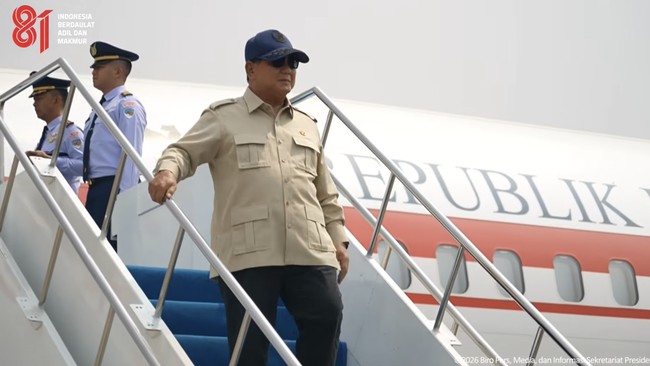
President Prabowo Subianto will launch and conduct the groundbreaking for the 100 gigawatt peak (GWp) Solar Power Plant (PLTS) Programme on Tuesday (25/8/2026) at the Java-Bali Sea Crossing Operation Monument in Gilimanuk, Jembrana Regency, Bali.
Minister of State Secretary Prasetyo Hadi said the programme is part of the National Priority Work Programme for the Energy and Water Independence Cluster. The programme is directed at strengthening national energy independence and resilience while reducing Indonesia’s dependence on fossil energy.
Prabowo has previously instructed that the construction of the PLTS with a total capacity of 100 GWp be accelerated and completed by 2029. The government estimates this programme can generate electricity cost savings of up to Rp73.9 trillion per year.
However, in 2026, the government is targeting the construction of 30 GWp of PLTS while also decommissioning 13 GW of diesel power plants.
Prasetyo explained that Indonesia has enormous solar energy potential, reaching approximately 3,294 GWp. However, the installed PLTS capacity as of April 2026 was only around 1.5 GWp.
For this reason, the construction of the 100 GWp PLTS will be carried out in stages. The first phase has a capacity of 17 GWp, the second phase 18 GWp, and the third phase 30 GWp.
In addition, throughout 2025, the government has built 15 renewable energy plants consisting of 12 PLTS and 3 micro-hydro power plants. The total construction value reached Rp103.3 billion and has served 1,831 households and 131 public facilities.
In 2026, construction will continue through 39 Integrated PLTS locations in underdeveloped, frontier, and outermost regions. The project is intended to serve 4,259 households with a construction value of Rp450.2 billion.
The government will also build three micro-hydro power plant locations that will serve 464 households with an investment value of Rp50.4 billion.
The Village Electricity Programme has also reached 1,403 locations spread across 36 provinces. A total of 220,845 underprivileged households have received benefits from the New Electricity Installation Assistance programme.
Prasetyo explained that the construction of the 100 GWp PLTS is not only related to energy transition but also has the potential to become a new engine of economic growth.
The programme is projected to encourage investment in the power generation, battery, and electricity network sectors. At the same time, the government wants to strengthen the domestic solar photovoltaic industry and create green jobs.
In the 2025-2034 Electricity Supply Business Plan, the electricity sector is projected to create around 1.7 million jobs. Of that number, more than 760,000 jobs have the potential to fall into the green jobs category.
“The government ensures that the construction of the 100 GWp PLTS will continue to be monitored in stages and measurably until the completion target in 2029. This programme is expected to become one of the foundations for realising a more independent, resilient, and competitive Indonesian energy system,” he said.