
Prabowo: Indonesian Cooperative Movement Will Rise as an Economic Power
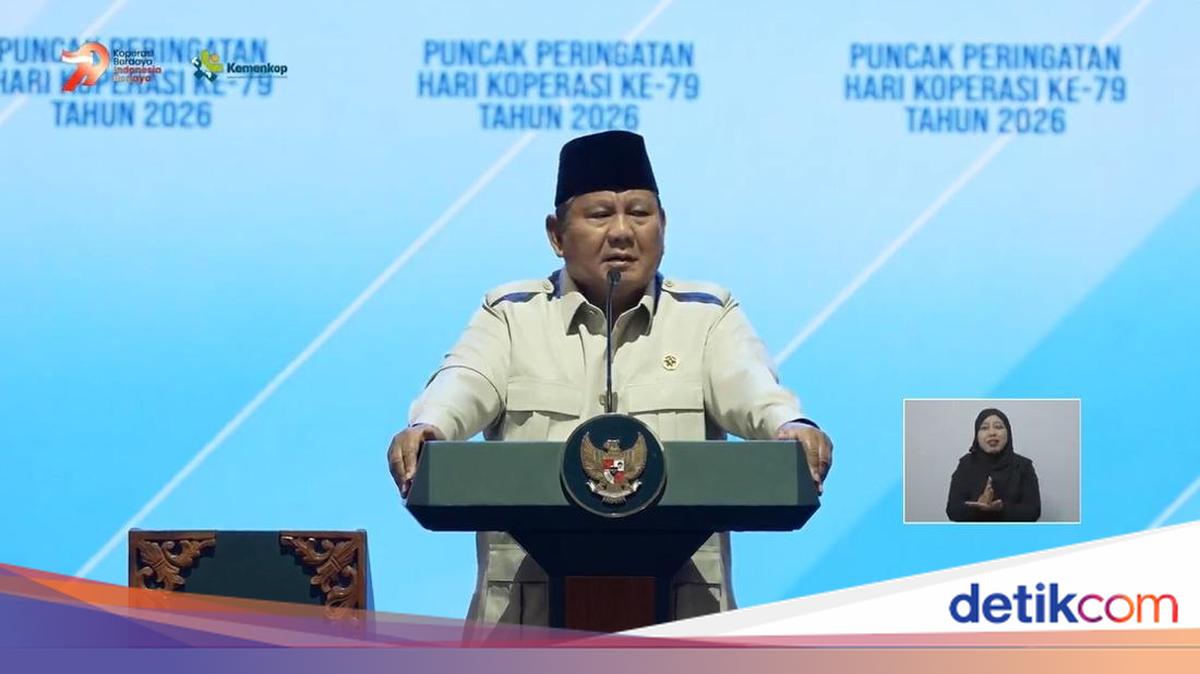
President of the Republic of Indonesia Prabowo Subianto attended the peak commemoration of the 79th National Cooperative Day (Harkopnas) held at the Indonesia Arena, Gelora Bung Karno, Jakarta, on Sunday (12/7). On this occasion, the Head of State affirmed the government’s strong commitment to restructuring the national economy by strengthening economic foundations from the very bottom.
Prabowo called for a total revival of the cooperative movement as the main driving force of the economy, deeply rooted in villages, districts and regencies. He likened cooperatives to a bundle of lidi palm-leaf ribs, capable of uniting every small element of society into a giant, robust and independent economic force.
“Cooperatives are the tool of the weak. But, like a lidi broom, a single rib is weak, but when joined together, that is strength, ladies and gentlemen. Do not worry, the Indonesian cooperative movement will rise to become an economic force for Indonesia! An economic force that will not carry money away from Indonesia,” said President Prabowo, quoted from a press release on Sunday (12/7/2026).
The Head of State was accompanied at the event by a number of senior state officials, including Speaker of the People’s Consultative Assembly (MPR RI) Ahmad Muzani, Deputy Speaker of the Regional Representative Council (DPD RI) Sultan Bachtiar Najamudin, ministers and deputy ministers of the Red-and-White Cabinet, and other high-ranking state officials.
Meanwhile, Minister of Cooperatives Ferry Juliantono affirmed in his remarks that under President Prabowo’s leadership, the cooperative movement in Indonesia has now been revived.
Cooperatives are now positioned as an ideological pillar for driving the economy from village level up to national strategic sectors.
“Under Pak (President)’s leadership, [the cooperative movement] has begun to rise again to make its best contribution alongside private enterprises and state-owned enterprises,” said the Minister.
As a concrete implementation of the mandate of Article 33 of the 1945 Constitution, the government has introduced the Red-and-White Village/Urban Ward Cooperative (KDKMP) programme. To date, as many as 83,000 KDKMP legal entity deeds have been completed.
The sign of the cooperative revival is also reflected in the expansion of strategic space granted by the government. Cooperatives are now permitted to enter heavy industry, such as managing people’s oil wells (idle wells), mineral mines, and establishing crude palm oil (CPO) factories.
In August 2026, the Ministry of Cooperatives is ready to inaugurate a CPO factory owned by the Sejahtera Village Unit Cooperative (KUD) in Musi Banyuasin, South Sumatra, as well as a 0.5–1 MW solar power plant (PLTS) on Galang Baru Island, Riau Islands.
In addition, this year Indonesia will soon have a new Cooperatives Law to replace Law Number 25 of 1992 as a robust legal umbrella for the national cooperative movement.
Echoing this, the Chairman of the Indonesian Cooperative Council (DEKOPIN), Bambang Haryadi, assessed that this turning point is a sacred moment after nearly three decades in which the cooperative movement received inadequate attention.
“Only under Pak President’s administration has the cooperative movement received attention and become a priority programme for strengthening the people’s economy,” said Bambang.
Series of Events for the 79th Harkopnas Commemoration
This year’s 79th Harkopnas celebrations were packaged on a massive scale throughout July. Activities began with the Kick Off of July as Cooperative Month on 2 July 2026, and on Friday (10/7) with a pilgrimage to the grave of the Father of Indonesian Cooperatives, Bung Hatta, in Tanah Kusir, South Jakarta, by the Minister of Cooperatives and officials from the Ministry of Cooperatives, LPDB and DEKOPIN.
The festivities continued on 19 July with a fun run and bazaar on Jalan Rasuna Said, Jakarta. Then, at the end of July, a revitalisation project for the historic cooperative monument in Tasikmalaya will be carried out as a cultural heritage site. The entire series will conclude on 29 July in Jakarta with the Cooperatives Award ceremony.
A Brief History of Cooperative Day
Historically, the embryo of the cooperative movement was born on 16 December 1886 in Purwokerto through the Hulp en Spaarbank founded by Raden Aria Wiriatmadja to combat usurious moneylenders. This spirit was nurtured by movement organisations such as Boedi Oetomo (1908), Sarekat Dagang Islam (1913), and the Studie Club (1927).
After independence, the First Cooperative Congress in Tasikmalaya on 12 July 1947 officially designated that date as Cooperative Day. It was followed by the Second Congress in Bandung (1953), which gave birth to DEKOPIN and confirmed Bung Hatta as the Father of Indonesian Cooperatives.
Source: jawawa.id (https://jawawa.id/newsitem/prabowo-indonesian-cooperative-movement-will-rise-as-an-economic-power-1783864324)
Originally published by detikcom (https://news.detik.com/berita/d-8570964/prabowo-gerakan-koperasi-indonesia-akan-bangkit-jadi-kekuatan-ekonomi), translated from Indonesian