
Prabowo: Indonesia an Investment Magnet, Japan Invests Rp 401.71 Trillion
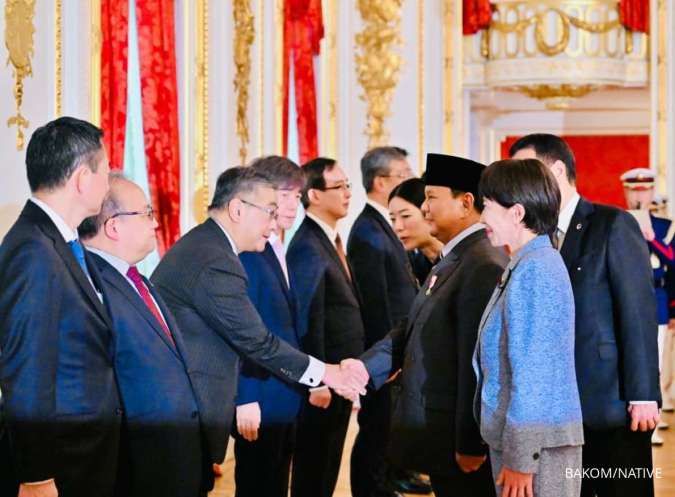
KONTAN.CO.ID - President Prabowo Subianto’s state visit to Tokyo at the end of March 2026 is tangible proof of strengthening Indonesia’s bargaining position on the world stage. The agenda began with a state call to Emperor Naruhito, followed by reinforcing investment commitments and business agreements worth a fantastic US$23.6 billion, equivalent to Rp 401.71 trillion.
This figure stems from the signing of ten strategic Memoranda of Understanding (MoUs) covering various vital national sectors. The cooperation focuses on petrochemical downstreaming, semiconductor ecosystems, the Masela Block (CCS), and Aviation Leasing Danantara. Additionally, agreements were reached on the AZEC energy transition, green hydrogen, port infrastructure, food security, maritime security, and Komodo wildlife conservation.
The significant interest from Japanese investors demonstrates Indonesia’s position as a highly stable regional investment magnet. Amid uncertain global economic fragmentation, Jakarta chooses to strengthen its partnership with Tokyo based on 67 years of empirical experience. Japan has proven consistent as an investor and anchor for national economic stability.
The President’s presence in Tokyo sends a strong signal to international markets that National Strategic Projects (PSNs) will continue without hindrance. Japanese capital involvement is assured to proceed without political interruptions, despite leadership transitions in both countries. This legal certainty becomes the main attraction for long-term investment sustainability.
Countering Crises and Supply Chains
The main target of the visit is the birth of public policy understandings focused on supply chain resilience. This step serves as a strategic shield against global crises due to escalations in the Middle East war. The Rp 401.71 trillion investment will be fully prioritised to secure the distribution of vital commodities for the prosperity of all Indonesian people.
As a response to geopolitical radicalism, President Prabowo’s visit also produced a strategic cooperation framework regarding regional logistics systems. This agreement includes an early warning system for global supply disruptions. It enables Indonesia and Japan to mutually ensure the availability of national energy and food through an integrated systematic buffer stock scheme.
By strengthening maritime routes and port connectivity, Indonesia now positions itself as a safe logistics hub in Southeast Asia. The semiconductor sector and petrochemical downstreaming are expected to maintain public purchasing power. This preventive step is crucial for shielding domestic inflation stability from external crisis impacts.
The strategic value of the visit to Japan can be accurately measured through the lens of strengthening national economic independence. Japan remains the main trading partner with a very significant positive growth trend for Indonesia. The latest data shows that the total bilateral trade value between the two countries has now exceeded US$37.3 billion.
Indonesia consistently records an impressive trade surplus, where export structures are still dominated by the energy and manufacturing sectors. Export transactions covering LNG and minerals reach US$20.8 billion, while imports of capital goods from Japan stand at US$16.5 billion. This condition provides a significant contribution to strengthening foreign exchange reserves and monetary stability.
A surplus of US$4.3 billion can serve as a vital foreign exchange buffer for the stability of the Rupiah’s exchange rate against foreign currencies. Through this visit, Indonesia also introduced the strategic role of Danantara Investment Management in its debut manoeuvres in the global market. This step is a tangible form of the government’s efforts to consolidate the country’s financial strength at the international level.
The agreement with SMBC Aviation Capital through the Mandiri Aviation Leasing Fund demonstrates Indonesia’s great ambition to strengthen national air fleet sovereignty. This step aims to reduce domestic logistics costs through strategic financial services downstreaming. Strengthening the aviation sector will become a new engine for economic connectivity across the archipelago.
Energy Transition and the Future
The most progressive substance of this visit includes strengthening the energy architecture through the Asia Zero Emission Community (AZEC) initiative. Japan offers realistic technological solutions through the development of Carbon Capture and Storage (CCS) and green hydrogen ecosystems. This policy is highly strategic because Indonesia is not forced into a drastic energy transition that requires very expensive costs.
Decarbonisation is carried out in a measured manner through Japanese high-tech support for existing power plants with co-firing schemes. This step ensures national energy resilience remains maintained amid fluctuations in world crude oil prices. The collaboration creates positive interdependence between the two parties, where Japan’s advanced technology meets Indonesia’s wealth of renewable energy resources.
Stable energy supply from Indonesia becomes the key to Japan’s future energy security. On the other hand, this partnership becomes the driving engine for domestic green transition to achieve net-zero emissions targets. This synergy proves that environmental protection and economic growth can go hand in hand through targeted technological innovation.
The entire series of the President’s agenda in Japan is a strategic step to strengthen the foundation towards the grand vision of Golden Indonesia 2045. Amid the encirclement of geopolitical radicalism dividing the world into rigid blocs, Indonesia-Japan relations offer a “third way”. An alliance standing firm on the principles of shared prosperity and efforts to maintain inclusive regional stability.
Maintaining Economic Sovereignty
Japan needs Indonesia as a stable production base with a growing middle class. Meanwhile, Indonesia needs Japan as a provider of quality standards
Source: jawawa.id (https://jawawa.id/newsitem/prabowo-indonesia-an-investment-magnet-japan-invests-rp-401-71-trillion-1775026262)
Originally published by native.kontan.co.id (https://native.kontan.co.id/news/prabowo-indonesia-magnet-investasi-jepang-menanam-rp-40171-triliun), translated from Indonesian