
Prabowo Government Plans Food Production Areas, Targets 6 Million Hectares
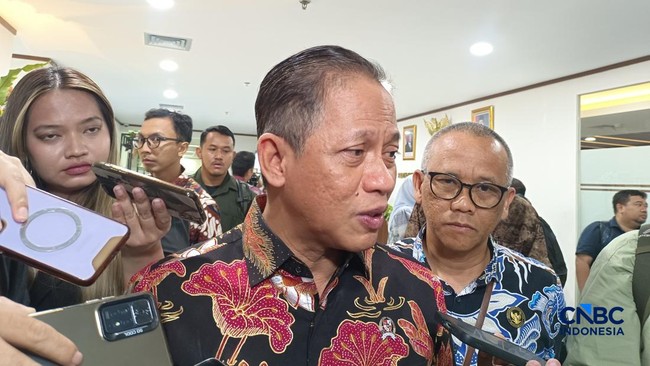
The government is preparing to use degraded land to support national food and energy self-sufficiency programmes. The move follows President Prabowo Subianto’s instruction prohibiting the clearing of natural forests to develop food and energy zones.
Deputy Coordinating Minister for Food Hanif Faisol Nurofiq said Indonesia had around 9.7 million hectares of potentially degraded land. The government is evaluating the land to identify sites that could be used for the national food estate programme.
However, not all of this land can be used immediately. The government must first identify areas within state forest zones so that their forest functions can be restored.
“Yesterday, the President gave clear instructions, asking all of us not to touch natural forests. His order was explicit: no more natural forest is to be converted. So we are shifting all our plans and repositioning and relocating areas to degraded land that already exists in our country,” Hanif said at his office in Jakarta on Friday (6 November 2026).
Hanif said that, of the total potential degraded land of around 9.7 million hectares, approximately six million hectares could be considered after state forest areas were excluded.
The government is still conducting a detailed assessment to confirm the locations. The process involves reconciling various sectoral data and maps to ensure that land use does not conflict with spatial-planning rules or the status of forest areas.
“The total is nearly 9.7 million hectares, which we are analysing. But the analysis is not simple; we need many sources to determine locations in reasonably precise detail,” he said.
Critical and degraded land are different
Hanif also clarified the distinction between critical land and degraded land, terms often used in discussions about land for government programmes.
He said critical land is more severely damaged, with soil conditions so poor that plants struggle to grow. Degraded land, meanwhile, has undergone a change from its previously productive condition, including a change in forest cover.
“Those 12.7 million hectares are critical land. There is degraded land and there is critical land. The difference is that critical land is severely damaged and plants cannot grow. Degradation, meanwhile, may involve a change in forest cover, with land that was once productive becoming degraded,” he explained.
He stressed that the government would recalibrate the land data. Areas within state forest zones would have their forest functions restored, while land outside those zones could potentially be used to support the national food programme.
“There is some overlap, and yesterday we asked for a recalibration. Areas in state forests will be restored to forest, while those outside them will be used to support our national food estate programmes,” Hanif said.
With this strategy, the government hopes to meet land requirements for food and energy self-sufficiency programmes without clearing new natural forests.
Source: jawawa.id (https://jawawa.id/newsitem/prabowo-government-plans-food-production-areas-targets-6-million-hectares-1793951426)
Originally published by CNBC Indonesia (https://www.cnbcindonesia.com/news/20261106122041-4-782935/pemerintahan-prabowo-mau-bangun-lahan-pangan-di-sini-incar-6-juta-ha), translated from Indonesian