
Prabowo Cuts Red Tape to Boost Downstream Investment and Introduces Automatic Permits
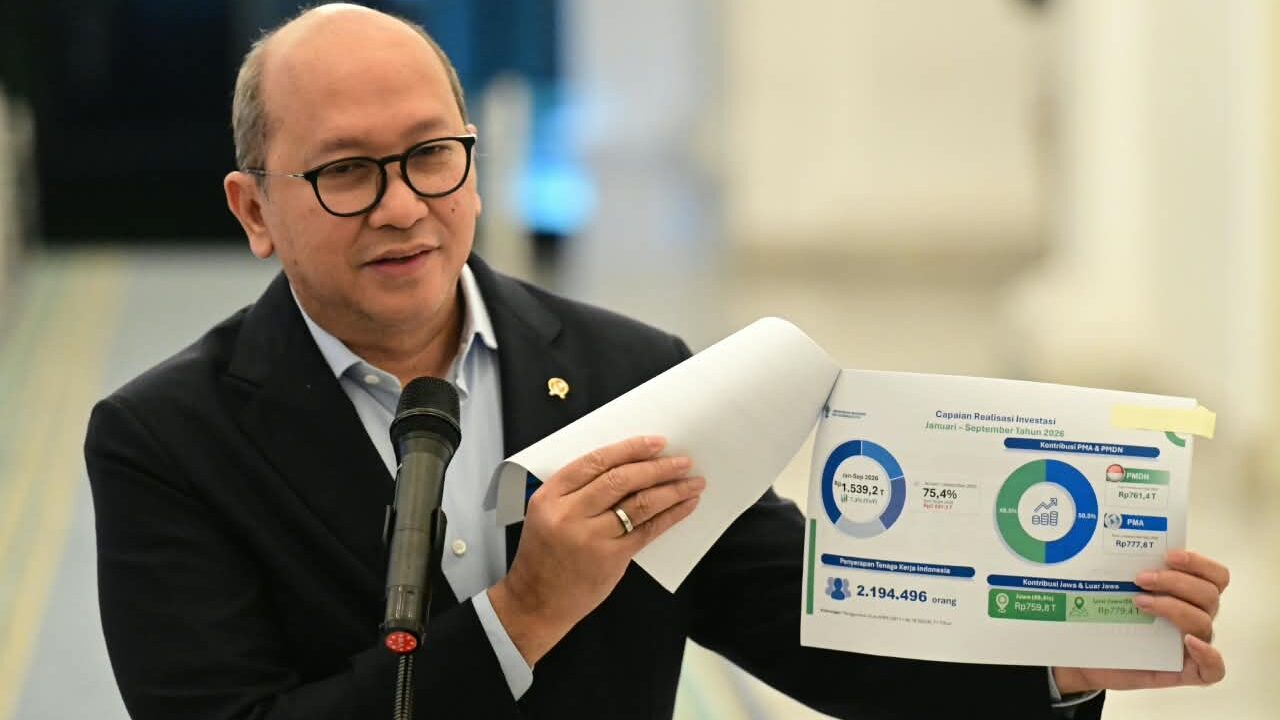
President Prabowo Subianto is continuing to promote higher-quality investment through stronger industrial downstreaming and faster licensing services. These issues were among the main topics at a limited meeting chaired by the President with several ministers from the Red and White Cabinet at Merdeka Palace in Jakarta on Monday, 19 October 2026.
Investment and Downstreaming Minister and Investment Coordinating Board (BKPM) Head Rosan Roeslani said investment in downstreaming had made significant gains. In the third quarter of 2026, downstreaming accounted for 35% of investment, up from around 26% in 2024.
“Looking at the trend, in 2024 downstreaming accounted for only 26%; in the third quarter of this year, it had already reached 35%,” Rosan said in a press statement.
Rosan said the government was not merely seeking to increase investment values, but also to ensure that incoming investment delivered tangible benefits to the national economy, particularly by creating jobs, advancing technology and strengthening Indonesia’s position in global supply chains.
“We will, of course, continue to encourage investment to grow into higher-quality investment that can also have a positive impact on employment,” he said.
Rosan explained that investment characteristics vary across sectors. For downstreaming, the government will continue to develop nickel- and battery-based industries while maintaining a balance in production, improving product quality, developing technological capabilities and creating jobs.
“As we have done with downstreaming in nickel, batteries and EV batteries, these are areas we may continue to develop, while maintaining equilibrium in production—both nickel and its derivatives—so that products improve, technology advances, and employment and technological development progress as well,” Rosan said.
Alongside strengthening downstreaming, Rosan outlined progress in investment-related bureaucratic reform through an integrated licensing system now involving 28 ministries and agencies. The integration is being implemented under Government Regulation No. 28 of 2025 to provide domestic and foreign investors with certainty over service timelines.
One innovation is the ‘positive fiction’ mechanism, under which the Investment and Downstreaming Ministry/BKPM can grant a permit if the relevant agency fails to complete the process within the prescribed timeframe. Rosan said the ministry had issued about 328 permits through this mechanism.
“If another ministry has a service-level deadline of, for example, 10 days and does not issue the permit within that period, our ministry can issue it automatically. That is what we call positive fiction. We have implemented it, and I have issued around 328 permits through this mechanism,” he said.
The government is also strengthening coordination between ministries through a joint ministerial decree with the Manpower Ministry and the Immigration and Corrections Ministry. The cooperation is intended to speed up and provide certainty in processing limited-stay permits (KITAS) for foreign workers employed in Indonesia. Rosan said a process that previously could take between one and six months is now targeted to take just five days for immigration services.
“Immigration and Corrections, for example, has said it will take only five days. Previously it could take a month, or even up to six months. This will provide certainty and greater clarity,” he said.
Rosan stressed that regulatory certainty, clear procedures and timely services were crucial to strengthening investor confidence. “What investors want, of course, is certainty—they don’t like surprises. Our main task is to reduce uncertainty for investors, both domestic and foreign, in licensing, timelines and investment.”