
Prabowo Controls Palm Oil: Export Manipulation Exists, Money Parked Abroad
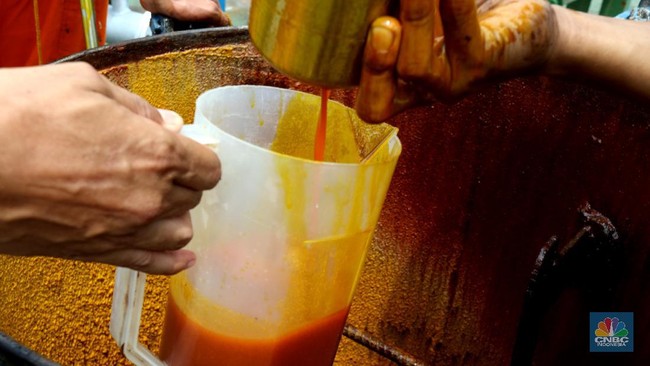
Jakarta, CNBC Indonesia – An agribusiness and agriculture analyst has spoken out about the government’s formation of a new state-owned enterprise to manage exports of strategic energy commodities such as crude palm oil (CPO), coal, and others.
Executive Director of the Palm Oil Agribusiness Strategic Policy Institute (PASPI), Tungkot Sipayung, said the background for establishing a Special Export State-Owned Enterprise is grounded in several issues, including practices of export manipulation.
‘From the information available, the policy background for the formation of the Export SOE rests on at least two major points: first, the rampant practice of export manipulation (undervaluing price, quality, and volume), smuggling in export activities of our natural resource-based products including palm oil, which according to government data is quite large and harms state revenue,’ Tungkot told CNBC Indonesia on Wednesday, 20 May 2026.
‘Secondly, the foreign exchange earnings (DHE) are largely parked abroad, or not entering our economy, so even if exports are large, the impact of DHE on the economy (injection effect) is minimal, thus our economic growth is not optimal,’ he continued.
Therefore, according to him, the government must be present to prevent these issues further.
‘To address both issues, the state must be present. The government has chosen to manifest this presence in the form of a state-owned enterprise, namely an Export State-Owned Enterprise for strategic commodities. The full mechanism still seems to be awaited. But the essence is that export transactions must pass through this SOE and cannot be directly between exporters and international buyers,’ he explained.
However, the transition from export practices to the new system will face friction, because the SOE was formed directly by President Prabowo, leaving entrepreneurs with no choice but to comply or adjust.
‘There will surely be turmoil during the transition to the new system. Moreover, this policy is issued directly by President Prabowo, based on Article 33 of the 1945 Constitution, not a ministerial-level policy and has already been reported to the DPR. So as citizens, we have no choice but to follow and adapt,’ he said.
Nevertheless, Tungkot still hopes the government has anticipated the impacts of the shift in the management of Indonesia’s strategic natural resource commodities, so that during the transition, tensions can be dampened by the government, and palm oil entrepreneurs can accept it.
‘We hope that the government through the Export SOE will anticipate it, so the transition process runs smoothly or with minimal turmoil, not under control and not harming palm oil players, especially palm oil farmers,’ he said.
Earlier, Eddie Martono, the General Chairman of the Indonesian Palm Oil Producers Association (GAPKI), reminded that changes to the management system for strategic commodity exports could become a boomerang for Indonesia.
‘The impact could be loss of markets for palm oil and its derivatives, Indonesia’s production revenue,’ he told CNBC Indonesia on Wednesday, 20 May 2026.
‘Not all exporters are companies that also operate downstream industries. Many are trading companies or traders serving volumes not large to certain countries. With a state body, how will these traders be served?’ he said.
‘Exporters usually already have their own markets. Let’s not lose markets if we can’t manage this properly,’ he added.
Meanwhile, Prabowo, in his speech, said the new policy for the governance of natural resource export commodities is not unusual because it has been implemented by many countries.
‘The main goal of this policy is to strengthen oversight and monitoring. In addition, to eradicate underpayment or under invoicing, transfer pricing, and leakage of foreign exchange earnings (DHE),’ he said.
‘This policy will optimise tax revenue and state revenue from processing our natural resources. It could be like Mexico, the Philippines, and our neighbouring countries. We do not want our revenue to be the lowest because we are not brave enough to manage our own resources, the nation’s resources, Indonesia’s resources,’ he emphasised.