
Prabowo Continues Trans Papua Road Project, Connecting Two Provinces
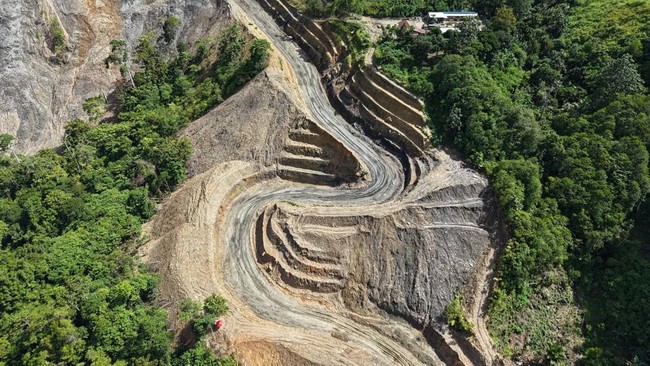
Jakarta - The Ministry of Public Works is continuing construction of the Trans Papua road, with the latest section being built from Jayapura to Wamena. The aim of this route is to open up isolated highland areas, strengthen connectivity, and promote equitable development in Papua. The Mamberamo-Elelim segment, spanning 50.14 km, is currently under construction and will connect Papua Province with Papua Pegunungan Province.
Public Works Minister Dody Hanggodo said road and bridge construction is the foundation for strengthening connectivity between economic growth centres. “We are developing road and bridge networks connecting cities, islands, and underdeveloped regions across Indonesia to open access for investment, support industrial zones, encourage tourism sector growth, and strengthen connectivity,” Dody said in a statement.
The Jayapura-Wamena Mamberamo-Elelim segment is being built as a main link to smooth public mobility, reduce logistics costs, and lower staple food prices in Papua Pegunungan, so that the benefits of development can be felt directly by the community. Its presence is expected to make it easier for children to reach school, speed up patient access to health facilities, smooth government services, and accelerate distribution of basic necessities. With improved connectivity, freight costs are projected to fall, making daily necessities that have been relatively expensive due to difficult transport access more affordable.
Construction of the Jayapura-Wamena Mamberamo-Elelim segment is being carried out through a Public-Private Partnership scheme with an availability payment mechanism. Construction work began in July 2024 and is targeted for completion in November 2026. As of mid-July 2026, physical construction progress had reached 51.59%, including road clearing and formation, pavement structure work, drainage, bridges, complementary buildings, earthworks, slope protection, road equipment, and construction of a vehicle weighing unit.
The project faces different challenges compared with other regions in Indonesia. The route crosses mountainous terrain with steep cliffs, dense forest, high rainfall almost all year round, and potential natural disasters such as landslides. Mobilisation of heavy equipment and construction materials also requires special time and handling due to limited access to work sites.
Despite these difficult natural challenges, the Ministry of Public Works continues to accelerate construction while prioritising construction quality and work safety, including the application of modern technology and construction methods. Route planning uses Real-Time Kinematic satellite-based GNSS survey technology combined with LiDAR surveys to produce accurate topographical data. Detailed geotechnical surveys are also carried out as the basis for construction design, with work methods adjusted to terrain and weather conditions, and strict quality and safety supervision.
At points with landslide potential, technical measures are being taken including construction of slope drainage systems, cliff stabilisation, installation of soil retaining structures at specific locations, revegetation, and periodic slope condition monitoring. These steps are intended to maintain safety and the long-term sustainability of the road’s function.
The Trans Papua road construction is also providing direct benefits to surrounding communities through the involvement of local workers. To date, 116 local workers, or around 28% of the total project workforce, are contributing to the construction process. This community involvement is part of efforts to empower the local economy while ensuring infrastructure development provides benefits from the construction phase onwards.
Through the construction of the Trans Papua road, the Ministry of Public Works is not only building connectivity but also creating broader opportunities for the people of Papua to obtain basic services, grow economic activity, and improve welfare.
For context, the Trans Papua road is a prestigious mega project whose construction was accelerated by former President Joko Widodo. The Trans Papua road is included in the National Strategic Projects and the 2020-2024 National Medium-Term Development Plan. When construction was launched in 2015, the Trans Papua road had a total length of 3,535 km across two provinces: Papua Province at 2,465 km and West Papua at 1,070 km.
According to a document titled “Roads in Indonesia: from Sabang to Merauke” compiled by researchers at the Ministry of Public Works and Public Housing, the purpose of the Trans Papua road is to improve the welfare of the Papuan people by increasing access and connectivity between regions so as to open up isolated areas.
Since late 2017, the Trans Papua road in West Papua, spanning 1,070.62 km, has been fully connected. The West Papua Trans route is divided into two segments: segment I Sorong-Maybrat-Manokwari (594.81 km) and segment II Manokwari-Mameh-Wasior-Papua Province border (475.81 km). Both segments can be traversed in about 36 hours.
Meanwhile, in 2018 the Trans Papua road successfully connected Merauke-Boven Digoel over 430 km. Overall, during the Jokowi administration, more than 3,446 km of the Trans Papua road was successfully built, comprising 1,733 km of paved road, 1,712 km unpaved, and the remainder not yet completed.