
Prabowo Asserts Indonesia Will Not Choose Sides
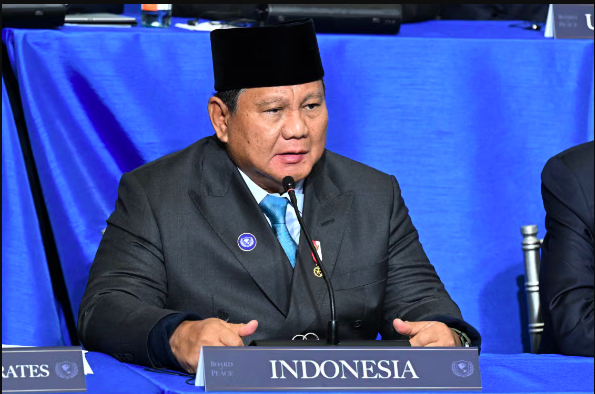
President Prabowo Subianto has emphasised that Indonesia will not side with one group to oppose another, even amidst the deepening of economic relations with Russia and the Eurasian region. He ensured that Jakarta will continue to conduct a free and active foreign policy by opening cooperation to all major powers.
This assertion was made by Prabowo while responding to questions regarding the balance of Indonesia’s relations with Western partners and Russia during a dialogue session at the 11th Eastern Economic Forum (EEF) in Vladivostok, Russia, on Thursday (3/9).
The question arose after Prabowo previously encouraged the strengthening of Indonesia-Russia trade relations, including the target of doubling trade and the implementation of the Indonesia-Eurasian Economic Union (EAEU) Free Trade Agreement. He also touched upon the importance of a payment system that does not depend on a single global financial architecture.
Prabowo stated that Indonesia’s position in establishing relations with various countries has been openly communicated for decades. Indonesia, he said, wishes to maintain the best relations with all countries and major powers without having to enter into any specific alliance.
“By tradition, we are a non-aligned nation. As I have said, we do not join any military alliance. We respect all major powers,” said Prabowo.
According to Prabowo, this principle also applies to economic relations. Indonesia wishes to remain independent while opening space for cooperation with all nations. Therefore, any partner wishing to enter and invest in Indonesia will be treated based on the principle of fair trade.
He emphasised that Indonesia’s openness does not mean that Jakarta will use its relationship with one country to oppose another. The government, Prabowo said, wants to ensure that all partners receive equal treatment when negotiating and conducting economic activities in Indonesia.
“We will not cooperate with one group to oppose the interests of another group. We will treat anyone who comes to Indonesia fairly,” Prabowo stated.
This stance serves as an answer to questions regarding how Indonesia maintains the balance between its obligations to Western partners and efforts to deepen relations with Russia and Eurasia. Prabowo does not see a need for conflict between these two directions of relations. For Indonesia, openness is a principle that allows Jakarta to establish cooperation with various parties without positioning one relationship as a threat to another.
He also asserted that Indonesia has no intention of threatening any nation. Indonesia’s foreign and economic policies are directed towards building mutually beneficial relationships with various partners.
In the context of Russia, Prabowo mentioned that the relationship between the two nations has long historical roots. He recalled the support provided by the Soviet Union to Indonesia when the Republic was young and in a vulnerable state.
According to Prabrym, this history is an inseparable part of the current Indonesia-Russia relationship. He sees no reason for Indonesia to hide or set aside this history when building relations with Russia today.
“And we are very open. We say that when we were weak, when we were a young republic, not many people truly thought of us. At that time, yes, the Soviet Union helped Indonesia when we were very weak,” said Prabowo.
He emphasised that Indonesia will continue to respect all major powers and determine its own interests. The relationship with Russia is placed within this framework, as part of the effort to expand cooperation without joining any specific political or military bloc.
Russian President Vladimir Putin also highlighted Indonesia’s position in the global landscape. On the same occasion, Putin stated that Indonesia’s large population makes it impossible to ignore in the formulation of policies across various regions of the world.
Putin initially compared Indonesia’s position to highly populous countries such as China and India. However, he later emphasised that Indonesia itself possesses significant weight with a population approaching 300 million people.
“I want to draw your attention to Indonesia. Indonesia is not only the country with the largest Muslim population, but generally is one of the largest countries in the world, with nearly 300 million people,” said Putin.
According to Putin, this demographic size makes Indonesia a nation that must be taken into account by anyone conducting policy in any part of the world.
“Anyone conducting any policy in any part of the world will always be compelled to take this into account,” said Putin.